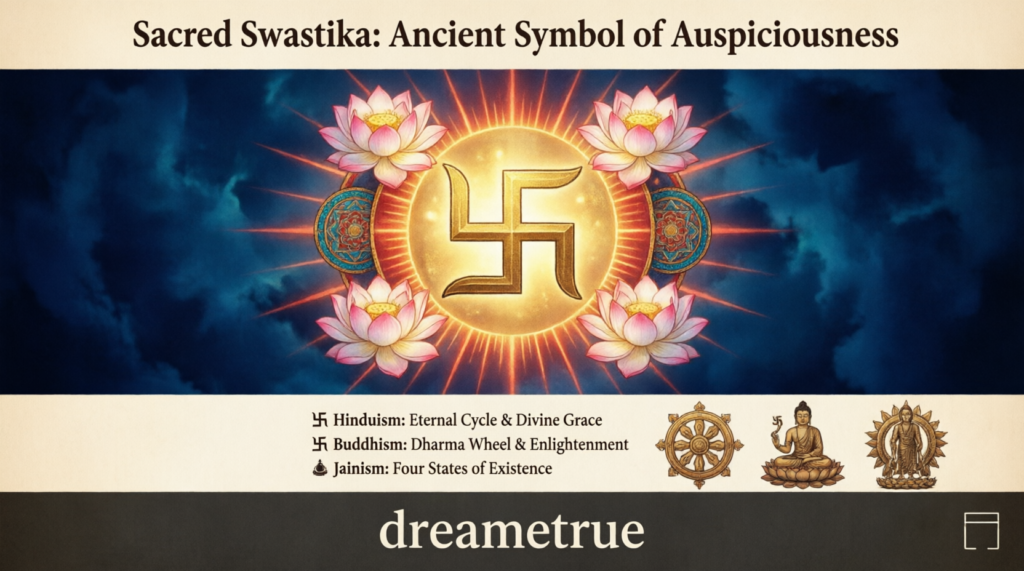
The swastika is one of the most misunderstood symbols in the world. For thousands of years, it represented good fortune, prosperity, well-being, and spiritual protection in several ancient cultures. Today, however, many people immediately associate it with Adolf Hitler, Nazi Germany, the Holocaust, and antisemitism.
So, what does the swastika symbol mean, and why can the same symbol carry such different meanings?
The answer depends on its historical background, cultural setting, religious significance, and how it is used. Understanding these differences helps explain why the swastika remains a sacred symbol for millions of people while also serving as a deeply painful reminder of hatred and genocide for others.
Featured Snippet: What Does the Swastika Symbol Mean?
The swastika is an ancient symbol traditionally associated with good fortune, prosperity, well-being, and auspiciousness in Hinduism, Buddhism, and Jainism. It has appeared in many cultures for thousands of years. However, Nazi Germany appropriated a right-facing swastika as an emblem of racial supremacy, antisemitism, and genocide, giving the symbol a profoundly different meaning in modern history.
What Is the Swastika Symbol?
The swastika is a geometric symbol formed by a cross with four arms bent at right angles. Its distinctive shape has appeared on ancient objects, religious artwork, architecture, textiles, and modern political emblems.
The symbol is known by different names and carries different meanings depending on the culture and historical period.
- Sanskrit: The word svastika is associated with well-being and good fortune.
- Hinduism: It commonly represents auspiciousness, prosperity, and blessings.
- Buddhism: It can represent auspiciousness and is associated with the Buddha and Buddhist teachings.
- Jainism: It has important religious significance, including connections to the cycle of rebirth and spiritual teachings.
- Nazi Germany: It became an emblem of racist nationalism, antisemitism, persecution, and genocide.
The United States Holocaust Memorial Museum documents the symbol’s use across cultures thousands of years before its adoption by the Nazi Party.
What Is the Origin of the Swastika?


4
The swastika’s origins reach far back into prehistory. Archaeological evidence shows that similar hooked-cross designs existed in Eurasia thousands of years before the rise of Nazi Germany.
Researchers have found the motif on ancient pottery, decorative objects, and other artifacts. Its original meaning wasn’t necessarily identical in every society, and its earliest use cannot be explained with certainty.
Where Did the Word Swastika Come From?
The English word swastika comes from the Sanskrit word svastika, associated with good fortune, well-being, and auspiciousness.
The term is connected to Sanskrit svasti, meaning well-being or good fortune. This linguistic origin helps explain why the symbol continues to have positive religious meanings in South Asian traditions.
Did the Swastika Originate in India?
India is one of the most important places associated with the swastika because of its long-standing religious and cultural use. However, the symbol’s history is broader than one country.
Similar designs appeared in prehistoric Eurasia and in various other societies. Archaeological discoveries establish that the motif is ancient, but they don’t prove that every culture adopted it from a single original source.
What Did the Swastika Originally Represent?
There is no universally established explanation for its earliest meaning. Scholars have proposed associations with the sun, movement, well-being, and religious ideas.
It’s important to distinguish these interpretations from proven facts. The symbol’s shape is recognizable in ancient artifacts, but its precise meaning in every archaeological context may remain unknown.
What Does the Swastika Mean in Different Religions?
The religious meaning of the swastika is especially important because the symbol remains sacred to many communities today. Its use in these traditions predates Nazi Germany by thousands of years.
1. Swastika Symbol Meaning in Hinduism

In Hinduism, the swastika is generally an auspicious symbol associated with good fortune, prosperity, well-being, and positive beginnings.
It may appear during religious ceremonies, weddings, festivals, housewarmings, and other important occasions.
Common associations include:
- Prosperity: Wishes for abundance and success.
- Good fortune: Hopes for favorable outcomes and blessings.
- Auspicious beginnings: Marking the start of an important event.
- Religious devotion: Expressing reverence and participating in established traditions.
- Harmony and well-being: Symbolizing a wish for a favorable and balanced life.
Hindu families may draw the symbol using red powder, turmeric, rice flour, or other traditional materials. It may also appear near doorways, on religious objects, or in ritual designs.
The exact interpretation and ritual practice can vary by region, family, and religious tradition. It shouldn’t be reduced to a single universal explanation.
2. Swastika Symbol Meaning in Buddhism

In Buddhism, the swastika is an auspicious symbol associated with the Buddha, good fortune, and Buddhist teachings.
It appears in Buddhist art, temple decoration, sculpture, and religious imagery in several Asian countries. Its orientation and presentation can vary according to local artistic and religious traditions.
In some Buddhist traditions, the symbol appears on images or representations of the Buddha and can be associated with spiritual qualities, blessings, or auspiciousness.
An important distinction: A swastika appearing in a Buddhist temple does not automatically indicate Nazi ideology. Its religious context, design, and purpose matter.
However, when the symbol appears in a modern political setting, the surrounding imagery and message must also be considered.
3. Swastika Symbol Meaning in Jainism
The swastika has a particularly significant role in Jainism, where it is one of the central symbols used in religious practice.
It is associated with the four possible states of existence within the cycle of rebirth, often described in Jain teachings as heavenly beings, human beings, animal and plant life, and hell beings.
The symbol can remind followers of the importance of ethical conduct, spiritual awareness, and liberation from the cycle of birth and death.
Jain religious artwork and rituals may incorporate the swastika alongside other sacred symbols. Its meaning belongs to a distinct religious framework and should not be confused with the Nazi emblem’s political meaning.
4. Is the Swastika a Christian Symbol?
The swastika is not a central or defining symbol of Christianity in the way the cross is.
Nevertheless, hooked-cross designs have appeared in some historical Christian and European decorative contexts. The presence of a similar geometric motif on an old building or artifact does not, by itself, establish that it was intended as a Christian symbol.
Its meaning must be assessed using the object’s date, location, artistic context, and documented history.
5. Does the Swastika Have Meaning in Other Cultures?
Yes. Similar motifs have appeared in a range of cultures, including ancient European societies and some Indigenous American traditions.
Their meanings have differed. Depending on the setting, a motif may have been decorative, religious, or associated with good fortune or other cultural ideas.
These traditions should be studied individually rather than treated as identical simply because they use a similar shape.
What Is the Difference Between the Hindu Swastika and the Nazi Swastika?
Although the designs can look similar, their cultural and historical meanings can be very different.
| Feature | Traditional religious swastika | Nazi swastika |
|---|---|---|
| Historical context | Ancient religious and cultural traditions | Nazi Germany and modern extremist movements |
| Common meaning | Good fortune, well-being, auspiciousness | Racial supremacy, antisemitism, and Nazi ideology |
| Religious significance | Sacred in Hinduism, Buddhism, and Jainism | Used as a political and ideological emblem |
| Typical setting | Temples, ceremonies, homes, religious artwork | Nazi flags, propaganda, uniforms, and extremist imagery |
| Modern interpretation | Positive and sacred in relevant religious communities | Widely recognized as a symbol of hate and genocide in Western contexts |
Does the Direction of the Swastika Change Its Meaning?
In some religious and cultural traditions, orientation can affect interpretation. For example, Hindu traditions distinguish between forms and uses of the symbol, and some contexts attach different associations to clockwise and counterclockwise orientations.
However, orientation alone is not a reliable way to determine meaning. The Nazi emblem is commonly shown tilted within a white circle on a red field, with the hooked arms arranged in a particular direction. Other versions of the swastika appear in religious and cultural settings.
A responsible interpretation considers the entire design, its location, accompanying imagery, and how the symbol is being used.
What Does the Swastika Mean in Nazi Germany?
In Nazi Germany, the swastika became the central emblem of the Nazi Party and later a defining symbol of the regime.
The Nazis appropriated an ancient symbol and gave it a new political meaning. They connected it to their false racial theories, German nationalism, antisemitism, and the idea of an imagined Aryan racial hierarchy.
When Did Hitler Adopt the Swastika?
The Nazi Party formally adopted the swastika as its emblem in 1920. Adolf Hitler designed the Nazi flag, combining a black swastika with a white circle on a red background.
The design drew on the colors of the former German Empire and became a powerful tool of Nazi political branding. After Hitler became chancellor in 1933, the swastika became increasingly visible in official settings, public ceremonies, propaganda, and state institutions.
Why Did the Nazis Choose the Swastika?
European nationalist and racist movements had already begun using the symbol before the Nazis came to power. Some racial theorists falsely connected it to a supposed shared Aryan ancestry.
The Nazi Party exploited these ideas to promote racial superiority, national identity, and loyalty to Hitler. It used the swastika repeatedly in public displays to make its ideology instantly recognizable.
The symbol was not merely decorative. It helped communicate political power and reinforce a worldview built on exclusion and racial persecution.
How Did the Swastika Become a Symbol of Hate?
As Nazi Germany expanded its power, the swastika became inseparable from the regime’s persecution of Jews and other targeted groups.
The Nazis stripped Jews of rights, encouraged antisemitic discrimination, imprisoned people in concentration camps, and carried out mass murder during the Holocaust. The regime and its collaborators murdered six million Jews, alongside persecuting and killing millions of other victims.
The swastika appeared throughout the machinery of Nazi rule and became a symbol of terror for those targeted by the regime.
After World War II, its association with Nazism, the Holocaust, and racist extremism became especially powerful in Europe and North America.
What Does the Swastika Symbol Mean Today?
Today, the swastika has two major, contrasting realities: it remains a sacred religious symbol in some communities, while it is widely recognized as an emblem of Nazi ideology and antisemitic hatred.
Understanding its modern meaning requires looking at where it appears and what message it communicates.
In India and Nepal
In many Hindu communities, the swastika continues to symbolize auspiciousness, prosperity, and blessings. It may be displayed during Diwali, weddings, religious ceremonies, and other celebrations.
Seeing it in these settings generally reflects an established cultural or religious tradition, not support for Nazism.
In Japan and Other Buddhist Communities
A swastika-like symbol appears in Buddhist art and on some maps of Japan to indicate Buddhist temples. The Japanese character known as manji (卍) has a long history in Buddhist and cultural contexts.
Its meaning depends on the context. A temple marker on a map is not equivalent to a Nazi political emblem.
In Europe and North America
In much of Europe and North America, the swastika is strongly associated with Nazi Germany, antisemitism, white supremacy, and the Holocaust.
Its display in political demonstrations, extremist propaganda, or threatening messages can communicate intimidation and support for racist ideology.
In Modern Extremist Movements
Neo-Nazi and white supremacist groups sometimes use the swastika to signal allegiance to Nazi ideology or to intimidate targeted communities. In these situations, its use is connected to the symbol’s modern history of hate rather than its ancient religious origins.
What Does the Swastika Symbol Mean Spiritually?
The spiritual meaning of the swastika depends on the religious tradition in which it appears.
In Hinduism, Buddhism, and Jainism, it can carry meanings related to auspiciousness, spiritual teachings, well-being, and religious practice.
Some people also interpret its four arms as representing balance, the movement of life, or the interconnectedness of existence. Such interpretations may be meaningful within particular traditions, but they should not be presented as universally accepted historical facts.
There is no scientific evidence that the shape itself brings supernatural protection, wealth, or good luck. Those associations belong to religious, cultural, and personal belief systems.
What Does the Swastika Mean Psychologically?
Symbols can influence people because they connect images with memories, emotions, social identity, and historical events.
The swastika is a particularly clear example of this process.
- For many Hindus, Buddhists, and Jains: It can evoke religious devotion, family traditions, hope, and auspicious occasions.
- For Holocaust survivors and their families: The Nazi version can evoke memories of persecution, trauma, and genocide.
- For people studying history: It can represent the power of political propaganda and the way a symbol can be appropriated.
- For extremist groups: It can be used as a sign of ideological affiliation, provocation, or intimidation.
These responses are shaped by personal experience, cultural background, and historical knowledge. There is no single psychological reaction that applies to everyone.
What Do the Swastika’s Colors Mean?
The symbol’s colors can provide clues about its context, but they don’t establish its meaning on their own.
| Appearance | Possible context |
|---|---|
| Red swastika on a home or religious object | Hindu religious or cultural use |
| Swastika incorporated into Buddhist artwork | Buddhist religious symbolism |
| Swastika on a Jain religious diagram | Jain religious practice |
| Black swastika in a white circle on a red field | Strongly associated with Nazi Germany |
| Swastika on an archaeological artifact | Requires historical and cultural interpretation |
The Nazi flag’s black, white, and red design was a deliberate political choice. Traditional religious uses employ a variety of colors and materials depending on local customs.
A red symbol is not automatically religious, and a black symbol is not automatically Nazi. The full context matters.
Common Myths About the Swastika
Several misconceptions make it difficult to discuss the symbol accurately.
Myth 1: Hitler Invented the Swastika
Fact: The swastika existed thousands of years before Hitler. The Nazi Party appropriated an ancient motif and repurposed it as a political emblem.
Myth 2: Every Swastika Represents Nazism
Fact: The symbol remains sacred in Hinduism, Buddhism, and Jainism. Its appearance in a religious ceremony is not inherently an expression of Nazi beliefs.
Myth 3: The Symbol Has the Same Meaning in Every Country
Fact: Cultural context changes its interpretation. A symbol used for religious blessings in one community can evoke genocide and hatred in another.
Myth 4: Reversing the Symbol Always Makes It Harmless
Fact: Orientation alone cannot establish intent. The design, setting, accompanying imagery, and message all matter.
Myth 5: The Swastika’s Ancient Meaning Erases Its Nazi History
Fact: Its ancient origins and its modern association with Nazism are both historically significant. Recognizing one does not require ignoring the other.
How Should You Interpret a Swastika When You See One?
If you encounter the symbol in a religious, historical, or public setting, consider these questions:
- Where does it appear? A temple, wedding ceremony, museum, political rally, and extremist website are very different environments.
- What accompanies it? Religious artwork and ritual objects communicate a different message from Nazi flags, hate slogans, or antisemitic imagery.
- Who is using it? A religious community, historian, political organization, and extremist group may use similar shapes for very different purposes.
- What is the historical context? The object’s age, origin, and documented use can help clarify its meaning.
- Does the use target or intimidate people? A swastika displayed alongside Nazi slogans or threats may communicate hostility and support for extremist ideology.
These questions help avoid two mistakes: assuming every occurrence is Nazi-related and overlooking genuine displays of Nazi hatred.
Frequently Asked Questions
1. What does the swastika symbol mean in one sentence?
The swastika is an ancient symbol associated with good fortune and auspiciousness in several religions, but its Nazi appropriation made it a widely recognized symbol of antisemitism, racial hatred, and genocide.
2. Is the swastika a good luck symbol?
Yes, in Hinduism and several other cultural and religious traditions, it is associated with good fortune, prosperity, and well-being. Its meaning depends on context, and it is not universally interpreted as a good luck symbol.
3. What does the swastika mean in Hinduism?
In Hinduism, the swastika commonly represents auspiciousness, prosperity, blessings, and positive beginnings. It is used in religious ceremonies, festivals, weddings, and other important occasions.
4. What does the swastika mean in Buddhism?
In Buddhism, the swastika is an auspicious religious symbol associated with the Buddha and Buddhist teachings. It appears in temple art, religious imagery, and cultural traditions across parts of Asia.
5. What does the swastika mean in Jainism?
In Jainism, the swastika is a central religious symbol associated with the four states of existence in the cycle of rebirth. It also features prominently in Jain rituals and religious artwork.
6. Why is the swastika considered offensive?
The Nazi regime used the swastika to represent its racist ideology, antisemitism, and political power. Because it became closely associated with the Holocaust and Nazi persecution, its display can be deeply distressing and threatening.
7. Is the swastika older than Nazi Germany?
Yes. The symbol appeared in ancient cultures thousands of years before the Nazi Party adopted it in 1920.
8. What is the difference between 卐 and 卍?
These are two forms of the hooked-cross motif. Different religious and cultural traditions use them in different ways, and their interpretations can vary. Neither character should be interpreted in isolation from its context.
9. Does the swastika appear in the Bible?
The swastika is not a standard or central symbol of biblical teaching. Similar geometric designs have appeared in historical decorative art, but the symbol’s presence in an artifact does not establish a biblical meaning.
10. Is it illegal to display a swastika?
The law depends on the country and circumstances. Some countries restrict Nazi symbols, propaganda, or public displays, while others protect their display under freedom-of-expression laws. Religious use and educational or historical display may be treated differently. Check the laws applicable to the specific location.
11. Can the swastika be used in historical education?
Yes. Museums, teachers, researchers, and historians may display the symbol to explain ancient cultures, Nazi ideology, and the Holocaust. Clear educational context helps distinguish historical analysis from endorsement.
12. Why does the swastika still appear on maps of Japan?
A swastika-like manji symbol is traditionally used to mark Buddhist temples on some Japanese maps. Its function in this setting is geographical and cultural, not an indication of Nazi affiliation.
Conclusion
So, what does the swastika symbol mean?
Its meaning depends on history, culture, religion, and context. For thousands of years, it has represented auspiciousness, good fortune, and spiritual significance in Hinduism, Buddhism, Jainism, and other traditions.
Its appropriation by Nazi Germany created a devastating modern association with antisemitism, racial supremacy, persecution, and the Holocaust. That history cannot be ignored, just as the symbol’s much older religious significance should not be erased.
The most accurate approach is to understand both histories. Doing so helps us recognize sacred cultural traditions, identify hateful political symbolism, and appreciate how the meaning of a symbol can change dramatically over time.
discover more post
What Does the Triangle Symbol Mean on a Car 2026
What Does the Car Lock Symbol Mean A Complete …
Symbol for Mean in Statistics What Do x̄ and μ Mean 2026

Zayan is the creator and lead writer at DreamETrue, a blog dedicated to exploring the fascinating world of dreams and their meanings. With a passion for dream symbolism, spiritual insights, and easy-to-understand explanations, Zayan creates well-researched content that helps readers better understand the messages and emotions behind their dreams.
Every article published on DreamETrue is written with a focus on accuracy, clarity, and reader value. By combining information from trusted sources, cultural perspectives, and psychological interpretations, Zayan aims to make dream-related topics simple, engaging, and accessible for everyone.
Whether you’re curious about a recurring dream, searching for the meaning of a specific symbol, or simply interested in learning more about dreams, Zayan’s goal is to provide helpful, reliable, and easy-to-read content that informs and inspires.