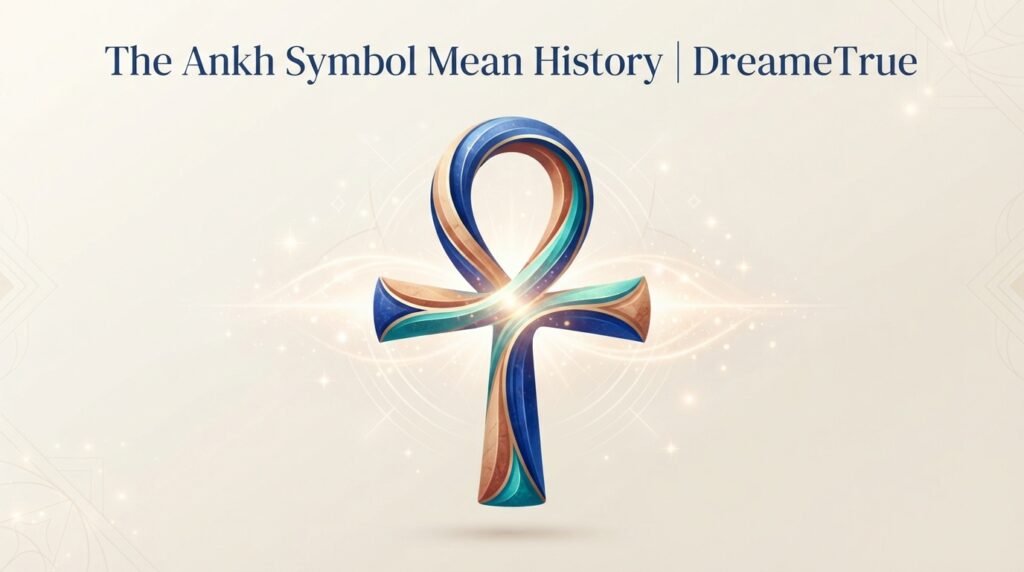
The ankh is one of the most recognizable symbols associated with ancient Egypt. Its distinctive looped-cross shape appears on temple walls, tombs, statues, jewelry, amulets, and modern artwork. But what does the ankh symbol mean—and why has it remained popular for thousands of years?
At its core, the ankh represents life. In ancient Egyptian writing, it was the hieroglyph for “life,” “to live,” and related ideas. But its meaning can go much deeper, especially when the symbol appears in religious art, funerary objects, or modern spiritual contexts.
8
Featured Snippet Answer: The ankh symbol is an ancient Egyptian hieroglyph meaning “life” or “to live.” It became associated with life, vitality, divine power, and continued existence after death. Egyptian gods are frequently shown holding or offering an ankh, making it a powerful symbol of life and eternal existence.
What Is the Ankh Symbol?
The ankh (☥) is a cross-like Egyptian symbol with a loop at the top. It is sometimes called the Egyptian cross, key of life, or cross of life.
Its most firmly established ancient meaning is life. The Metropolitan Museum of Art notes that the ankh was used as a hieroglyph to write “live,” “alive,” or “life,” and that it also became a general symbol for life.
The symbol appears in Egyptian art from very early periods. An Early Dynastic object at the Met, dated approximately 3100–2900 BCE, incorporates the ankh hieroglyph and connects it with the concept of life or living.
What Does ☥ Mean?
The basic meaning of ☥ is:
- Life
- To live
- Living existence
- Vitality
- Continued existence
- In religious contexts, divine or eternal life
However, not every interpretation commonly found online has the same historical evidence. Some ideas about the ankh’s shape are theories rather than established facts.
What Does the Ankh Symbol Mean in Ancient Egypt?
In ancient Egyptian culture, the ankh primarily represented life.
This wasn’t simply an abstract idea. Egyptian religion connected earthly existence with the continuation of existence after death. Consequently, the ankh could appear in contexts involving gods, kings, temples, tombs, and funerary objects.
For example, Egyptian gods are frequently portrayed holding an ankh. In one Old Kingdom sculpture at the Metropolitan Museum of Art, a divine figure offers an ankh—the hieroglyph meaning “life”—to King Sahure.
This imagery is important because it shows the symbol functioning as more than decoration. Life was something associated with divine power and could symbolically be given by a god to a king.
The Ankh and the Breath of Life
The ankh can also appear near the nose or face of a person or deity.
During the Amarna period, for example, rays from the Aten are depicted ending in hands that hold ankhs toward the noses of Akhenaten and members of his family. The imagery communicates the idea of life being bestowed by divine power.
So when you see an Egyptian figure holding an ankh near someone’s face, the scene can be understood in the context of giving or sustaining life.
Ankh Symbol Meaning: Quick Reference
| Context | Meaning or association |
|---|---|
| Ancient Egyptian hieroglyph | Life / to live |
| Egyptian religious art | Divine life or life bestowed by the gods |
| Funerary contexts | Continued existence and life beyond death |
| Amulets | Protection and life-related symbolism |
| Modern jewelry | Life, vitality, identity, or personal spirituality |
| Modern spiritual use | Often interpreted as eternal life or balance |
| Egyptian mythology | Closely associated with gods and divine power |
The first two rows have particularly strong historical evidence. Modern spiritual interpretations can vary considerably.
Why Does the Ankh Have a Loop?
The exact origin of the ankh’s shape remains uncertain.
That’s an important distinction because you’ll often see websites state that the loop definitely represents one specific thing. Archaeological evidence doesn’t allow us to be that certain.
One proposed explanation is that the ankh developed from a sandal strap. Another theory connects its shape with the so-called Knot of Isis. Other interpretations have suggested anatomical or reproductive symbolism. These theories remain debated rather than established historical facts.
The Metropolitan Museum’s educational material similarly describes the ankh as possibly representing a sandal strap or an elaborate bow while emphasizing its meaning as “life” and “to live.”
What We Know vs. What We Don’t
Well established:
- The ankh is an Egyptian hieroglyph.
- It means “life” or “to live.”
- It was used extensively in Egyptian art.
- Gods and rulers are frequently depicted with it.
Less certain:
- Exactly what physical object inspired its shape.
- Whether every part of its shape had a separate symbolic meaning.
- Whether it originally represented male and female anatomy.
- Whether it was intended as a literal “key.”
This distinction matters if you want an historically accurate understanding of the symbol.
What Does the Ankh Symbol Represent Spiritually?
Today, many people use the ankh as a spiritual symbol.
Modern interpretations commonly connect it with:
- Eternal life
- Spiritual existence
- Rebirth
- Renewal
- Vitality
- Balance
- Connection between life and death
- Divine energy
However, these modern meanings shouldn’t automatically be presented as the exact beliefs of every ancient Egyptian.
Ancient Egyptian religion was complex and changed over thousands of years. The safest historical interpretation is that the ankh fundamentally represented life, while its placement in religious and funerary contexts gave that idea broader associations.
Does the Ankh Mean Eternal Life?
It can be associated with eternal or continuing life, but its primary hieroglyphic meaning is simply “life” or “to live.”
The connection to eternal life comes from the wider Egyptian religious worldview.
Ancient Egyptians had elaborate beliefs concerning death, burial, the soul, resurrection, and continued existence. The ankh therefore appears naturally in contexts where life continues beyond ordinary earthly existence.
The National Park Service describes the ankh as representing eternal life in ancient Egyptian culture and notes its appearance with important Egyptian figures and deities.
So “eternal life” is a reasonable interpretation in many contexts—but “life” is the more fundamental meaning.
What Does the Ankh Mean in Egyptian Religion?
The ankh appears throughout Egyptian religious imagery.
Gods such as Isis, Osiris, Ra, and Horus can be represented holding ankhs. The British Museum, for example, depicts Isis holding an ankh in its educational material about Egyptian gods and goddesses.
The symbol could therefore communicate a relationship between divine beings and life itself.
The Ankh and the Gods
The ankh wasn’t limited to one Egyptian deity.
Its use across different religious contexts demonstrates that it was a broad symbol of life rather than simply the personal emblem of one god or goddess.
For example, Egyptian art can show:
- A god presenting an ankh to a king
- A goddess holding an ankh
- Ankhs appearing alongside other sacred symbols
- Ankhs incorporated into jewelry and amulets
- The symbol appearing in funerary settings
What Does the Ankh Mean in Egyptian Art?
The meaning depends partly on how the ankh is being used.
Consider a scene where a god holds an ankh toward a king. The visual message is different from an ankh carved into an amulet.
The Met records an Early Dynastic vessel in which arms representing ka, or spirit, surround an ankh. The combination can be interpreted as a wish along the lines of “may my spirit live.”
This is a useful example of why Egyptian symbols shouldn’t always be interpreted in isolation.
Ankh + Djed + Was
The ankh was sometimes combined with other Egyptian symbols.
A particularly interesting combination is:
- Ankh = life
- Djed = stability
- Was = dominion or power
The Metropolitan Museum describes this combination as expressing powerful wishes involving life, stability, and dominion.
What Does the Ankh Mean in Egyptian Tombs?
The ankh frequently appears in funerary and tomb-related contexts.
This makes sense because Egyptian funerary religion placed enormous importance on continued existence after death.
An ankh could therefore reinforce ideas such as:
life → death → continued existence
But it shouldn’t be understood as a simple Egyptian equivalent of the modern phrase “life after death.” Egyptian ideas about the afterlife involved several aspects of the person and a complex religious system.
The symbol’s presence in funerary objects nevertheless demonstrates the importance of life-related symbolism in Egyptian burial practices. The Met’s collections include ankhs found in tomb contexts, including amulets bearing the sign.
Was the Ankh Used as an Amulet?
Yes.
Ankhs were made as amulets and decorative objects, including examples made from materials such as faience.
The Met has an ankh-shaped ceremonial object from the New Kingdom and a Middle Kingdom model ankh. Archaeological examples demonstrate that the symbol existed in physical objects rather than appearing only in monumental inscriptions.
The use of ankh amulets reflects the broader Egyptian practice of using symbolic objects in connection with protection, religious devotion, and hopes for well-being.
What Does the Ankh Symbol Mean in Modern Culture?
The ankh has survived far beyond ancient Egypt.
Today, people may encounter it in:
- Jewelry
- Tattoos
- Fashion
- Artwork
- Music and entertainment
- Spiritual communities
- Egyptian-themed designs
- Historical education
- Popular culture
For many modern users, it represents life, immortality, spirituality, or connection with ancient Egyptian culture.
But modern interpretations aren’t necessarily ancient Egyptian interpretations.
That’s why context matters.
Someone wearing an ankh necklace might simply appreciate Egyptian history. Another person may use it as a personal symbol of life or spiritual identity. There isn’t one universal modern meaning.
What Does an Ankh Tattoo Mean?
An ankh tattoo often symbolizes:
- Life
- Strength
- Renewal
- Immortality
- Personal transformation
- Spirituality
- Connection with ancient Egypt
The exact meaning depends on the person.
For example, someone might choose an ankh after overcoming a difficult period as a personal reminder of survival and renewed life.
Another person may choose it purely because they admire ancient Egyptian art.
Does an Ankh Tattoo Have One Fixed Meaning?
No.
A symbol can have an established historical meaning while also carrying a personal meaning.
The historical meaning of the ankh is strongly connected to life. A tattoo adds another layer based on the wearer’s own interpretation.
What Does an Ankh Necklace Mean?
An ankh necklace can symbolize life, vitality, eternal existence, spirituality, or an interest in ancient Egyptian culture.
There’s no single rule that says wearing an ankh necklace means someone follows a particular religion.
In modern culture, the symbol is often worn simply as meaningful jewelry.
If you’re giving an ankh necklace to someone, the message might naturally be interpreted as:
“Life, strength, and continued existence.”
The personal meaning is ultimately determined by the wearer.
Is the Ankh a Religious Symbol?
Historically, yes, it was deeply connected with ancient Egyptian religion.
However, it was also a hieroglyph used in writing.
That’s an important distinction.
The ankh wasn’t merely a religious logo. It was a written sign meaning life/to live, and it was simultaneously used as a powerful visual symbol in religious and artistic contexts.
Today, whether someone considers it religious depends on how they use it.
Is the Ankh a Christian Symbol?
This question is more complicated than a simple yes or no.
The ankh predates Christianity by thousands of years and originated within ancient Egyptian culture.
Egypt later became an important center of Christianity, and Coptic Christianity developed distinctive artistic traditions that incorporated elements from earlier Egyptian culture. The Egyptian Museum notes that Coptic art reflects interaction between Coptic Christianity and earlier Pharaonic, Greek, Roman, Byzantine, and other cultural traditions.
Some sources describe the Coptic cross as related to or derived from the ankh, but the historical relationship should not be oversimplified into “the Christian cross came directly from the ankh.” The development of Christian cross forms is more complicated.
Bottom line: the ankh itself is an ancient Egyptian symbol of life, not originally a Christian symbol.
Ankh vs. Christian Cross
| Feature | Ankh | Christian cross |
|---|---|---|
| Origin | Ancient Egypt | Early Christianity |
| Basic historical meaning | Life / to live | Central Christian symbol associated with Jesus’ crucifixion and resurrection |
| Shape | Cross with loop | Usually intersecting bars |
| Original period | Ancient Egyptian civilization | 1st century CE onward |
| Ancient Egyptian religious use | Yes | No |
| Modern use | History, spirituality, jewelry, art | Christian faith and culture |
The similarities in shape can make the two symbols easy to confuse, but they have different historical origins and meanings.
Is the Ankh Connected to Isis?
The ankh is strongly associated with Egyptian gods and goddesses, including Isis, but it isn’t exclusively an Isis symbol.
Isis was associated with motherhood, protection, magic, healing, fertility, and rebirth in ancient Egyptian religious traditions. Egyptian art frequently depicts her holding an ankh.
Because of this association, modern audiences sometimes assume:
ankh = Isis
That’s too narrow.
A better understanding is:
ankh = life, and Isis is one of the many divine figures associated with and depicted holding the symbol.
Is the Ankh Connected to Osiris?
Yes, the ankh appears in imagery involving Osiris and the afterlife.
Osiris was closely associated with death, resurrection, the deceased, and the afterlife in Egyptian religion. Egyptian Museum material describes Osiris as the god of the deceased, master of the underworld and lord of eternity.
Because the ankh represented life, its appearance alongside Osiris creates a meaningful relationship between life, death, and continued existence.
But again, the ankh wasn’t simply “the symbol of Osiris.” Its meaning remained broader.
Does the Ankh Have a Biblical Meaning?
There is no biblical meaning for the ankh in the sense of being a symbol established by the Bible.
The ankh originated in ancient Egyptian culture before Christianity and before the biblical Christian tradition.
If someone uses an ankh in a Christian context today, that represents a later interpretation or cultural association rather than a symbol prescribed by biblical scripture.
Therefore, it’s useful to separate:
- Ancient Egyptian meaning: life
- Christian biblical teaching: no specific ankh symbol
- Modern interpretations: may connect it with eternal life or resurrection
These shouldn’t be treated as interchangeable.
What Does the Ankh Mean Spiritually in Modern Beliefs?
Modern spiritual interpretations often expand the ancient idea of life.
People may interpret the ankh as representing:
Life and vitality
A reminder to appreciate existence and remain connected to life.
Death and rebirth
A symbolic cycle of endings and new beginnings.
Eternal existence
A representation of life continuing beyond physical existence.
Balance
Some modern interpretations view the loop and cross as complementary elements.
Spiritual transformation
The symbol may represent personal growth or a transition into a new phase of life.
These interpretations can be meaningful to individuals, but they should be identified as modern or interpretive meanings, not automatically attributed to ancient Egyptians.
Does the Ankh Represent Male and Female Energy?
You’ll often encounter the claim that the ankh represents the union of masculine and feminine principles.
Some interpretations connect the cross and loop with male and female anatomy or complementary forces. The National Park Service notes that theories about the ankh’s origins include interpretations involving the union of male and female symbols, among other possibilities.
However, this is an interpretation of the symbol’s form, not its firmly established ancient Egyptian definition.
The safest historical answer remains:
The ankh is a hieroglyph meaning “life” or “to live.”
Is the Ankh a Symbol of Fertility?
The ankh can be connected with fertility in broader interpretations of life, creation, and reproduction.
However, saying “the ankh specifically means fertility” is too strong.
Ancient Egyptian fertility symbolism involved many gods, objects, myths, and signs. Some scholars have proposed connections between the ankh’s shape and fertility symbolism, but these theories aren’t universally accepted.
So:
Life: strongly established
Fertility: possible associated interpretation, but not the primary dictionary meaning
What Does the Ankh Mean in Different Contexts?
Context can change how the symbol is understood.
| Where you see it | Likely interpretation |
|---|---|
| Ancient Egyptian inscription | Life / to live |
| Temple relief | Divine life or life bestowed by a deity |
| Tomb | Life and continued existence |
| Amulet | Life-related religious symbolism |
| Statue of a god | Divine association with life |
| Modern necklace | Personal symbolism, life, spirituality, or Egyptian culture |
| Tattoo | Personal meaning, often life or transformation |
| Modern spiritual artwork | Life, eternity, balance, or renewal |
This is why looking only at the shape isn’t enough. The surrounding imagery tells you a great deal.
Ankh Symbol vs. Other Ancient Egyptian Symbols
The ankh is only one part of a much larger Egyptian symbolic system.
| Symbol | General meaning |
|---|---|
| ☥ Ankh | Life |
| Djed | Stability |
| Was scepter | Dominion / power |
| Eye of Horus | Protection and well-being |
| Scarab | Transformation / rebirth associations |
| Shen ring | Eternity / protection |
| Lotus | Rebirth and regeneration associations |
The meanings of Egyptian symbols can change according to period and context, so these descriptions are useful summaries rather than complete definitions.
The Met specifically documents combinations of the ankh, djed, and was signs, demonstrating how Egyptian artists could place several concepts together in one composition.
Common Myths About the Ankh
Myth 1: The Ankh Definitely Means “Key of Life”
“Key of life” is a popular nickname, but life is the firmly established hieroglyphic meaning.
Calling it a “key” is a later descriptive interpretation based partly on its shape.
Myth 2: The Ankh Was Originally a Christian Cross
No.
The ankh is an ancient Egyptian symbol that predates Christianity by thousands of years.
Myth 3: The Loop Definitely Represents Female Anatomy
This is a theory, not a proven fact.
The origin of the ankh’s distinctive shape remains debated.
Myth 4: Everyone Who Wears an Ankh Practices Egyptian Religion
Not necessarily.
Modern people wear ankh jewelry for many reasons, including historical interest, fashion, personal symbolism, and spirituality.
Myth 5: The Ankh Has Only One Meaning
Its core ancient meaning is clear, but its significance can become broader depending on artistic, religious, historical, and modern context.
Why Is the Ankh Still Popular Today?
Few ancient symbols have remained as recognizable as the ankh.
Part of its appeal comes from its simple design. The looped cross is immediately distinctive, while the idea of life is universal.
The symbol also has a remarkable archaeological history. It appears in objects spanning different periods of Egyptian history, and Egyptian-style symbolism traveled beyond Egypt as Egyptian cultural influence spread.
For example, the UCL Petrie Museum documents an ankh from Meroë in Sudan, where Egyptian traditions were incorporated into the art and religious culture of the Meroitic Kingdom.
So the ankh isn’t just a modern fashion symbol. It has a long history of adaptation and cultural transmission.
What Does the Ankh Mean in Psychology?
There isn’t a scientifically established psychological meaning assigned to the ankh.
However, people can attach personal psychological significance to symbols.
Someone might associate the ankh with:
- Survival
- Personal identity
- Hope
- Renewal
- Connection to ancestry or history
- Personal transformation
- Appreciation for life
These are individual interpretations, not universal psychological meanings.
In other words, psychology can explain why symbols become personally meaningful, but it doesn’t establish that the ankh objectively produces a particular psychological effect.
Is the Ankh Good Luck?
Some modern people treat the ankh as a positive or protective symbol.
Historically, Egyptian amulets could carry symbolic and protective purposes, and ankhs were among the objects associated with life. But there is no single universal ancient Egyptian rule saying that an ankh was simply a “good luck charm.”
It’s more accurate to describe it as a symbol connected with life and well-being, whose use could have protective or religious significance depending on the object and context.
What Does the Ankh Mean in a Dream?
Dream interpretation is subjective.
If you dream about an ankh, common modern symbolic interpretations might include:
- A new beginning
- Renewal
- Personal growth
- Fear or acceptance of death
- A desire for longevity
- Spiritual exploration
- Connection with ancient history
But there is no scientifically proven universal meaning for dreaming about an ankh.
Your personal experiences and the context of the dream matter more than a fixed dream dictionary.
What Does ☥ Mean in Texting or Social Media?
The ankh emoji-like symbol ☥ isn’t generally used with one standardized texting meaning.
People may use it to communicate:
- Ancient Egypt
- Life
- Spirituality
- Egyptian history
- Immortality
- Mysticism
- Aesthetic interest in Egyptian culture
The meaning depends heavily on the surrounding message.
For example:
“☥ Life is precious.”
Here, the symbol likely reinforces the idea of life.
“Visiting Egypt ☥”
Here, it may simply refer to Egyptian culture or history.
How Do You Pronounce “Ankh”?
Ankh is commonly pronounced approximately:
“ank”
It rhymes closely with words such as “bank” and “thank.”
The spelling comes from the ancient Egyptian word associated with life.
What Is the Egyptian Word Behind the Ankh?
The word represented by the ankh sign is commonly transliterated as ꜥnḫ in Egyptological writing.
It is associated with the meaning “life” or “to live.”
The Metropolitan Museum’s collections explicitly describe the sign as the hieroglyph for “life,” while examples of objects bearing the sign reinforce its written and symbolic use.
How Old Is the Ankh Symbol?
The ankh is extremely old.
Archaeological evidence places its use in Egypt at least as early as the Early Dynastic Period. The Metropolitan Museum has an Early Dynastic object dated approximately 3100–2900 BCE featuring the ankh sign.
That means the symbol has a documented history stretching back more than 5,000 years.
It continued to appear throughout later periods of Egyptian history.
What Did the Ankh Mean to Ancient Egyptians?
If we reduce the evidence to its strongest foundation, the answer is beautifully simple:
The ankh meant life.
But “life” was an enormous concept in ancient Egyptian thought.
It could be connected with:
- Living people
- Divine power
- Health and well-being
- The continuation of existence
- The afterlife
- Royal legitimacy
- Religious ritual
The symbol’s power came partly from this broad concept. Life wasn’t merely biological existence—it was embedded in Egyptian religion, kingship, ritual, and ideas about what happened after death.
The Most Accurate Way to Understand the Ankh
When researching ancient symbols, it’s easy to fall into the trap of giving every shape a dramatic hidden meaning.
The ankh is a good example of why evidence matters.
Historical fact
The ankh is an ancient Egyptian hieroglyph meaning life / to live.
Strong historical association
It became an important visual symbol of life and appears frequently with Egyptian gods and kings.
Religious association
Its use in temples, tombs, amulets, and religious art connects it with Egyptian ideas about divine and continued life.
Scholarly uncertainty
The exact origin of its distinctive shape remains debated.
Modern interpretation
People today may use it to represent life, spirituality, immortality, renewal, or personal identity.
Keeping these categories separate gives you a much more accurate picture.
Frequently Asked Questions
What does the ankh symbol mean?
The ankh is an ancient Egyptian hieroglyph meaning “life” or “to live.” It became a powerful symbol associated with life, divine power, and continued existence.
What does ☥ mean?
☥ is the Unicode character commonly used to represent the ankh, the ancient Egyptian symbol of life.
Is the ankh a symbol of eternal life?
It can represent or be associated with continued or eternal life, especially in funerary and religious contexts. Its fundamental hieroglyphic meaning, however, is life.
Is the ankh a religious symbol?
Historically, yes. It was deeply integrated into ancient Egyptian religious art, although it was also a written hieroglyph.
What does an ankh necklace symbolize?
It commonly symbolizes life, vitality, spirituality, immortality, or an appreciation of ancient Egyptian culture. The exact modern meaning depends on the wearer.
What does an ankh tattoo symbolize?
An ankh tattoo often represents life, renewal, strength, immortality, or personal transformation.
Is the ankh Egyptian or African?
The ankh originated in ancient Egypt, which is in northeastern Africa. It is therefore both an ancient Egyptian cultural symbol and part of Africa’s ancient heritage.
Is the ankh older than Christianity?
Yes. The ankh was used in ancient Egypt thousands of years before Christianity emerged.
Is the ankh the same as a cross?
No. It has a cross-like form, but the ankh has a distinctive loop at the top and originated as an Egyptian hieroglyph.
Is the ankh connected with Isis?
Isis is frequently depicted holding an ankh, but the symbol wasn’t exclusive to her. It represented life more broadly.
Does the ankh mean fertility?
Fertility can be part of some interpretations because fertility creates life, but life is the better-supported primary meaning.
What is the ankh called?
It is generally called the ankh, and it is also popularly known as the key of life or cross of life.
What is the spiritual meaning of the ankh?
In modern spirituality, people may interpret it as life, eternal existence, renewal, balance, or spiritual transformation. These meanings vary and shouldn’t automatically be attributed to ancient Egyptian religion.
Final Answer
So, what does the ankh symbol mean?
The simplest and most historically reliable answer is life.
The ankh was an ancient Egyptian hieroglyph meaning “life” or “to live.” Over time, its use in religious art, royal imagery, amulets, and funerary contexts connected it with broader ideas such as divine life, vitality, continued existence, and the afterlife.
Today, the ankh carries additional meanings for different people. It may symbolize life, immortality, renewal, spirituality, strength, or a connection with ancient Egyptian culture.
The most important thing to remember is the difference between historical evidence and modern interpretation. The ancient Egyptian meaning is firmly rooted in life; many of the more specific explanations about the symbol’s shape or spiritual significance are later theories or personal interpretations.
That combination of simplicity and depth is precisely why the ankh remains one of the world’s most enduring ancient symbols.
discover more post
What Does the TM Symbol Mean Explained Simply 2026
What Does a Lock Symbol Mean on a Text 2026
What Does the Lock Symbol Mean on Google Messages …

About Zoya
Zoya is the author and content creator behind DreamETrue, where she shares well-researched articles about dream meanings, dream symbolism, and interpretations from cultural, spiritual, and psychological perspectives.
Her goal is to make dream-related topics simple, trustworthy, and easy to understand for readers around the world. Every article is carefully written with a focus on clarity, accuracy, and providing genuine value, helping readers explore the fascinating world of dreams with confidence.
Through DreamETrue, Zoya is committed to publishing original, informative, and reader-focused content that follows high editorial standards. Whether you’re curious about a recurring dream or looking for the meaning behind a specific dream symbol, her mission is to provide reliable guidance in a clear and engaging way.
When she’s not researching dream symbolism, Zoya enjoys reading, learning about human psychology, and creating helpful content that inspires curiosity and understanding.