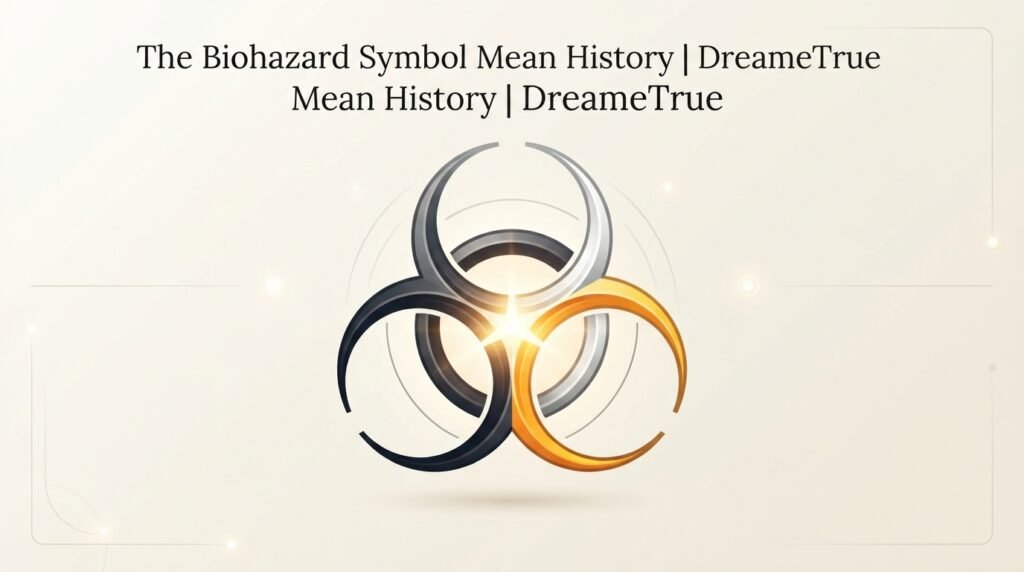
The unmistakable biohazard symbol—three curved shapes arranged around a central circle—can make people stop and pay attention. You’ll see it on medical waste containers, laboratory doors, contaminated materials, and warning labels.
But what does the biohazard symbol mean, exactly? Does it mean something is poisonous, radioactive, infectious, or simply dangerous?
The answer is more specific than a general “danger” warning. The symbol identifies a biological hazard: a biological agent or material that can pose a risk to humans, animals, or the environment under particular circumstances.
In this guide, you’ll learn what the biohazard symbol means, where it came from, what the different colors mean, where you’ll encounter it, how it differs from other hazard symbols, and what you should—and shouldn’t—do when you see it.
Featured Snippet Answer:
The biohazard symbol warns that biological material or an area may contain a biological hazard capable of causing harm, such as infectious microorganisms or contaminated materials. It is used on medical and laboratory waste, containers, equipment, and areas where biological hazards may be present. The symbol means caution and requires appropriate safety procedures.
What Does the Biohazard Symbol Mean?
The biohazard symbol is a warning sign used to identify biological hazards.
A biological hazard, often called a biohazard, can include biological material that presents a potential risk to human health, animals, or the environment.
Examples can include:
- Infectious microorganisms
- Certain biological toxins
- Human or animal specimens
- Materials contaminated with infectious agents
- Certain laboratory cultures
- Contaminated medical waste
- Sharps or equipment contaminated with biological material
The symbol itself doesn’t tell you exactly which biological agent is present or how dangerous it is.
Instead, it communicates a much simpler message:
Biological hazard may be present. Follow the appropriate safety procedures.
That’s an important distinction.
A biohazard symbol isn’t a diagnosis of danger. It’s a hazard warning.
What Does the Biohazard Symbol Look Like?
The standard biohazard symbol consists of three curved, interlocking shapes surrounding a central circle.
It looks roughly like this:
☣
The Unicode character ☣ is officially associated with the biohazard sign.
The design is deliberately distinctive so it can be recognized quickly, even when someone doesn’t read the accompanying text.
You may see the symbol:
- On waste containers
- On laboratory equipment
- On specimen containers
- On warning signs
- On medical waste packaging
- On restricted laboratory areas
- On biological material labels
The symbol is often displayed in black on a yellow or orange-yellow background, although exact colors and formats can vary according to the relevant workplace, regulatory, or labeling system.
What Is the Purpose of the Biohazard Symbol?
The main purpose is hazard communication.
A symbol can communicate a warning much faster than a paragraph of text.
Imagine a medical worker approaching a container in a busy hospital.
They don’t need to read a long explanation before realizing that the container requires special handling.
The biohazard symbol immediately signals:
Stop. Pay attention. Follow the required biological-safety procedures.
The Occupational Safety and Health Administration (OSHA) specifies the use of the biohazard symbol and warning wording for certain regulated occupational situations, including containers of regulated waste and contaminated instruments.
What Is a Biohazard?
A biohazard is a biological substance, material, or situation that can pose a potential hazard to people, animals, or the environment.
The term can cover a wide range of materials.
Depending on the setting, a biohazard may involve:
- Bacteria
- Viruses
- Fungi
- Parasites
- Biological toxins
- Human tissues or fluids
- Animal tissues or fluids
- Cultures containing microorganisms
- Materials contaminated with infectious agents
However, not every biological substance is automatically a biohazard.
For example, ordinary food, healthy skin, or a harmless microorganism isn’t necessarily considered a biohazard simply because it is biological.
The hazard depends on the material, its properties, concentration, route of exposure, and circumstances.
What Does the Biohazard Symbol Warn You About?
The symbol can indicate that a material or area may present a biological hazard.
The exact risk depends on what’s actually present.
Potential routes of exposure can include:
- Contact with skin
- Contact with eyes
- Inhalation
- Ingestion
- Accidental injection or needlestick
- Contact with mucous membranes
Different biological hazards create different risks.
That’s why the symbol alone isn’t enough to determine what precautions are required.
Important distinction
Biohazard symbol = warning about a biological hazard
It does not automatically mean:
- The material is poisonous
- The material is radioactive
- The material will definitely cause infection
- Everyone who touches it will become sick
- The material is immediately lethal
The surrounding label, workplace procedures, safety data, and applicable regulations provide the additional information.
History of the Biohazard Symbol
The biohazard symbol has a surprisingly interesting history.
Unlike some ancient warning symbols, the modern biohazard symbol was deliberately designed in the 1960s.
Researchers and industrial organizations needed a symbol that could communicate biological hazards clearly and consistently.
According to historical accounts from the Centers for Disease Control and Prevention (CDC), the symbol was developed in 1966 by a team at Dow Chemical Company led by Charles Baldwin.
The design was selected because it was:
- Unique
- Easy to recognize
- Easy to stencil
- Symmetrical
- Memorable
- Not strongly associated with another existing symbol
The CDC’s historical discussion describes how the symbol was evaluated for factors such as memorability, uniqueness, and usefulness in communicating biological hazards.
Who Invented the Biohazard Symbol?
The modern biohazard symbol is generally credited to Charles L. Baldwin and his team at Dow Chemical Company.
Baldwin worked with colleagues to develop and evaluate potential designs for biological hazard communication.
The project wasn’t simply about creating an attractive icon.
The researchers wanted something that people could recognize and remember.
The CDC’s account of the symbol’s development describes testing candidate symbols with people to determine which designs were distinctive and memorable.
When Was the Biohazard Symbol Created?
The biohazard symbol was developed in 1966.
That makes it much newer than many familiar warning symbols.
Its development reflects a growing need for standardized communication of biological hazards in laboratories, hospitals, manufacturing facilities, and other workplaces.
The symbol subsequently became widely recognized as the visual shorthand for biological hazards.
Why Was the Biohazard Symbol Designed That Way?
There’s no secret ancient meaning hidden inside the three curved shapes.
The design was created to be:
- Distinctive
- Visually memorable
- Easily reproduced
- Recognizable from different orientations
- Unlikely to be confused with existing symbols
Its threefold symmetry also makes the symbol visually unusual.
That unusual appearance helps it stand out.
The original design process emphasized recognition and memorability rather than giving each individual curved section a separate symbolic meaning.
Does Each Part of the Biohazard Symbol Have a Meaning?
A common internet misconception is that every curved section represents a specific biological concept.
There isn’t good evidence that the original designers assigned a separate symbolic meaning to each of the three curved elements.
The important meaning is the complete symbol as a whole.
It functions as a recognizable hazard sign.
So don’t interpret the three sections as three separate diseases, organisms, or stages of infection.
What Does the Biohazard Symbol Mean in Science?
In scientific and laboratory settings, the symbol indicates that biological materials may require special precautions.
It can appear in places involving:
- Microbiology
- Virology
- Clinical laboratories
- Medical research
- Biomedical research
- Diagnostic testing
- Biotechnology
- Animal research
- Biological waste handling
The precise safety requirements depend on the material and facility.
A symbol on a laboratory door, for example, may indicate controlled access and specific procedures for entering the area.
What Does the Biohazard Symbol Mean in a Laboratory?
In a laboratory, the symbol generally tells personnel that a biological hazard may be present.
Depending on the laboratory and material, required precautions can include:
- Restricted access
- Protective clothing
- Gloves
- Eye protection
- Appropriate containment
- Biological safety procedures
- Proper waste disposal
- Decontamination procedures
The symbol itself doesn’t tell an employee which personal protective equipment to wear.
That information should come from the laboratory’s safety procedures and risk assessment.
What Does the Biohazard Symbol Mean on Medical Waste?
If you see the biohazard symbol on a medical-waste container, it generally indicates that the contents may contain regulated biological or potentially infectious material.
Examples may include certain:
- Contaminated dressings
- Laboratory materials
- Disposable medical equipment
- Cultures
- Contaminated specimens
- Other regulated medical waste
OSHA’s bloodborne pathogens standard specifies biohazard labeling requirements for certain regulated waste containers and other materials.
The exact waste categories and disposal requirements vary by jurisdiction.
What Does the Biohazard Symbol Mean on a Sharps Container?
A sharps container is designed for items such as needles and other objects capable of puncturing skin.
If it carries a biohazard symbol, it signals that the container may contain contaminated sharps or other regulated biological waste.
Never put your hands inside a sharps container.
The physical hazard of the sharp object can exist independently of the biological hazard.
In other words:
Needle + biological contamination = potentially two different hazards at once.
What Does the Biohazard Symbol Mean on a Door?
A biohazard symbol on a door usually means that the area beyond the door may contain biological hazards or materials requiring controlled access.
In a professional environment, the sign may also be accompanied by:
- A warning statement
- Contact information
- Required protective equipment
- Access restrictions
- Emergency instructions
- Laboratory-specific information
Don’t enter a restricted biohazard area simply because the door appears unlocked.
Follow the facility’s access and safety procedures.
What Does the Biohazard Symbol Mean on a Bag?
A bag displaying the biohazard symbol may be intended for biological or regulated medical waste.
In healthcare settings, special bags or containers may be used for certain contaminated materials.
However, not every red or yellow bag is automatically a biohazard bag.
Color coding can vary between organizations and jurisdictions.
The label and facility procedures are more reliable than color alone.
What Do the Colors of the Biohazard Symbol Mean?
The biohazard symbol is often associated with black and yellow.
However, there isn’t one universal rule saying that every possible color combination represents a different biological danger level.
Common presentation
A familiar format is:
Black symbol + yellow background
This high-contrast combination makes the warning easy to see.
Does red mean more dangerous?
Not necessarily.
Red may be used in particular warning systems or contexts, but you shouldn’t assume that a red biohazard symbol automatically means a higher biological risk.
The meaning of a label depends on the regulatory or institutional system in which it is being used.
Biohazard Symbol vs. Radiation Symbol
These two symbols are sometimes confused because both indicate serious hazards.
But they represent completely different things.
| Symbol | Meaning |
|---|---|
| ☣ | Biological hazard |
| ☢ | Ionizing radiation hazard |
Biohazard ☣
Used for hazards involving biological materials or agents.
Radiation ☢
Used for ionizing radiation hazards.
A radioactive material isn’t automatically a biohazard.
Likewise, an infectious biological material isn’t automatically radioactive.
They are separate hazard categories.
Biohazard Symbol vs. Toxic Symbol
Another common confusion involves poison or toxic-substance warnings.
A skull-and-crossbones symbol:
☠
is generally associated with acute toxicity or poisoning hazards in relevant hazard communication systems.
The biohazard symbol:
☣
communicates a biological hazard.
These warnings shouldn’t be treated as interchangeable.
Biohazard Symbol vs. Chemical Hazard Symbols
Chemical hazards are commonly communicated using the Globally Harmonized System of Classification and Labelling of Chemicals (GHS) pictograms.
These include symbols for hazards such as:
- Acute toxicity
- Corrosive substances
- Flammable materials
- Oxidizers
- Explosives
- Gas under pressure
- Environmental hazards
- Health hazards
A chemical can be dangerous without being a biohazard.
Likewise, a biological material can be hazardous without being a chemical hazard.
Biohazard vs. Biological Material: Are They the Same?
No.
This distinction is important.
Biological material is a broad term.
Biohazard refers to a biological material, agent, or situation that presents a relevant hazard.
For example, a biological sample in a laboratory might be perfectly safe under one set of circumstances but require strict containment under another.
Hazard is about risk and circumstances, not simply whether something comes from a living organism.
What Are Examples of Biohazards?
Potential biohazards can include:
- Certain pathogenic bacteria
- Certain viruses
- Certain fungi
- Certain parasites
- Some biological toxins
- Infected tissue
- Contaminated blood
- Certain clinical specimens
- Cultures containing infectious microorganisms
- Contaminated laboratory waste
- Certain contaminated sharps
The presence of the symbol doesn’t tell you which specific agent is involved.
You need the accompanying documentation or labeling for that information.
Is Blood a Biohazard?
Blood isn’t automatically a biohazard in every situation.
However, human blood can be considered potentially infectious in occupational settings, particularly under rules governing bloodborne pathogens.
For example, OSHA’s Bloodborne Pathogens Standard addresses occupational exposure to human blood and other potentially infectious materials.
This is why biohazard labeling is common around certain healthcare waste and specimen-handling systems.
Is Human Waste a Biohazard?
It depends on the circumstances.
Human waste can contain microorganisms, but not every situation involving human waste is automatically classified or labeled as a biohazard.
Healthcare, laboratory, occupational, and environmental regulations can define specific categories of regulated material.
The correct approach is to follow the applicable facility or public-health guidance rather than treating every biological substance as equally hazardous.
Is a Biohazard Symbol Always Dangerous?
The symbol indicates a potential hazard, but it doesn’t tell you the exact level of danger.
For example, a sealed, properly contained laboratory specimen and an exposed contaminated surface are very different exposure situations.
Risk depends on factors such as:
- What biological agent is present
- How much material is present
- Whether it’s infectious
- How it can enter the body
- Whether it is contained
- How long exposure occurs
- What protective measures are in place
That’s why professional biosafety uses risk assessment rather than relying on a symbol alone.
What Should You Do When You See the Biohazard Symbol?
If you encounter a biohazard warning in a professional or healthcare setting, don’t panic.
Instead:
- Stop and read the accompanying warning.
- Don’t touch the material unnecessarily.
- Don’t open sealed containers.
- Follow posted instructions.
- Use required protective equipment if you’re authorized and trained.
- Ask responsible staff if you don’t know what to do.
- Report accidental exposure according to the facility’s procedures.
The correct response depends on the situation.
A warning sign isn’t an invitation to investigate the material.
What Should You Never Do Around a Biohazard?
Avoid:
- Touching unknown biological material
- Opening containers
- Handling contaminated waste without authorization
- Picking up unknown sharps
- Eating or drinking in controlled laboratory areas
- Removing contaminated materials from a designated area
- Attempting to clean a suspected biological spill without appropriate procedures
If you’re not trained or authorized to handle the material, don’t improvise.
What If You Accidentally Touch Something With a Biohazard Symbol?
Don’t assume that exposure automatically means infection.
The actual risk depends on what the material was, how you were exposed, and whether the material was infectious.
If you think you’ve had an occupational or accidental exposure:
- Stop further exposure if you can do so safely.
- Follow the relevant workplace exposure procedure.
- Wash or flush the affected area according to the applicable emergency protocol.
- Report the incident promptly.
- Seek professional medical advice when appropriate.
For significant or unknown exposure, prompt professional assessment is important because some exposures require time-sensitive evaluation.
What Does the Biohazard Symbol Mean in Hospitals?
In hospitals, the symbol can identify areas, containers, equipment, specimens, or waste associated with biological hazards.
You might see it around:
- Clinical laboratories
- Isolation-related areas
- Specimen containers
- Regulated medical waste
- Sharps disposal
- Certain contaminated equipment
However, hospitals use many other signs and symbols too.
A biohazard symbol does not necessarily mean that an entire room is contaminated.
It identifies a biological hazard associated with the particular item, area, or activity.
What Does the Biohazard Symbol Mean in Schools?
Schools may display biohazard warnings in:
- Science laboratories
- Biology classrooms
- Medical training areas
- Research facilities
- Waste-storage areas
Students should follow their instructor’s laboratory safety rules.
If you see a biohazard symbol on an unfamiliar container, don’t open or touch it.
What Does the Biohazard Symbol Mean in Public Places?
Occasionally, you’ll encounter the symbol outside laboratories and hospitals.
It may appear on:
- Medical waste containers
- Sharps disposal units
- Healthcare facilities
- Public health facilities
- Specialized waste collection systems
- Certain research facilities
Its presence doesn’t necessarily mean the surrounding public area is dangerous.
The sign usually identifies a specific material, container, or controlled area.
Is the Biohazard Symbol a Symbol of Death?
Not exactly.
Popular culture sometimes treats the biohazard symbol as a symbol of death, disease, apocalypse, or contamination.
That isn’t its formal meaning.
The official purpose is much more practical:
to communicate the presence or potential presence of a biological hazard.
Movies, video games, clothing, tattoos, and artwork may use the symbol metaphorically.
That’s a cultural use—not the technical meaning of the sign.
What Does the Biohazard Symbol Mean Spiritually?
The biohazard symbol doesn’t have an established universal spiritual meaning.
Its recognized modern meaning is related to biological hazards and safety communication.
People can give symbols personal or spiritual meanings, but those interpretations shouldn’t be confused with the symbol’s historical or scientific meaning.
What Does the Biohazard Symbol Mean in Christianity?
There is no standard biblical or Christian meaning assigned to the modern biohazard symbol.
The symbol was created in the 20th century for biological hazard communication.
Therefore, claims that the three sections represent a particular biblical concept, demonic meaning, or ancient religious symbol should not be presented as historical fact without evidence.
If someone uses the biohazard symbol in a religious or artistic context, its intended meaning may be personal or metaphorical.
What Does the Biohazard Symbol Mean in Dreams?
Dream interpretation is different from scientific symbol interpretation.
There is no scientifically established universal meaning that says dreaming about a biohazard symbol means a particular thing.
A person might personally associate it with:
- Fear
- Illness
- Contamination
- Boundaries
- Danger
- Anxiety
- Avoidance
But those are possible personal associations, not established scientific meanings.
Dream interpretation should therefore be treated as subjective rather than as a proven psychological system.
Why Does the Biohazard Symbol Feel Scary?
Its visual design has become strongly associated with contamination, disease, laboratories, and danger.
Popular media has reinforced this association through:
- Horror movies
- Video games
- Science fiction
- Pandemic stories
- Apocalyptic fiction
- Warning graphics
The result is that many people recognize the symbol emotionally before they understand its technical meaning.
That’s an example of cultural symbolism developing around an originally practical safety sign.
Biohazard Symbol in Movies and Video Games
Entertainment frequently uses the biohazard symbol to communicate ideas such as:
- Virus outbreaks
- Secret laboratories
- Mutations
- Contamination
- Biological weapons
- Quarantine
- Zombie outbreaks
- Scientific experiments
These are fictional or narrative uses.
They shouldn’t be confused with the symbol’s real-world safety purpose.
A movie might use the symbol to create suspense.
A hospital uses it to communicate a practical hazard.
Same symbol. Different context.
Biohazard Symbol Tattoos: What Can They Mean?
Someone who gets a biohazard tattoo may use it to represent very different ideas.
Possible personal meanings include:
- Interest in science
- Medical or laboratory work
- Dark humor
- Rebellion
- Survival
- A fascination with biology
- Fictional contamination or apocalypse themes
- A personal experience with illness
There isn’t one universal tattoo meaning.
The person’s explanation is more reliable than an online symbol dictionary.
Does the Biohazard Symbol Mean You Will Get Sick?
No.
The symbol is a warning, not a prediction.
It doesn’t mean exposure has occurred.
It also doesn’t tell you that infection is inevitable.
The actual health risk depends on:
- The biological agent
- The amount of exposure
- Route of exposure
- Duration
- Infectivity
- Environmental conditions
- Personal protective measures
A properly contained biological material may present little or no exposure risk when handled correctly.
Does the Biohazard Symbol Mean Something Is Radioactive?
No.
This is one of the most common misunderstandings.
The biohazard symbol is:
☣
The radiation trefoil is:
☢
They identify different hazard categories.
Biohazard = biological hazard
Radiation symbol = ionizing radiation hazard
A material can theoretically present more than one type of hazard, but the symbols themselves mean different things.
Does the Biohazard Symbol Mean Something Is Poisonous?
Not necessarily.
Poisoning and biological hazards are different concepts.
A chemical pesticide might be toxic without being a biohazard.
A pathogenic microorganism might be a biohazard without being classified as a chemical poison.
The relevant warning symbol depends on the hazard classification.
What Is the Difference Between a Biohazard and a Hazard?
Hazard is the broader concept.
A hazard is something that has the potential to cause harm.
A biohazard is a hazard associated with biological agents or materials.
Other hazard categories include:
- Chemical hazards
- Physical hazards
- Radiation hazards
- Electrical hazards
- Fire hazards
- Mechanical hazards
The biohazard symbol specifically communicates the biological category.
Biohazard Symbol Meaning at a Glance
| Question | Answer |
|---|---|
| What does ☣ mean? | Biological hazard |
| When was it developed? | 1966 |
| Who developed it? | Charles Baldwin’s team at Dow Chemical |
| Does it mean radioactive? | No |
| Does it mean poisonous? | Not necessarily |
| Does it mean infectious? | It may identify potentially infectious biological material, depending on context |
| Does it always mean immediate danger? | No |
| Is it a religious symbol? | No established religious origin |
| Is it an ancient symbol? | No; the modern symbol dates to the 20th century |
| Where is it used? | Laboratories, healthcare, regulated waste, research, and other settings |
| Is every biological material a biohazard? | No |
| Does the symbol itself identify the specific organism? | No |
Common Myths About the Biohazard Symbol
Myth 1: The symbol is ancient
False.
The modern biohazard symbol was developed in 1966.
Myth 2: Each curved section represents a different disease
There is no solid historical basis for treating the three curved shapes as separate disease symbols.
The complete design functions as the warning symbol.
Myth 3: It means radioactive
False.
Radioactive hazards use the radiation trefoil.
Myth 4: It means poison
Not necessarily.
It identifies biological hazards, not toxicity in general.
Myth 5: Seeing it means you’ll get infected
False.
It indicates a potential hazard; actual risk depends on the material and exposure.
Myth 6: Every red container with the symbol contains the same material
False.
Container systems and color conventions vary.
Myth 7: The symbol has a universal spiritual meaning
There is no established spiritual meaning associated with its creation.
How the Biohazard Symbol Compares With Other Warning Symbols
| Symbol | Hazard category | Common association |
|---|---|---|
| ☣ | Biological | Infectious/biological hazards |
| ☢ | Radiation | Ionizing radiation |
| ☠ | Toxicity | Poison/acute toxicity |
| 🔥 | Fire | Flammable/fire-related warning |
| ⚡ | Electrical | Electrical hazard |
| Corrosion pictogram | Chemical | Corrosive substances |
| Exploding-bomb pictogram | Chemical/physical | Explosive hazards |
Different workplaces and regulatory systems may use additional symbols.
The key is to read the label and follow the applicable safety instructions, rather than relying solely on a symbol.
Why Standardized Hazard Symbols Matter
Imagine if every laboratory invented its own warning sign.
Workers moving between facilities would have to learn dozens of unrelated symbols.
Standardized signs reduce that problem.
A recognizable symbol can communicate across:
- Languages
- Countries
- Workplaces
- Educational backgrounds
That’s particularly useful in environments where a misunderstanding can have serious consequences.
The history of the biohazard symbol specifically reflects the goal of creating something distinctive and easily remembered.
Expert Safety Tips for Biohazard Symbols
If you encounter a biohazard warning in real life, remember these principles:
Don’t assume the symbol tells you everything
It identifies a hazard category, not the complete risk assessment.
Don’t touch unknown materials
Especially if they’re in a labeled container or restricted area.
Read the accompanying information
Labels and procedures provide details the symbol cannot.
Respect restricted areas
Don’t enter laboratories or waste-handling areas without authorization.
Don’t handle unknown sharps
Needles and other sharp objects can create both physical and biological hazards.
Follow workplace procedures
Training and facility-specific protocols take priority over general internet advice.
Frequently Asked Questions
What does the biohazard symbol mean?
The biohazard symbol warns that biological material, an area, or an item may present a biological hazard and may require specific safety precautions.
What does ☣ stand for?
☣ is the Unicode character associated with the biohazard sign.
What is the biohazard symbol used for?
It’s used to communicate biological hazards in places such as laboratories, healthcare facilities, research environments, and regulated waste-handling systems.
Who invented the biohazard symbol?
The modern biohazard symbol is credited to Charles L. Baldwin and his team at Dow Chemical, who developed it in 1966.
When was the biohazard symbol invented?
It was developed in 1966.
Why does the biohazard symbol have three circles?
The threefold curved design was part of a distinctive, symmetrical graphic selected to make the warning recognizable and memorable. There isn’t reliable evidence that each individual section represents a separate biological concept.
What color is the biohazard symbol?
A common presentation uses a black symbol on a yellow background, although color and labeling requirements can vary by context and jurisdiction.
Is the biohazard symbol dangerous?
The symbol itself isn’t dangerous. It warns that something associated with the sign may present a biological hazard.
Does biohazard mean infectious?
It can indicate material associated with infectious hazards, but the symbol alone doesn’t identify the specific agent or prove that infection will occur.
Does biohazard mean radioactive?
No. Radioactive and ionizing-radiation hazards use the radiation trefoil, ☢.
Does biohazard mean toxic?
Not necessarily. Biological hazards and chemical toxicity are different hazard categories.
Is the biohazard symbol universal?
It is widely recognized internationally, but exact labeling requirements and surrounding information can vary between countries, industries, and institutions.
What should I do if I see a biohazard symbol?
Don’t handle the material unnecessarily. Read the accompanying instructions, respect restricted areas, and follow the relevant safety procedures.
Can the biohazard symbol be used for decoration?
Yes, people sometimes use it in art, clothing, tattoos, games, and popular culture. In those contexts, it may be metaphorical rather than an actual safety warning.
Does the biohazard symbol have a spiritual meaning?
There is no established universal spiritual meaning associated with the symbol’s origin. Spiritual or personal interpretations are separate from its technical safety meaning.
Is the biohazard symbol biblical?
No. The modern biohazard symbol was created in the 20th century and has no established biblical origin.
Does the biohazard symbol mean death?
Not formally. It means biological hazard, although popular culture sometimes uses it to represent disease, death, contamination, or apocalypse.
Why is the biohazard symbol used on medical waste?
It alerts people that the container may contain regulated biological or potentially infectious material and therefore requires appropriate handling and disposal procedures.
Final Takeaway
So, what does the biohazard symbol mean?
In simple terms, it means:
A biological hazard may be present. Take appropriate precautions.
The symbol was developed in 1966 as a practical warning sign, not as an ancient religious or mystical symbol. Its unusual three-part design was deliberately created to be distinctive, recognizable, and memorable.
You may encounter it on laboratory doors, medical waste containers, specimen containers, sharps containers, contaminated equipment, and other materials or areas associated with biological hazards.
Most importantly, don’t assume that the symbol tells you exactly how dangerous something is.
It doesn’t identify the organism.
It doesn’t automatically mean infection.
It doesn’t mean radiation.
It doesn’t necessarily mean poison.
It tells you that biological safety matters in that situation.
When you see ☣, the smartest response isn’t curiosity or panic. It’s simple: stop, read the warning, respect the controls, and follow the appropriate safety instructions.
discover more post
What Does the TM Symbol Mean Explained Simply 2026
What Does a Lock Symbol Mean on a Text 2026
What Does the Lock Symbol Mean on Google Messages …

Zayan is the creator and lead writer at DreamETrue, a blog dedicated to exploring the fascinating world of dreams and their meanings. With a passion for dream symbolism, spiritual insights, and easy-to-understand explanations, Zayan creates well-researched content that helps readers better understand the messages and emotions behind their dreams.
Every article published on DreamETrue is written with a focus on accuracy, clarity, and reader value. By combining information from trusted sources, cultural perspectives, and psychological interpretations, Zayan aims to make dream-related topics simple, engaging, and accessible for everyone.
Whether you’re curious about a recurring dream, searching for the meaning of a specific symbol, or simply interested in learning more about dreams, Zayan’s goal is to provide helpful, reliable, and easy-to-read content that informs and inspires.