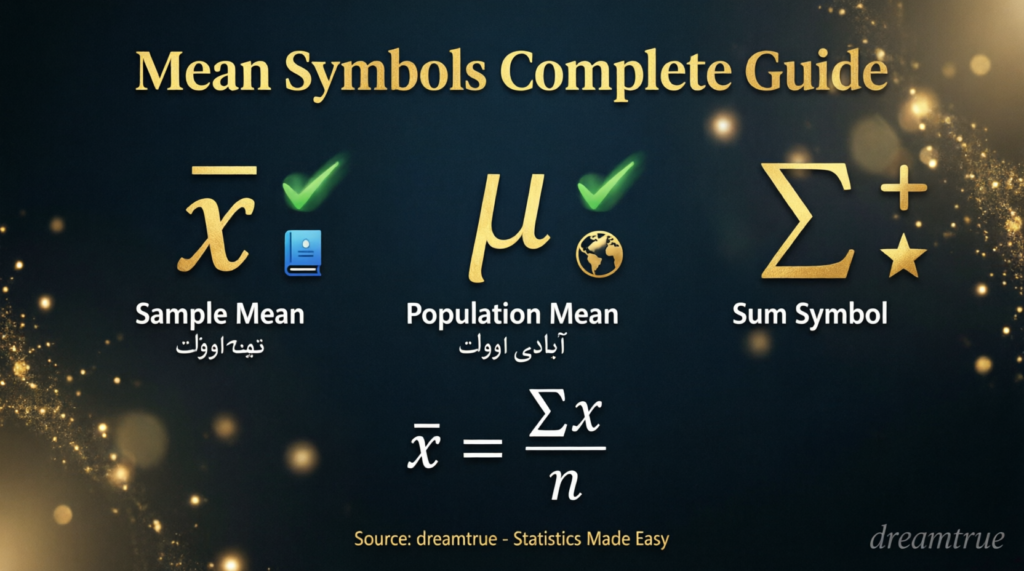
If you’ve ever studied mathematics, statistics, or data analysis, you’ve probably seen symbols like x̄ (x-bar) or μ (mu) and wondered what they mean. These symbols represent the mean, commonly known as the average, but each has a different purpose depending on the type of data being analysed.
Whether you’re a student, researcher, teacher, or simply curious, understanding the symbol for mean makes it much easier to read formulas, solve statistical problems, and interpret data correctly.
In this guide, you’ll learn what each mean symbol represents, when to use it, how to calculate the mean, common mistakes to avoid, and the differences between sample and population means.
Featured Snippet
The symbol for mean depends on the type of data. x̄ (x-bar) represents the sample mean, while μ (Greek letter mu) represents the population mean. Both symbols describe the average value of a set of numbers, but they apply to different statistical situations.
What Is the Mean?
The mean is the arithmetic average of a group of numbers.
To find it:
- Add all values together.
- Divide the total by the number of values.
Formula
Mean = Sum of all values ÷ Number of values
Example:
Data:
2, 4, 6, 8
Mean
= (2 + 4 + 6 + 8) ÷ 4
= 20 ÷ 4
= 5
What Is the Symbol for Mean?
Different symbols represent different kinds of means.
| Symbol | Name | Meaning | Used For |
|---|---|---|---|
| x̄ | x-bar | Sample mean | Statistics |
| μ | Mu | Population mean | Statistics |
| M | Mean | General average (sometimes) | Psychology & research papers |
| Average | Plain language | Arithmetic mean | Everyday use |
The two most important symbols are x̄ and μ.
x̄ (X-Bar): Sample Mean
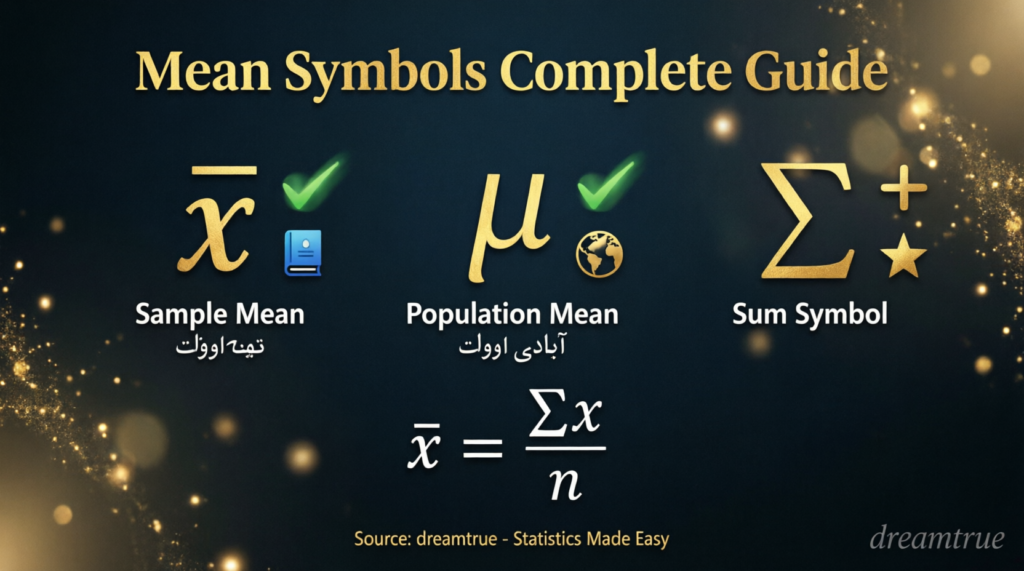
The symbol x̄ is pronounced:
“x bar”
It represents the average of a sample, not the entire population.
Example
Suppose a teacher selects 10 students from a school of 2,000 students.
The average marks of these 10 students are represented as:
x̄ = 82
Since only a sample was used, x̄ is the correct symbol.
Formula for Sample Mean
xˉ=n∑x
Where:
- x̄ = sample mean
- Σx = sum of observations
- n = sample size
Example:
Marks:
70, 80, 90
x̄
= (70 + 80 + 90) ÷ 3
= 80
μ (Mu): Population Mean
The Greek letter μ (mu) represents the population mean.
A population includes every member of the group being studied.
Example:
A company calculates the average salary of all 500 employees.
This average is written as:
μ = £38,000
Because the calculation includes everyone, μ is the correct symbol.
Formula for Population Mean
μ=N∑X
Where:
- μ = population mean
- ΣX = total of all values
- N = population size
Difference Between x̄ and μ
| Feature | x̄ | μ |
|---|---|---|
| Represents | Sample mean | Population mean |
| Uses | Sample data | Entire population |
| Common in | Statistical analysis | Probability & statistics |
| Known exactly? | Calculated from a sample | Usually unknown unless the whole population is measured |
Why Are There Different Mean Symbols?
Statistics separates samples from populations because researchers often cannot measure every individual.
For example:
- Surveying 500 voters out of 50 million uses x̄.
- Measuring every voter would produce μ.
This distinction helps ensure statistical methods are applied correctly.
Mean Formula Explained Step by Step
Suppose the numbers are:
12, 18, 20, 25, 30
Step 1
Add them.
12 + 18 + 20 + 25 + 30 = 105
Step 2
Count the numbers.
There are 5 values.
Step 3
Divide.
105 ÷ 5 = 21
Mean = 21
Different Types of Mean
The word “mean” can refer to several mathematical averages.
| Type | Description | Best Used For |
|---|---|---|
| Arithmetic Mean | Sum divided by count | Most common datasets |
| Geometric Mean | Multiplies values, then takes the root | Growth rates and finance |
| Harmonic Mean | Reciprocal-based average | Speeds, rates, and ratios |
| Weighted Mean | Some values have greater importance | Grades, investments, surveys |
Unless stated otherwise, mean usually refers to the arithmetic mean.
Why Is the Mean Important?
The mean helps us:
- Summarise large datasets.
- Compare groups.
- Analyse trends.
- Make predictions.
- Support research and decision-making.
It is widely used in:
- Education
- Medicine
- Business
- Economics
- Psychology
- Engineering
- Sports analytics
- Machine learning
Mean vs Median vs Mode
| Measure | Meaning | Best For |
|---|---|---|
| Mean | Average of all values | Balanced datasets |
| Median | Middle value | Data with outliers |
| Mode | Most frequent value | Categorical or repeated values |
Example
Numbers:
2, 3, 4, 5, 100
- Mean = 22.8
- Median = 4
- Mode = None
The large value (100) pulls the mean upwards, showing why the median can sometimes be a better measure of centre.
Common Places You’ll See Mean Symbols
You may encounter x̄ or μ in:
- Statistics textbooks
- Scientific journals
- Research papers
- University assignments
- Excel reports
- SPSS output
- R programming
- Python data analysis
- Machine learning models
- Quality control charts
Common Mistakes People Make
Avoid these frequent errors:
- Confusing x̄ with μ.
- Forgetting to divide by the total number of values.
- Using the mean when extreme outliers distort the data.
- Assuming “average” always means the arithmetic mean in every context.
Practical Examples
Example 1: Student Marks
Marks:
80, 90, 75, 85, 70
Mean:
(80 + 90 + 75 + 85 + 70) ÷ 5
= 80
Example 2: Monthly Sales
Sales:
£400, £450, £500, £550
Mean:
£475
Example 3: Daily Temperatures
18°C
20°C
22°C
24°C
26°C
Mean:
22°C
Symbol for Mean in Different Fields
| Field | Symbol Commonly Used |
|---|---|
| Statistics | x̄, μ |
| Mathematics | Mean or Average |
| Economics | x̄, μ |
| Psychology | M, x̄ |
| Scientific Research | x̄, μ |
| Data Science | x̄, μ |
Frequently Asked Questions
What is the symbol for the mean?
The two primary symbols are x̄ (sample mean) and μ (population mean).
Is average the same as mean?
Usually, yes. In everyday language, “average” most often refers to the arithmetic mean. In statistics, however, “average” can also refer to the median or mode depending on the context.
What does x̄ mean?
It represents the average value calculated from a sample.
What does μ stand for?
It represents the true average of an entire population.
Is x̄ always an estimate?
Yes. Because it is based on a sample, x̄ is generally used as an estimate of the population mean (μ).
Which symbol is used in school mathematics?
Most school mathematics uses the word mean or average. More advanced statistics courses introduce x̄ and μ.
Quick Summary
| Topic | Key Point |
|---|---|
| Sample mean | x̄ |
| Population mean | μ |
| Basic formula | Sum of values ÷ Number of values |
| Most common type | Arithmetic mean |
| Used in | Statistics, science, research, business, education |
Key Takeaways
- The symbol for mean depends on the dataset being analysed.
- x̄ (x-bar) represents the sample mean.
- μ (mu) represents the population mean.
- The mean is calculated by dividing the sum of all values by the number of observations.
- Understanding the distinction between x̄ and μ is essential for correctly interpreting statistical results, conducting research, and analysing data.
By mastering these symbols and their uses, you’ll be better equipped to understand mathematical formulas, academic papers, and real-world data analysis.

Zayan is the creator and lead writer at DreamETrue, a blog dedicated to exploring the fascinating world of dreams and their meanings. With a passion for dream symbolism, spiritual insights, and easy-to-understand explanations, Zayan creates well-researched content that helps readers better understand the messages and emotions behind their dreams.
Every article published on DreamETrue is written with a focus on accuracy, clarity, and reader value. By combining information from trusted sources, cultural perspectives, and psychological interpretations, Zayan aims to make dream-related topics simple, engaging, and accessible for everyone.
Whether you’re curious about a recurring dream, searching for the meaning of a specific symbol, or simply interested in learning more about dreams, Zayan’s goal is to provide helpful, reliable, and easy-to-read content that informs and inspires.