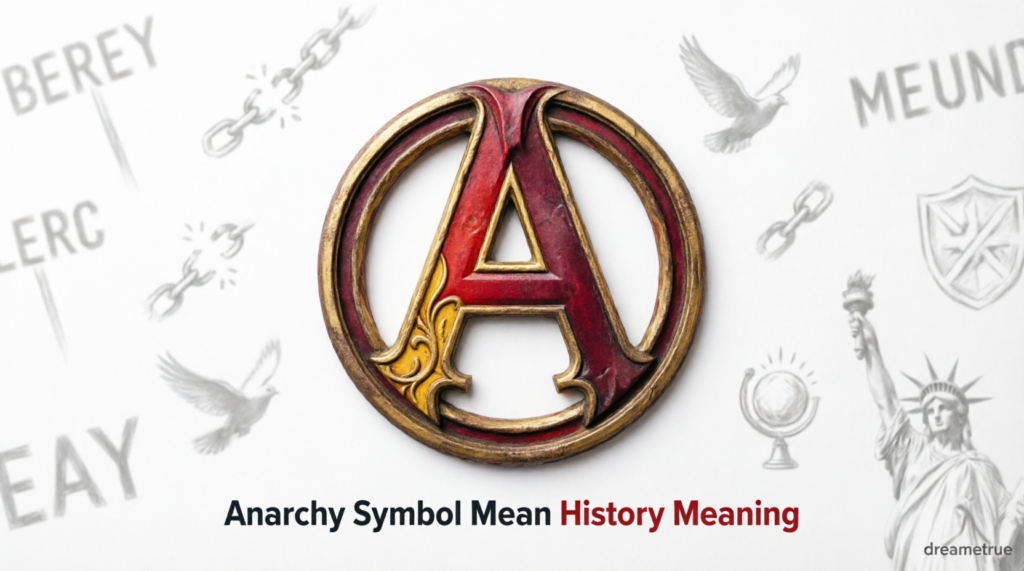
You’ve probably seen the anarchy symbol Ⓐ spray-painted on a wall, printed on a punk T-shirt, used on a protest sign, or displayed online. It’s one of the most recognizable political symbols in modern culture—but what does it actually mean?
For some people, Ⓐ represents freedom and resistance to authority. For others, it immediately suggests chaos, rebellion, or destruction. The truth is more nuanced. The symbol is closely connected to anarchism, a political and philosophical tradition that questions coercive authority and explores how people might organize society without a centralized ruling authority.
So, what does the anarchy symbol mean, where did it come from, and why has it become so popular? This guide explains its history, symbolism, cultural associations, common misconceptions, and modern uses.
Featured Snippet: What Does the Anarchy Symbol Mean?
The anarchy symbol Ⓐ, also called the circled A, is a symbol of anarchism. It generally represents opposition to authoritarian or coercive rule, individual freedom, self-organization, and resistance to imposed hierarchy. Although the symbol is often associated with chaos or rebellion, anarchism does not simply mean disorder or destruction.
What Is the Anarchy Symbol?
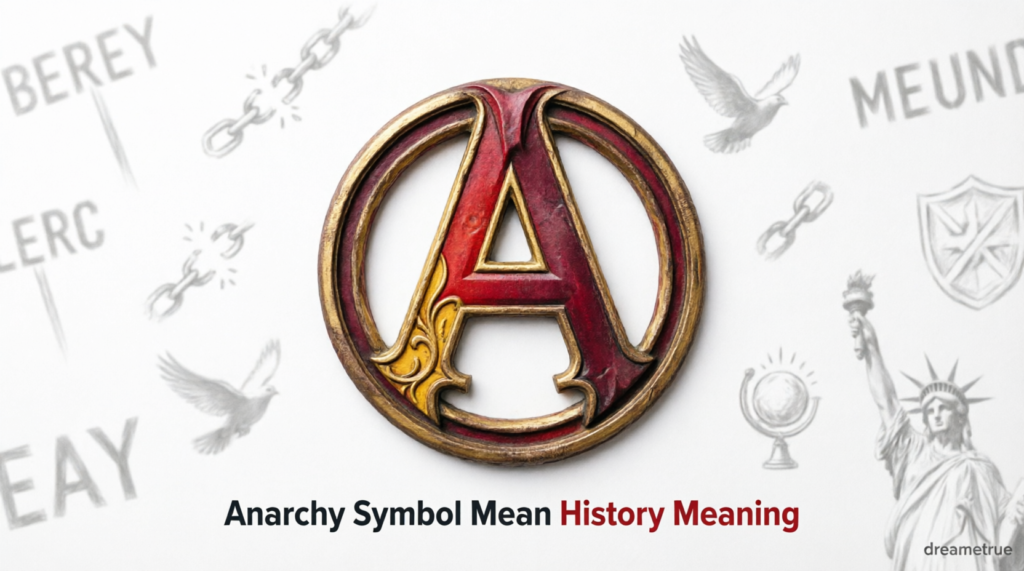
The anarchy symbol is usually drawn as a capital letter A surrounded by a circle:
Ⓐ
It is commonly called:
- The anarchy symbol
- The anarchist symbol
- The anarchist A
- The circled A
- Circle-A
- A in a circle
- Anarchist circle A
The symbol represents anarchism, although its meaning can vary depending on who is using it and the context in which it appears.
At its most basic level, it identifies with an idea of society that rejects imposed, authoritarian rule and emphasizes voluntary organization, autonomy, and freedom.
Importantly, anarchy and anarchism aren’t necessarily synonymous with chaos.
The everyday use of “anarchy” often describes a situation in which there is disorder or no effective control. Political anarchist thought is more specific. It has traditionally explored whether people can organize social life without a coercive state or centralized authority.
Quick answer: Ⓐ usually means anarchism, not simply “chaos.”
What Does the Ⓐ Symbol Stand For?
The circled A is most commonly associated with several ideas.
1. Opposition to authoritarian authority
Anarchist traditions generally question systems in which people are subjected to centralized or coercive authority.
That doesn’t automatically mean opposition to every rule, agreement, or form of organization. Different anarchist traditions have proposed different ways of organizing communities and relationships.
2. Individual freedom
Freedom is a major theme in anarchist philosophy.
The symbol can therefore represent the idea that individuals should have greater control over their own lives rather than being dominated by institutions or authorities.
3. Self-organization
An important part of anarchist thought is the possibility of people cooperating voluntarily rather than relying on hierarchical government structures.
That can include concepts such as:
- Mutual aid
- Voluntary association
- Community organization
- Worker organization
- Horizontal decision-making
- Direct participation
- Autonomy
4. Resistance
In modern culture, Ⓐ is frequently used as a visual shorthand for resistance to established authority or the status quo.
This is one reason it appears in protest art, graffiti, underground publications, music, and alternative subcultures.
5. Anarchism itself
Sometimes the symbol has no complicated hidden message.
Someone may simply use Ⓐ to say:
“I identify with anarchism.”
The surrounding context is important.
Does the Anarchy Symbol Mean Chaos?
Not necessarily.
This is probably the biggest misconception surrounding the symbol.
In everyday English, “anarchy” is commonly used to describe a breakdown of order. Political anarchism, however, has a much richer intellectual history.
Anarchist thinkers have proposed forms of social organization based on voluntary cooperation rather than authoritarian government. Encyclopedia.com notes that reducing anarchism to chaos obscures the diversity of anarchist political thought.
In other words:
| Popular interpretation | Political meaning |
|---|---|
| Chaos | Opposition to imposed authority |
| Disorder | Alternative forms of social organization |
| Destruction | Resistance to coercive institutions |
| Lawlessness | Rejection of certain forms of centralized authority |
| Violence | Not a universal requirement of anarchism |
| Rebellion | Resistance to hierarchy or domination |
This distinction matters because anarchism has never represented one single political program.
Different anarchist thinkers and movements have disagreed about economics, religion, violence, organization, community life, and many other subjects.
The History of the Anarchy Symbol
The symbol looks ancient, but its modern history is surprisingly recent.
The circled A as a recognizable anarchist symbol emerged in the 1960s, rather than during the nineteenth-century origins of anarchist political thought. Historical research places an important documented appearance in Paris in April 1964, when the Jeunes Libertaires group presented the symbol in its bulletin as a proposed common sign for the anarchist movement.
The original proposal was practical as well as symbolic.
The group wanted a simple mark that could:
- Be drawn quickly
- Make anarchist messages more recognizable
- Work across different anarchist tendencies
- Give the movement a common visual identity
That helps explain why the symbol was so effective.
A simple A inside a circle could be drawn almost anywhere.
Who Created the Anarchy Symbol?
The modern circled-A is associated with Tomás Ibáñez and the Paris Jeunes Libertaires group, with the design graphically rendered by René Darras.
The first documented appearance is on the cover of the April 1964 issue of the Bulletin des Jeunes Libertaires.
The important point is that the symbol wasn’t invented as an ancient mystical sign.
It was deliberately proposed as a simple, recognizable symbol for anarchism.
A historical complication
The history isn’t completely free of competing claims.
The Alliance Ouvrière Anarchiste has also claimed earlier use of a circled-A-style mark in internal correspondence during the 1960s. The Centro studi libertari notes this claim while distinguishing it from the 1964 Paris proposal that became internationally influential.
So the safest historical conclusion is:
The modern circled-A became established as a general anarchist symbol through developments in France and Italy during the 1960s, with the April 1964 Paris publication providing a particularly well-documented starting point.
How Did the Circled A Become Famous?
The symbol didn’t become globally recognizable overnight.
After its appearance in Paris, it began spreading through anarchist networks.
By the late 1960s, anarchist youth groups in Milan were using the symbol more regularly. It subsequently spread throughout Italy, France, and eventually other countries.
The social upheavals of the late 1960s also provided an environment in which radical political symbols could spread rapidly.
Later, the symbol became strongly associated with punk and underground music culture.
That’s why many people who have never studied anarchist philosophy still recognize Ⓐ.
Why Is the Anarchy Symbol Associated With Punk?
The connection between Ⓐ and punk is one of the most important parts of its modern cultural history.
Punk culture embraced imagery associated with:
- Anti-authoritarianism
- DIY culture
- Rebellion
- Anti-establishment politics
- Individual expression
- Social criticism
The circled A fit naturally into this visual language.
It was also extremely easy to reproduce.
A person didn’t need a printing press or sophisticated design software. A marker, spray can, pen, or paintbrush was enough.
As a result, the symbol appeared on:
- Album artwork
- Jackets
- Posters
- Flyers
- Graffiti
- Concert merchandise
- Zines
- Protest signs
- Tattoos
The symbol therefore moved beyond strictly political circles and became part of a broader alternative aesthetic.
Does the Circle Mean “Order”?
This is where the history gets especially interesting.
You may have heard the explanation that:
A = Anarchy
Circle/O = Order
Therefore:
Ⓐ = “Anarchy is Order.”
This interpretation is widely repeated in discussions of the symbol. It connects the design with the famous anarchist idea that anarchy does not necessarily mean chaos.
However, there’s an important historical qualification.
The idea that the circle was deliberately designed as an “O” for “Order” is not securely established as the original intention of the symbol’s creators.
Historical accounts associated with Tomás Ibáñez indicate that the 1964 Paris group was primarily interested in creating a simple, broadly usable visual identifier for anarchism.
So it’s better to distinguish between two things:
| Interpretation | Status |
|---|---|
| Ⓐ represents anarchism | Well established |
| A stands for anarchism/anarchy | Common and straightforward interpretation |
| Circle represents “Order” | Popular interpretation |
| Ⓐ was originally designed specifically to mean “Anarchy is Order” | Historically disputed |
This distinction is important if you’re looking for the historically accurate meaning rather than a popular explanation.
What Does “Anarchy” Actually Mean?
The word anarchy comes from a Greek root associated with the absence of a ruler or master.
That historical meaning is different from the modern everyday use of “anarchy” as a synonym for complete chaos.
Anarchist thinkers developed political theories around the question of whether society could exist without centralized coercive government.
Pierre-Joseph Proudhon was particularly important in the development of modern anarchist thought and famously used the term “anarchist” to describe his political position in the nineteenth century.
Over time, anarchism developed into multiple traditions rather than one unified ideology.
Is Anarchism the Same as Lawlessness?
No.
This is another common misunderstanding.
Anarchism generally challenges authority and coercion, but that doesn’t mean every anarchist believes people should behave without any agreements or social norms.
Different anarchist traditions have imagined societies based on voluntary cooperation, mutual aid, federations, worker organizations, or other forms of collective decision-making.
Therefore, saying:
“Anarchism means everyone can do whatever they want.”
is an oversimplification.
Anarchist philosophy contains substantial debates about responsibility, cooperation, community, economics, and social organization.
What Does the Anarchy Symbol Mean in Politics?
In political contexts, Ⓐ can communicate opposition to:
- Authoritarianism
- Centralized political power
- Coercive hierarchy
- State authority
- Certain forms of capitalism
- Institutional domination
However, not every person who uses the symbol agrees on all of these issues.
That’s because anarchism contains many different schools of thought.
For example, anarcho-communists, anarcho-syndicalists, individualist anarchists, and other anarchist traditions can have significantly different views.
Therefore, the symbol identifies a broad political tradition more reliably than it identifies one specific political program.
What Does the Anarchy Symbol Mean in Punk Culture?
In punk culture, Ⓐ can have a broader meaning than strict political anarchism.
Someone wearing it may be communicating:
- “I reject authority.”
- “I don’t follow the mainstream.”
- “I support rebellion.”
- “I value independence.”
- “I support DIY culture.”
- “I’m anti-establishment.”
In some cases, it may simply be an aesthetic reference to punk history.
That’s why context matters.
A circled A on an academic political poster and a circled A on a vintage punk jacket don’t necessarily communicate exactly the same thing.
What Does the Anarchy Symbol Mean in Graffiti?
Graffiti is another place where the symbol is commonly seen.
A circled A can function as a quick political statement, an anarchist identifier, or an anti-authoritarian piece of street art.
Its simplicity makes it especially suitable for graffiti.
A person can draw it in seconds, and the meaning is recognizable in many countries.
That visual simplicity is one reason the symbol has survived across generations.
What Does the Anarchy Symbol Mean in Tattoos?
An Ⓐ tattoo can have many personal meanings.
Common interpretations include:
- Freedom
- Independence
- Rebellion
- Anti-authoritarianism
- Individuality
- Resistance
- Punk identity
- Anarchist political beliefs
- Rejection of social expectations
But there is no universal personal meaning.
Two people can have the same tattoo while attaching completely different ideas to it.
If you’re considering an anarchy symbol tattoo, the safest interpretation is the one you personally intend rather than assuming everyone will understand it identically.
What Does a Black Anarchy Symbol Mean?
A black Ⓐ usually has the same basic symbolic meaning as the standard circled A: anarchism or anti-authoritarianism.
Black is particularly significant within anarchist visual culture because the black flag has a long association with anarchism. The black flag predates the circled A by many decades.
However, color can also be purely aesthetic.
A black circled A doesn’t automatically indicate a particular anarchist faction.
What Does a Red Anarchy Symbol Mean?
A red Ⓐ can still simply mean anarchism.
However, red has historically been strongly associated with revolutionary socialist and labor movements. In some contexts, combining anarchist imagery with red can suggest a particular anarchist tendency or political emphasis.
For example, red-and-black imagery is commonly associated with anarcho-syndicalist and anarchist-communist traditions.
Still, don’t assume that every red circled A represents a specific political faction.
Context is essential.
Anarchy Symbol vs. Chaos Symbol
People sometimes search for the “chaos symbol” when they actually mean the anarchist symbol.
They’re not the same thing.
| Symbol/concept | General association |
|---|---|
| Ⓐ Circled A | Anarchism |
| Black flag | Anarchist tradition |
| Chaos symbol | Chaos magic / popular occult imagery |
| ☮ Peace symbol | Peace movement |
| ✊ Raised fist | Solidarity/resistance |
| ⚒ Hammer and sickle | Communist symbolism |
The circled A specifically identifies with anarchism.
It isn’t simply a universal symbol for disorder.
Is the Anarchy Symbol Religious?
No.
The circled A is primarily a political and philosophical symbol, not a religious symbol.
Anarchists themselves have held different views about religion. Some anarchist thinkers were strongly anti-religious, while other people with anarchist politics have been religious or spiritually motivated.
Therefore, it’s inaccurate to assign one universal spiritual meaning to Ⓐ.
Does the Anarchy Symbol Have a Spiritual Meaning?
There is no single established spiritual meaning.
An individual may interpret the symbol spiritually as representing:
- Personal freedom
- Liberation
- Independence
- Breaking away from imposed beliefs
- Inner autonomy
- Resistance to domination
Those are personal or philosophical interpretations, rather than a standardized religious meaning of the symbol.
If someone tells you that Ⓐ has one universal mystical meaning, that’s not supported by the symbol’s documented history.
Does the Anarchy Symbol Have a Biblical Meaning?
There is no standard biblical meaning for the circled A.
The Bible predates the modern anarchist movement by many centuries, and the modern circled-A symbol emerged in twentieth-century anarchist political culture.
Therefore, claims that the Ⓐ symbol has a specific biblical origin should be treated cautiously.
Some Christians may interpret anarchism through their own theological framework, but that is different from saying the symbol itself has an established biblical meaning.
What Does the Anarchy Symbol Mean Psychologically?
There isn’t one scientifically established psychological meaning for seeing or wearing Ⓐ.
However, symbols can acquire personal and cultural associations.
Someone may associate the circled A with:
- Freedom
- Defiance
- Identity
- Independence
- Nonconformity
- Group belonging
- Rebellion
These associations can be shaped by someone’s political beliefs, social environment, music preferences, personal experiences, or exposure to protest culture.
So psychology can help explain why people connect emotionally with symbols, but it shouldn’t be used to claim that every person who uses Ⓐ has the same personality.
Is the Anarchy Symbol Always Political?
No.
It originated as a political symbol, but its modern use is broader.
You might see Ⓐ used:
- Politically
- In punk culture
- In fashion
- In music
- In graffiti
- In artwork
- In tattoos
- In online communities
- As a general symbol of rebellion
The meaning depends heavily on context.
A teenager wearing an Ⓐ patch may be expressing political anarchism—or may simply be interested in punk culture.
Why Is the Anarchy Symbol So Simple?
The simplicity is actually part of its strength.
The 1964 proposal was intended to provide anarchists with a recognizable symbol that was practical for public writing and visual communication.
The design has several advantages:
- It’s easy to draw.
- It’s easy to recognize.
- It works at different sizes.
- It doesn’t require complicated artwork.
- It can be reproduced without expensive equipment.
- It works across languages because the letter A is visually recognizable.
- It can be incorporated into posters, clothing, graffiti, and digital graphics.
In other words, the design itself helped the symbol spread.
The Anarchy Symbol in Digital Culture
Today, the symbol appears online just as it once appeared on walls and posters.
People may use Ⓐ in:
- Usernames
- Social media profiles
- Digital artwork
- Forums
- Political discussions
- Music communities
- Gaming communities
- Memes
- Personal bios
The digital version is often used as a shorthand for anti-authoritarian or rebellious identity.
But, again, context matters.
Online symbolism can be ironic, aesthetic, political, or simply part of a subculture.
What Is the Unicode Anarchy Symbol?
There’s an important technical detail.
The character Ⓐ is Unicode’s CIRCLED LATIN CAPITAL LETTER A, U+24B6.
It wasn’t created exclusively as an “anarchy character.” Instead, the anarchist movement adopted a general circled-letter character that visually resembles the familiar symbol.
This is why digital versions can look slightly different from hand-drawn anarchist symbols.
For example:
Ⓐ
may look cleaner and more standardized than:
A inside a hand-drawn circle
The familiar anarchist graphic can also be drawn in many different styles.
How to Type the Anarchy Symbol Ⓐ
If you want to copy it, here it is:
Ⓐ
You can copy and paste that character into:
- Social media posts
- Documents
- Messages
- Website content
- Usernames where supported
- Graphic-design software
Remember that the Unicode character is technically a circled Latin capital A rather than a special Unicode code point exclusively dedicated to anarchism.
Common Myths About the Anarchy Symbol
Myth 1: The symbol is thousands of years old
False.
The modern circled-A has a documented twentieth-century history, with the influential Paris version appearing in 1964.
Anarchist political ideas are much older than the symbol itself.
Myth 2: It was invented during the Spanish Civil War
Not according to the strongest documented history of the modern symbol.
The circled A is sometimes mistakenly connected to photographs from the Spanish Civil War. Historical research into the symbol’s origin instead places its modern emergence in Paris in 1964, with later development in Milan.
Myth 3: The circle definitely means “order”
That’s an interpretation, not an established fact about the original design.
The “A for anarchy inside O for order” explanation is widespread, and it connects naturally with the anarchist argument that anarchy need not mean chaos.
But historical accounts of the symbol’s creation indicate that this was not necessarily the designers’ original intention.
Myth 4: Anarchists believe in total chaos
False.
Anarchist philosophy contains extensive discussion of cooperation, organization, mutual aid, voluntary association, and social structure.
The assumption that anarchism simply means chaos is a common oversimplification.
Myth 5: Anyone using Ⓐ supports violence
False.
Anarchist traditions have included both violent revolutionary currents and nonviolent, pacifist, communal, and other approaches.
The symbol alone doesn’t tell you what methods or political positions an individual supports.
Anarchy Symbol vs. Anarchism: What’s the Difference?
The distinction is simple:
Anarchism is the political and philosophical tradition.
Ⓐ is one of its most recognizable visual symbols.
Think of it like this:
| Term | Meaning |
|---|---|
| Anarchism | A broad political/philosophical tradition |
| Anarchy | A term historically associated with absence of rulers; commonly used today to mean disorder |
| Anarchist | A person who identifies with anarchism |
| Ⓐ | A widely recognized symbol associated with anarchism |
| Circled A | Another name for Ⓐ |
Why Do People Use the Anarchy Symbol?
People use the symbol for very different reasons.
Political reasons
They may genuinely identify with anarchist political philosophy.
Cultural reasons
They may associate it with punk, underground music, or alternative culture.
Personal reasons
They may see it as a symbol of independence or resistance.
Artistic reasons
The symbol is visually simple and recognizable, making it useful in graphic design.
Historical reasons
Some people use it to reference anarchist movements and political history.
This is why you shouldn’t automatically judge someone’s political beliefs based on a single symbol without considering the surrounding context.
What Does the Anarchy Symbol Mean on Clothing?
On clothing, Ⓐ can represent anything from explicit anarchist politics to a general punk or rebellious aesthetic.
For example:
An Ⓐ patch on a political protest jacket may have a direct political meaning.
An Ⓐ printed on a punk band’s shirt may reference anarchist punk culture.
An Ⓐ used in fashion photography might simply be an aesthetic choice.
The symbol has accumulated several layers of cultural meaning over time.
What Does the Anarchy Symbol Mean in a Relationship?
There is no established relationship-specific meaning for Ⓐ.
If someone sends or uses the symbol in a personal conversation, its meaning depends on their context.
They could be talking about:
- Freedom
- Independence
- Rebellion
- Anti-authoritarian beliefs
- Punk culture
- Politics
- A personal philosophy
There’s no universal romantic or relationship meaning attached to the symbol.
What Does the Anarchy Symbol Mean in Texting?
In texting, Ⓐ usually means anarchism or rebellion, especially if the conversation involves politics, punk culture, protest movements, or anti-authoritarian ideas.
However, because the symbol is sometimes used decoratively, context matters.
If someone sends you:
“Ⓐ”
by itself, you can’t reliably determine their exact intended message without knowing the surrounding conversation.
What Does the Anarchy Symbol Mean in Different Cultures?
The symbol is internationally recognizable, but its associations can vary.
In some places, it is strongly associated with political anarchist movements.
In others, it may be more closely connected with punk music and youth subculture.
It can also appear in protest movements, independent media, artistic communities, and activist spaces.
The basic political association remains anarchism, but the cultural meaning can change according to location and context.
Is the Anarchy Symbol a Hate Symbol?
The circled A is not inherently a hate symbol.
Its primary historical association is with anarchism.
However, virtually any political symbol can potentially be used by individuals or groups in different contexts. A symbol’s meaning should therefore be evaluated based on who is using it, what else appears alongside it, and what message is being communicated.
The circled A itself is not equivalent to a hate symbol simply because it represents a radical political tradition.
Is the Anarchy Symbol Dangerous?
A symbol itself isn’t physically dangerous.
The important issue is the meaning and context attached to it.
Ⓐ can represent a political ideology, artistic identity, protest message, or cultural affiliation.
Like other political symbols, it can generate strong reactions because it represents ideas about authority, government, freedom, and social organization.
Understanding the symbol is therefore more useful than automatically treating it as either harmless decoration or evidence of dangerous behavior.
What Is the Black Flag Compared With the Circled A?
Both are strongly associated with anarchism, but they have different histories.
The black flag has roots in nineteenth-century anarchist movements and became an important anarchist symbol long before the circled A appeared.
The circled A, by contrast, is a much newer graphic symbol that emerged in the 1960s.
Quick comparison
| Feature | Black Flag | Circled A |
|---|---|---|
| Historical emergence | 19th century | 20th century |
| Main association | Anarchism | Anarchism |
| Easy to draw | Yes | Extremely easy |
| Punk association | Strong | Very strong |
| Political use | Strong | Strong |
| Modern digital use | Common | Very common |
What Does the Anarchy Symbol Really Mean?
If you want the most accurate short explanation, it’s this:
The anarchy symbol Ⓐ represents anarchism and is broadly associated with opposition to authoritarian or coercive authority, individual autonomy, resistance, and alternative forms of social organization.
It does not automatically mean chaos, violence, lawlessness, or destruction.
Its meaning has also expanded through decades of use in punk, protest, art, fashion, graffiti, and popular culture.
And while the popular “A inside O means Anarchy in Order” explanation is memorable, historical evidence suggests that this wasn’t necessarily the original intention behind the 1964 design.
Frequently Asked Questions About the Anarchy Symbol
What does the anarchy symbol Ⓐ mean?
It is the most recognizable modern symbol of anarchism. It commonly represents opposition to authoritarian authority, autonomy, resistance, and voluntary or decentralized forms of social organization.
What does A in a circle mean?
A capital A inside a circle, Ⓐ, is commonly known as the circled A and is strongly associated with anarchism.
Does the anarchy symbol mean chaos?
Not necessarily. Political anarchism is not simply a philosophy of chaos. It includes theories about voluntary cooperation, self-organization, and societies without centralized coercive authority.
Who invented the anarchy symbol?
The modern influential circled A was proposed by the Jeunes Libertaires group in Paris in April 1964, associated with Tomás Ibáñez and graphically rendered by René Darras.
When was the circled A invented?
The best-documented modern version appeared in April 1964 in Paris. It later gained wider adoption, particularly in Italy during the late 1960s.
Does the circle mean order?
That’s a popular interpretation connecting the design to “Anarchy is Order,” but historical accounts indicate that this wasn’t necessarily the original intention of the designers.
Is the anarchy symbol a religious symbol?
No. It is primarily a political and philosophical symbol associated with anarchism.
Does the anarchy symbol have a biblical meaning?
No established biblical meaning exists for the modern circled-A symbol.
Why do punks use the anarchy symbol?
The symbol fits punk’s longstanding associations with anti-authoritarianism, rebellion, DIY culture, and opposition to established norms.
What does a black circled A mean?
It generally still means anarchism. Black also has a longstanding association with anarchist visual culture.
What does a red circled A mean?
It can still simply represent anarchism, although red-and-black combinations may signal particular revolutionary or anarchist traditions depending on context.
Is the circled A the same as a chaos symbol?
No. The circled A specifically represents anarchism. “Chaos symbol” can refer to different symbols and traditions.
Is Ⓐ an official anarchist Unicode emoji?
No. Ⓐ is technically the Unicode character CIRCLED LATIN CAPITAL LETTER A (U+24B6) rather than a special Unicode code point created exclusively for anarchism.
Can the anarchy symbol mean freedom?
Yes. Freedom and autonomy are common concepts associated with anarchist thought, so people sometimes use Ⓐ as a personal symbol of freedom or independence.
Final Takeaway
So, what does the anarchy symbol mean?
The Ⓐ circled A is primarily a symbol of anarchism. It represents a broad tradition of political thought associated with opposition to authoritarian or coercive authority, personal autonomy, resistance to domination, and alternative forms of social organization.
Its history is also more recent than many people realize. The modern symbol was publicly proposed in Paris in April 1964, later spread through European anarchist networks, and eventually became globally recognizable through political activism, punk music, graffiti, art, fashion, and popular culture.
The most important thing to remember is that anarchism isn’t simply another word for chaos. The symbol’s meaning is political and philosophical, and different people use it in different ways.
The familiar “A inside a circle means Anarchy in Order” explanation is an interesting interpretation, but it shouldn’t be presented as an unquestionable fact about the symbol’s original design.
In short:
Ⓐ = anarchism, resistance to authoritarian authority, autonomy, and anti-establishment thought—not automatically chaos or violence.
Understanding that distinction makes the symbol much easier to interpret wherever you encounter it.
descover more post
What Does the Diamond Symbol Mean?
What Does the Om Symbol Mean ॐ Meaning History …
Evil Eye Symbol Mean History 🧿 Nazar 2026

Luna Dream is a dream enthusiast and writer dedicated to exploring the meanings, symbols, and stories behind dreams. Through DreamETrue, she shares thoughtful and easy-to-understand insights to help readers discover the fascinating world of dreams.