If you’ve ever seen ॐ or 🕉️ on a yoga mat, temple wall, necklace, tattoo, meditation app, or spiritual artwork, you may have wondered: what does the Om symbol mean?
Om is much more than a decorative symbol. It represents a sacred syllable known as Om or Aum, with deep roots in Indian religious and philosophical traditions. Its meaning changes somewhat depending on the tradition, but it is commonly connected with ultimate reality, consciousness, sacred sound, meditation, and spiritual practice.
The interesting part is that Om isn’t simply a symbol to look at. It can also be spoken, chanted, contemplated, and interpreted philosophically.
So what does Om really mean? Where did it come from? Why is it associated with meditation? And is the popular idea that Om is the “sound of the universe” actually found in ancient texts?
Let’s separate historical teachings from modern interpretations and explore the meaning of this ancient symbol clearly.
What Does the Om Symbol Mean?
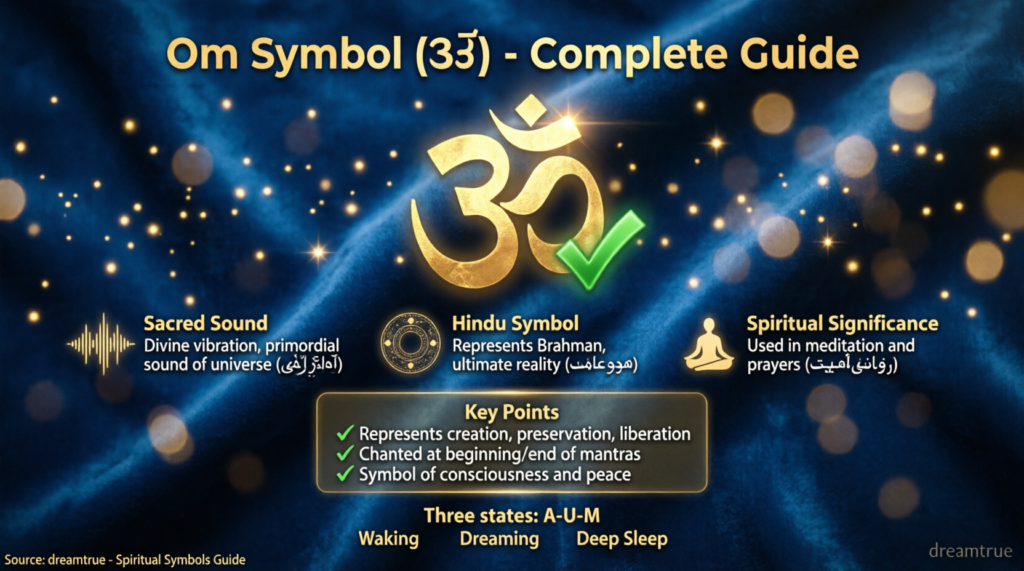
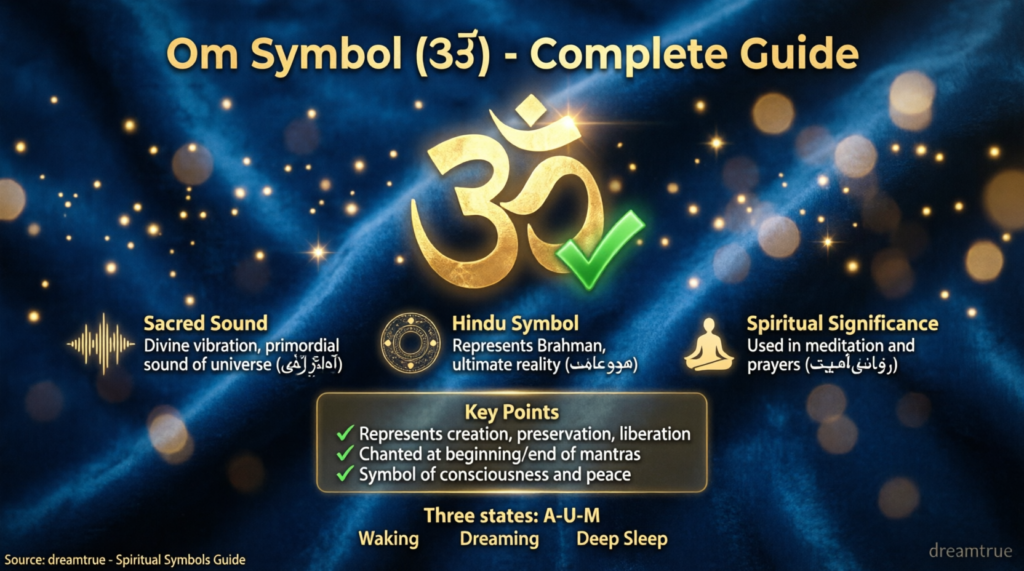
The Om symbol (ॐ or 🕉️) represents the sacred syllable Om, also written Aum, and is especially important in Hindu traditions. It is associated with ultimate reality, consciousness, and the totality of existence. In the Mandukya Upanishad, Om is connected with the Self and four states of consciousness. It is also used in Buddhist and Jain traditions, although its meaning differs by tradition.
Quick meaning of Om
| Question | Short answer |
|---|---|
| What is Om? | A sacred syllable and spiritual symbol |
| How is it written? | ॐ or 🕉️ |
| Is Om also called Aum? | Yes |
| What does it symbolize? | Ultimate reality, consciousness, sacred sound, and wholeness |
| Which religion uses Om? | Primarily Hindu traditions, with important uses in Buddhism and Jainism |
| Is Om the same as the Ohm symbol? | No |
| Is Om mentioned in the Bible? | No; it originates in Indian religious traditions |
| Is Om only a symbol? | No. It is also a syllable/mantra used in religious and contemplative practice |
What Is Om or Aum?
Om is commonly transliterated from Sanskrit as Oṃ or Aum.
The word can be understood in two connected ways:
- Om as a sacred sound or syllable
- ॐ as a written symbol representing that sound
This distinction matters.
The sound is Om/Aum, while ॐ is a written form used to represent it. The emoji 🕉️ is a Unicode symbol based on the Om symbol. Unicode lists 🕉️ as “Om Symbol” and links it with the Devanagari ॐ.
In Hindu philosophical traditions, Om can carry an exceptionally broad meaning. It isn’t merely the name of a particular deity or object. It is used as a way of pointing toward Brahman, the ultimate reality, and toward the nature of the Self or Atman, depending on the philosophical context.
What Does AUM Mean?
A common explanation divides AUM into three sounds:
A + U + M
These aren’t simply three ordinary letters. In the Mandukya Upanishad, the syllable is examined through its components and related to different states of consciousness.
A simplified interpretation is:
- A — waking consciousness
- U — dreaming consciousness
- M — deep sleep
- Silence after the sound — the fourth state, traditionally called Turiya
This is one of the most important philosophical interpretations of Om.
The four parts of AUM
| Part | Associated state | Basic idea |
|---|---|---|
| A | Waking | Awareness of the external world |
| U | Dreaming | Inner or dream consciousness |
| M | Deep sleep | Consciousness without ordinary dream experience |
| Silence | Turiya | The transcendent “fourth” beyond the three states |
The Mandukya Upanishad is particularly important because it directly explores Om through these four aspects of consciousness.
That means the meaning of Om goes deeper than the popular phrase “universal vibration.” In this philosophical framework, Om acts almost like a map of consciousness.
What Does the Om Symbol Look Like?
The traditional Devanagari form is:
ॐ
The familiar emoji version is:
🕉️
They are closely related, but they aren’t simply two unrelated symbols.
Unicode identifies 🕉️ as the “Om Symbol” and associates it with the Devanagari Om character ॐ. The emoji was added to Unicode’s emoji repertoire after being encoded as a symbol.
You’ll also encounter Om written as:
- Om
- Aum
- Oṃ
- Omkara
- Pranava
These terms aren’t always interchangeable in every scholarly or religious context, but they’re commonly associated with the same sacred syllable.
What Does the Om Symbol Mean in Hinduism?
Hindu traditions give Om some of its deepest and oldest philosophical interpretations.
Om is frequently associated with Brahman, the ultimate reality, and Atman, the Self. The Mandukya Upanishad famously makes Om the central subject of its teaching and connects it with the totality of experience and consciousness.
In this context, Om can symbolize:
- Ultimate reality
- The Self
- Consciousness
- The totality of existence
- The relationship between the individual Self and ultimate reality
- Sacred knowledge
- Meditation and contemplation
Is Om the “sound of God”?
That’s a common modern description, but it needs some qualification.
In Hindu philosophical writing, Om can represent or point toward Brahman, which is not simply equivalent to the personal concept of “God” found in every religious tradition.
Therefore, saying “Om means God” is an oversimplification.
A more accurate explanation is that Om is a sacred syllable used to signify or contemplate ultimate reality, particularly in the Upanishadic and Vedantic traditions.
What Does AUM Mean in the Mandukya Upanishad?
The Mandukya Upanishad gives Om a particularly sophisticated philosophical meaning.
It connects the syllable’s components with four aspects of the Self:
- Waking consciousness
- Dream consciousness
- Deep sleep
- Turiya, the fourth state
The first three correspond to A, U, and M. The fourth is associated with what lies beyond or after those sounds—the silence.
This is why the silence after chanting Om is sometimes considered spiritually significant.
The point isn’t simply that “A means creation, U means preservation, and M means destruction.” That is a popular interpretation found in many modern explanations, but the Mandukya Upanishad’s own central framework focuses on the four states of the Self and consciousness.
What Does the Om Symbol Mean Spiritually?
The spiritual meaning of Om depends on the tradition and individual interpretation.
Broadly, it can represent:
Oneness: the idea that reality is ultimately interconnected or unified.
Consciousness: awareness and the nature of the Self.
Transcendence: something beyond ordinary sensory experience.
Wholeness: the totality of existence and experience.
Meditation: a sound used to focus attention and turn awareness inward.
Sacred reality: a verbal and visual representation of ultimate reality in Hindu philosophical traditions.
It’s important to distinguish these religious interpretations from scientific claims. Spiritual traditions may describe Om in metaphysical terms, while science studies measurable effects of practices such as chanting and meditation.
Why Is Om Called the “Primordial Sound”?
You’ve probably seen Om described online as the “primordial sound of the universe.”
This phrase reflects a popular spiritual interpretation of Om, but it shouldn’t be confused with a scientifically established statement that the universe literally began with the audible sound “Om.”
In Hindu philosophical traditions, Om is associated with the fundamental nature of reality and is treated as an especially profound sacred syllable.
That’s a religious and philosophical claim, not a claim established by modern cosmology.
So when someone says:
“Om is the sound of the universe.”
it’s better understood as symbolic or spiritual language, rather than a scientific description of the Big Bang or cosmic physics.
What Does Om Mean in Buddhism?
Om also appears in Buddhist traditions, particularly in Mahayana and Vajrayana Buddhism.
One of the best-known examples is:
Om Mani Padme Hum
This is an extremely famous Buddhist mantra associated with Avalokiteshvara, the bodhisattva of compassion, and is particularly important in Tibetan Buddhism. The mantra is documented in the Kāraṇḍavyūha, a Mahayana text associated with Kashmir and dated to around the late fourth or early fifth century CE.
In Tibetan Buddhist contexts, Om can symbolize or invoke the ultimate nature of reality within the mantra’s broader meaning. PBS’s overview of Tibetan Buddhism, for example, explains Om in this mantra as referring to the ultimate nature of reality.
Important distinction
Om does not have exactly the same meaning in Buddhism that it has in Hindu philosophical traditions.
It’s better to say:
- Hindu traditions often connect Om with Brahman, Atman, consciousness, and ultimate reality.
- Buddhist traditions use Om within particular mantras and ritual contexts.
- The meaning depends on the Buddhist school and the specific mantra.
This distinction prevents the common mistake of treating every Asian religious tradition as if it had one identical interpretation of Om.
What Does Om Mean in Jainism?
Om is also important in Jainism, where it has a distinct religious interpretation.
Jain tradition can use Om as a condensed form referring to the Pañca-Parameṣṭhi, the five supreme beings honored in Jain practice. Unicode documentation also records the importance of Om-related forms in Jain iconography.
This is another reason not to assume that Om has exactly one universal meaning.
Hindu, Buddhist and Jain meanings compared
| Tradition | Common significance of Om |
|---|---|
| Hindu traditions | Ultimate reality, Self, consciousness, sacred syllable |
| Buddhism | Sacred syllable used in mantras, especially Vajrayana/Tibetan contexts |
| Jainism | Condensed reference to the five supreme beings |
| Sikhism | Om-related ideas should not be confused with the distinct Sikh symbol Ik Onkar (ੴ) |
Is Om a Sikh Symbol?
This question deserves careful treatment.
Sikhism has the famous symbol:
ੴ — Ik Onkar
Ik Onkar expresses the Sikh theological concept of the oneness of God.
Although Om and Ik Onkar can both be discussed in relation to spiritual unity or ultimate reality, they are not the same symbol and should not be casually treated as interchangeable.
The Om symbol belongs to a different historical and religious tradition, while Ik Onkar is foundational to Sikh scripture and theology.
What Does the Om Symbol Mean in Yoga?
In modern yoga, Om is frequently used at the beginning or end of a class, during meditation, or as part of mantra practice.
Its use can have several layers:
- A connection to traditional yoga philosophy
- A way of beginning or ending a practice
- A meditation object
- A sacred sound
- A way of bringing attention to breathing
- A symbolic reminder of unity or awareness
However, modern yoga studios don’t all use Om in precisely the same religious way.
Some practitioners use it devotionally. Others approach it as a traditional meditation practice. Some use it simply as a way to focus attention and breathing.
Understanding that difference makes the practice more respectful and less reductive.
What Happens When You Chant Om?
Chanting Om generally involves producing a sustained vocal sound, often represented as:
A-U-M
The sound is commonly extended through a controlled exhalation, followed by a brief period of silence.
From a practical perspective, chanting can combine several things at once:
- Slow breathing
- Sustained vocalization
- Auditory attention
- Repetition
- Concentration
- A short period of silence
That combination can make Om chanting a form of focused contemplative practice.
Does Chanting Om Have Scientific Benefits?
There is some scientific research on Om chanting, but it’s important not to overstate what the evidence proves.
A small fMRI pilot study involving 12 healthy participants found changes in brain activity during Om chanting, including reduced activity in several limbic and related regions. However, the study was small and exploratory, so it doesn’t establish that Om has a unique or universal neurological effect.
A 2022 randomized controlled study involving people with hypertension examined Om chanting combined with Yoga Nidra. The researchers reported improvements in measures including stress, anxiety, sleep quality, and heart-rate variability in the intervention group. Because the intervention combined two practices, the findings can’t be used to attribute all of those effects specifically to Om chanting.
Research on chanting more generally also suggests that group chanting may influence stress and social connection, although the evidence base remains developing.
What science can reasonably say
Research suggests Om chanting may be associated with relaxation and changes in physiological or brain measures.
What research does not establish is that:
- Om is scientifically proven to be the vibration of the universe.
- Om can cure disease.
- Om automatically activates a supernatural energy field.
- Chanting Om produces the same result for everyone.
- Om replaces medical or psychological treatment.
That’s an important E-E-A-T distinction: spiritual belief and scientific evidence aren’t the same type of evidence.
Why Does Om Feel Calming to Some People?
Several ordinary mechanisms may contribute to the calming experience.
Slow breathing
A long vocalized exhalation naturally slows the breathing rhythm.
Focused attention
Repeating one sound can give the mind a simple object to concentrate on.
Vibration and resonance
People can physically feel the humming portion of the sound in the mouth, throat, chest, or head.
Repetition
Repetitive sounds can reduce the number of competing thoughts demanding attention.
Silence
The pause after the sound provides a natural moment of stillness.
These factors can exist alongside a person’s spiritual interpretation of Om.
What Is the Difference Between Om and Aum?
Om and Aum generally refer to the same sacred syllable, but “Aum” makes the three sound components—A, U, and M—more visible in English spelling.
The difference is primarily one of transliteration and pronunciation rather than two completely unrelated symbols.
You’ll commonly see:
- Om
- Aum
- Oṃ
The spelling Aum is especially useful when explaining the philosophical division into A, U, and M.
What Does the Om Symbol Look Like and What Do Its Parts Represent?
People often ask what each visual part of ॐ means.
You may encounter explanations claiming that every curve has a fixed meaning. Some traditional and modern interpretations do associate the visual components with different states of consciousness.
However, these explanations shouldn’t automatically be presented as if the shape has one universally accepted interpretation across all Hindu traditions.
The most firmly established philosophical structure is the relationship between A-U-M, the three states of ordinary consciousness, and Turiya, as discussed in the Mandukya Upanishad.
So if you’re explaining the symbol to someone else, it’s safer to say that the visual form represents the sacred syllable Om, while its deeper philosophical symbolism is explained through the syllable’s sound and associated states of consciousness.
Is Om a Mantra or a Symbol?
It can be both, depending on how you’re using the term.
Om as a sound
Om is a sacred syllable that can be spoken or chanted.
Om as a mantra
It can function as a mantra or object of contemplation in religious and yogic practice.
Om as a symbol
The written form ॐ visually represents the sacred syllable.
This is why you’ll see Om in both textual and visual contexts.
What Does Om Mean in Meditation?
In meditation, Om can function as a focal point.
A practitioner may:
- Sit comfortably.
- Breathe naturally.
- Inhale gently.
- Exhale while slowly chanting “A-U-M.”
- Notice the sound and physical resonance.
- Allow a moment of silence afterward.
- Repeat.
The goal can vary.
For some people, the purpose is spiritual contemplation. For others, it’s concentration, breath awareness, or relaxation.
There is no need to make extraordinary claims about the practice for it to be meaningful.
A Simple Way to Chant Om
If you’d like to experience the practice, keep it simple.
Step 1: Find a comfortable position
Sit somewhere quiet where you won’t be interrupted.
Step 2: Take a natural breath
Don’t force a huge inhalation.
Step 3: Slowly vocalize A-U-M
Let the sound move naturally from the open “A” through “U” and toward the humming “M.”
Step 4: Notice the vibration
Pay attention to the sound rather than trying to create a particular mystical sensation.
Step 5: Sit quietly afterward
Notice the silence following the chant.
Step 6: Repeat
A few repetitions can be enough for a beginner.
The purpose isn’t to chant as loudly or as long as possible. Comfort and attention matter more than volume.
What Does Om Symbolize in Everyday Life?
Outside formal religious practice, people may use the Om symbol to represent:
- Peace
- Meditation
- Mindfulness
- Spirituality
- Yoga
- Inner awareness
- Unity
- Balance
- Connection with Indian spiritual traditions
But context matters.
A person wearing an Om necklace, for example, might identify with Hindu spirituality, practice yoga, appreciate Indian philosophy, or simply like the symbol’s aesthetic. You can’t determine someone’s religious beliefs from the symbol alone.
Is the Om Symbol Religious?
Yes, Om has deep religious significance.
It is especially sacred in Hindu traditions and also appears in Buddhist and Jain contexts. It isn’t merely a generic “peace symbol.”
That doesn’t mean every modern use is explicitly religious. Om has also become part of global wellness and yoga culture.
Still, because of its religious importance, using the symbol thoughtfully and respectfully is appropriate.
Can You Wear an Om Symbol?
Yes, people wear Om symbols on:
- Necklaces
- Bracelets
- Rings
- Clothing
- Pendants
- Tattoos
But because Om is sacred to many people, cultural sensitivity matters.
A useful rule is simple: understand the symbol before treating it as a fashion graphic.
The same principle applies to tattoos, home décor, yoga merchandise, and digital artwork.
What Does an Om Tattoo Mean?
An Om tattoo can have many personal meanings.
Common interpretations include:
- Spiritual connection
- Inner peace
- Meditation
- Self-awareness
- Unity
- Hindu identity
- Connection with yoga
- A reminder of spiritual practice
There isn’t one universal meaning.
If you’re considering an Om tattoo, learning its religious context first is a good idea. That helps you make an informed choice rather than using the symbol simply because it looks interesting.
Om Symbol vs Ohm Symbol: Are They the Same?
No.
This is one of the most common mistakes.
Om
ॐ / 🕉️
A sacred syllable and religious symbol associated primarily with Indian religious and philosophical traditions.
Ohm
Ω
A scientific unit of electrical resistance, named after physicist Georg Ohm.
| Symbol | Name | Meaning |
|---|---|---|
| ॐ | Om/Aum | Sacred syllable |
| 🕉️ | Om Symbol | Unicode symbol for Om |
| Ω | Ohm | SI unit of electrical resistance |
So if you were searching for “what does the om symbol mean”, don’t confuse it with Ω, the electrical symbol.
Is Om the Same as “Amen”?
Not exactly.
People sometimes claim that Om, Amen, and similar sacred sounds are essentially the same word or have the same historical origin.
That is not established as a straightforward historical fact.
Om belongs to the Sanskrit and Indian religious tradition. Amen comes from a different linguistic and religious history associated with Hebrew and related traditions.
The sounds may invite comparisons because they occur in religious contexts, but similarity in sound doesn’t prove a shared origin.
Does the Bible Mention Om?
No, the Om symbol does not originate in the Bible, and the biblical texts do not teach Om as a sacred syllable.
Om belongs to Indian religious and philosophical traditions.
Therefore, claims that Om has a specific biblical meaning should be treated carefully. You may find modern websites making comparisons between Om and biblical concepts, but those are interpretations rather than evidence that the Bible established Om.
Is Om a Hindu Symbol?
Yes, Om is strongly associated with Hinduism and Hindu philosophy, where it has profound religious and philosophical significance.
However, saying it is exclusively Hindu can be too narrow because Om also appears in Buddhist and Jain contexts.
The safest wording is:
Om is a sacred syllable with especially deep roots in Hindu traditions and important uses in other Indian religious traditions.
What Does Om Mean in Different Religions?
Here’s the clearest comparison:
| Tradition | Meaning or use |
|---|---|
| Hinduism | Sacred syllable associated with Brahman, Atman, consciousness, and ultimate reality |
| Buddhism | Sacred syllable used in mantras, especially Tibetan/Vajrayana practice |
| Jainism | Condensed reference to the five supreme beings |
| Sikhism | Not the same as Ik Onkar, though both can be discussed in relation to divine oneness |
| Modern yoga | Often used for chanting, meditation, reflection, and connection to yogic tradition |
These meanings overlap in places, but they should not be treated as identical.
Common Myths About the Om Symbol
Myth 1: Om literally created the universe according to science
Not established.
“Primordial sound” is a spiritual or philosophical description, not a scientific finding about cosmic origins.
Myth 2: Om has only one meaning
Not true.
Its interpretation varies across Hindu philosophical schools and across Buddhist and Jain traditions.
Myth 3: Om and Ohm are the same
False.
ॐ is a sacred syllable; Ω is the unit of electrical resistance.
Myth 4: Every part of the visual symbol has one universally accepted meaning
Too simplistic.
Many symbolic interpretations exist, but the strongest textual framework comes from the sacred syllable’s A-U-M structure and the four states of consciousness in the Mandukya Upanishad.
Myth 5: Chanting Om cures illness
Unsupported as a general medical claim.
Research has explored possible effects on stress, physiological measures, and brain activity, but that doesn’t make Om a medical cure.
What Does Om Represent in the Four States of Consciousness?
This is arguably one of the most profound answers to “what does the Om symbol mean?”
The Mandukya Upanishad links Om with four aspects of the Self:
1. Waking — A
This is ordinary waking awareness, directed toward the external world.
2. Dreaming — U
This refers to dream consciousness and the internal world of experience.
3. Deep sleep — M
This represents deep sleep, in which ordinary waking and dreaming experiences aren’t present.
4. Turiya — Silence
The “fourth” isn’t simply another ordinary state. It is described as transcending the first three.
This is why the silence after Om can have philosophical importance rather than being treated as an empty gap.
What Is the Historical Origin of Om?
Om has a long history in Indian religious literature.
Its significance developed through Vedic and especially Upanishadic traditions, where sacred syllables and sounds became important objects of ritual, meditation, and philosophical reflection.
The Mandukya Upanishad is especially significant because it devotes its brief text to the relationship between Om, the Self, and the states of consciousness.
It’s worth avoiding a common historical mistake: claiming that the modern-looking ॐ graphic itself existed unchanged thousands of years ago.
The sound and religious concept are ancient, while the written visual forms of Om developed through the history of South Asian scripts.
In other words:
Ancient sacred syllable ≠ unchanged modern graphic.
Why Is Om Written as ॐ?
The character ॐ is the Devanagari representation commonly associated with Om.
The visual symbol became an established way to represent the sacred syllable in written form.
Today, the symbol can appear in:
- Sanskrit texts
- Hindu temples
- Prayer materials
- Meditation spaces
- Yoga studios
- Religious artwork
- Jewelry
- Tattoos
- Digital communication
The Unicode standard separately includes ॐ in Devanagari and 🕉️ as the Om Symbol emoji.
Is 🕉️ an Emoji?
Yes.
🕉️ is the Unicode “Om Symbol” emoji.
It represents the traditional Om symbol in digital communication and is commonly used in conversations involving:
- Hinduism
- Buddhism
- Jainism
- Yoga
- Meditation
- Spirituality
- Indian culture
Unicode lists the emoji as Om Symbol and associates it with the Devanagari Om character.
What Is the Difference Between ॐ and 🕉️?
The simplest explanation:
ॐ is the Devanagari character for Om.
🕉️ is a Unicode emoji/symbol representing Om.
They communicate essentially the same underlying sacred symbol, but they belong to different digital encoding contexts.
Does Om Mean Peace?
Not literally.
Om is often associated with peace because it is used in meditation, prayer, yoga, and contemplative practices.
But translating Om simply as “peace” loses much of its philosophical meaning.
A better explanation is that Om can be associated with ultimate reality, consciousness, sacred sound, and spiritual contemplation.
Peace may be one experience or intention associated with its practice, but it isn’t the complete definition.
Does Om Mean Unity?
Unity is a reasonable modern interpretation, especially because Om is often connected with wholeness and ultimate reality.
However, “unity” is not a complete one-word translation of Om.
In Upanishadic philosophy, the concept reaches into questions about the Self, reality, consciousness, and the relationship between individual experience and ultimate reality.
So “unity” captures part of the modern spiritual interpretation but not the whole philosophical framework.
Why Do People Say Om Is the Sound of Creation?
This idea comes from the sacred and philosophical status given to Om in Indian traditions.
The syllable is sometimes described in spiritual writing as encompassing all existence or representing the fundamental reality from which creation emerges.
The three sounds can also be interpreted through various traditional triads, such as beginning, continuation, and dissolution.
But different texts and traditions emphasize different meanings.
Therefore, there is no need to force every interpretation into the popular formula:
A = creation, U = preservation, M = destruction.
That is one interpretive framework, not the only meaning of AUM.
Om Symbol Meaning: Facts vs Beliefs
Understanding the difference between historical evidence and spiritual interpretation makes this subject much easier.
| Statement | Best classification |
|---|---|
| Om is a sacred syllable in Indian religious traditions | Historical/religious fact |
| The Mandukya Upanishad discusses Om and consciousness | Textual fact |
| A-U-M relates to three states of consciousness in the Mandukya framework | Traditional/philosophical teaching |
| Om represents ultimate reality | Religious/philosophical interpretation |
| Om is the literal sound produced by the universe | Spiritual belief, not established science |
| Om chanting can feel calming | Personal experience and plausible practice effect |
| Om chanting has measurable physiological/brain effects | Research-supported but still limited |
| Om cures disease | Unsupported general claim |
This distinction is especially important when writing about spirituality online.
Frequently Asked Questions About the Om Symbol
What does the Om symbol mean in simple words?
In simple terms, Om is a sacred syllable associated with ultimate reality, consciousness, spiritual unity, and meditation, especially in Hindu traditions.
What does 🕉️ mean?
🕉️ is the Unicode Om Symbol emoji. It represents the sacred Om/Aum symbol and is commonly associated with Hinduism, Buddhism, Jainism, yoga, meditation, and spirituality.
Is Om the same as Aum?
Yes, Om and Aum generally refer to the same sacred syllable. “Aum” emphasizes the three components A-U-M.
What are the three sounds of Om?
The three components are A, U, and M. In the Mandukya Upanishad, they correspond with waking, dreaming, and deep sleep, respectively.
What does the silence after Om mean?
In the Mandukya Upanishad’s philosophical framework, the silence is associated with Turiya, the “fourth” aspect of consciousness beyond waking, dreaming, and deep sleep.
Is Om a Hindu symbol?
It is especially important in Hindu traditions, but it is also found in Buddhist and Jain religious contexts.
Is Om Buddhist?
Om is used in Buddhism, particularly in mantras such as Om Mani Padme Hum, but its meaning and role aren’t identical to Hindu interpretations.
What does Om mean in Jainism?
In Jainism, Om can function as a condensed reference to the Pañca-Parameṣṭhi, the five supreme beings.
Is Om the same as the Ohm symbol?
No. ॐ is Om, a sacred syllable. Ω is the ohm, the SI unit of electrical resistance.
Is Om mentioned in the Bible?
No. Om originates in Indian religious and philosophical traditions and isn’t a biblical symbol.
Does Om mean God?
That’s an oversimplification. In Hindu philosophical contexts, Om is deeply associated with Brahman, ultimate reality, and the Self.
Is Om the sound of the universe?
That’s a spiritual and philosophical description, not an established scientific statement about the physical universe.
Why is Om used in yoga?
It’s used in some yoga traditions as a sacred sound, meditation object, and way of beginning or ending practice.
Does chanting Om reduce stress?
Some research suggests Om chanting may be associated with changes in stress-related psychological or physiological measures, but the evidence remains limited and doesn’t establish Om as a cure or medical treatment.
Can anyone chant Om?
People from many backgrounds practice Om chanting, but because it is sacred in several traditions, approaching it with awareness and respect is appropriate.
Is Om a religious or spiritual symbol?
It can be both. Historically, it has deep religious significance; today, it is also used in broader spiritual, meditation, and yoga contexts.
The Bottom Line: What Does the Om Symbol Mean?
So, what does the Om symbol mean?
At its deepest level, Om is not simply a decorative religious character. ॐ represents a sacred syllable whose meaning reaches into questions of reality, consciousness, the Self, and spiritual practice.
In the Mandukya Upanishad, Om is connected with the four aspects of consciousness: waking, dreaming, deep sleep, and Turiya.
In Buddhism, Om appears in important mantras such as Om Mani Padme Hum, while Jain traditions use Om in a distinct way to refer to the five supreme beings.
Modern yoga and meditation have introduced Om to a much wider audience. Scientific research has also begun examining what happens during Om chanting, although those findings should be kept separate from spiritual claims about the nature of reality.
Perhaps the most useful way to understand Om is this:
Om is a sacred sound and symbol used to contemplate the deepest questions of existence and consciousness. Its exact meaning depends on the religious and philosophical tradition in which it is understood.
That makes the symbol far richer than a simple translation like “peace,” “God,” or “universe.”
descover more post
Symbol for Mean x̄, μ, and More Complete Guide …
Mean Symbol in Statistics x̄, μ, Formulas Examples and …
What Does the Evil Eye Symbol Mean History 🧿 Nazar …

Zayan is the creator and lead writer at DreamETrue, a blog dedicated to exploring the fascinating world of dreams and their meanings. With a passion for dream symbolism, spiritual insights, and easy-to-understand explanations, Zayan creates well-researched content that helps readers better understand the messages and emotions behind their dreams.
Every article published on DreamETrue is written with a focus on accuracy, clarity, and reader value. By combining information from trusted sources, cultural perspectives, and psychological interpretations, Zayan aims to make dream-related topics simple, engaging, and accessible for everyone.
Whether you’re curious about a recurring dream, searching for the meaning of a specific symbol, or simply interested in learning more about dreams, Zayan’s goal is to provide helpful, reliable, and easy-to-read content that informs and inspires.