If you’ve ever wondered what does the Nazi symbol mean, you’re probably thinking of the black hooked cross associated with Adolf Hitler and Nazi Germany.
Today, that symbol is strongly connected with Nazism, antisemitism, racial hatred, dictatorship, and the Holocaust. But there’s an important part of the story that often gets missed: the swastika itself is thousands of years older than Nazism and has been used as a positive or sacred symbol in several cultures.
So how did an ancient symbol become one of the most recognizable symbols of hate in modern history?
The answer lies in how the Nazi Party appropriated the symbol, attached it to its racist ideology, and used it relentlessly in propaganda. Understanding that history also helps explain why the symbol can mean very different things depending on its historical and cultural context.
What Does the Nazi Symbol Mean?
The Nazi symbol most commonly refers to the swastika used by Nazi Germany, especially the black hooked cross displayed inside a white circle on a red background. The Nazi Party adopted the symbol in 1920 and connected it with its racist concept of so-called “Aryan” identity, German nationalism, antisemitism, and the Nazi political movement. Under Hitler, it became a central symbol of Nazi propaganda, dictatorship, persecution, and ultimately the Holocaust.
In short: the Nazi swastika represents Nazism, racial supremacy, antisemitism, authoritarianism, and the violent ideology of Nazi Germany.
Important: The Nazi use of the swastika should not be confused with the much older religious and cultural uses of the symbol in Hinduism, Buddhism, Jainism, and other traditions.
What Is the Nazi Symbol Called?
The symbol is generally called a swastika, although the Nazi version is also referred to in German as the Hakenkreuz, meaning “hooked cross.”
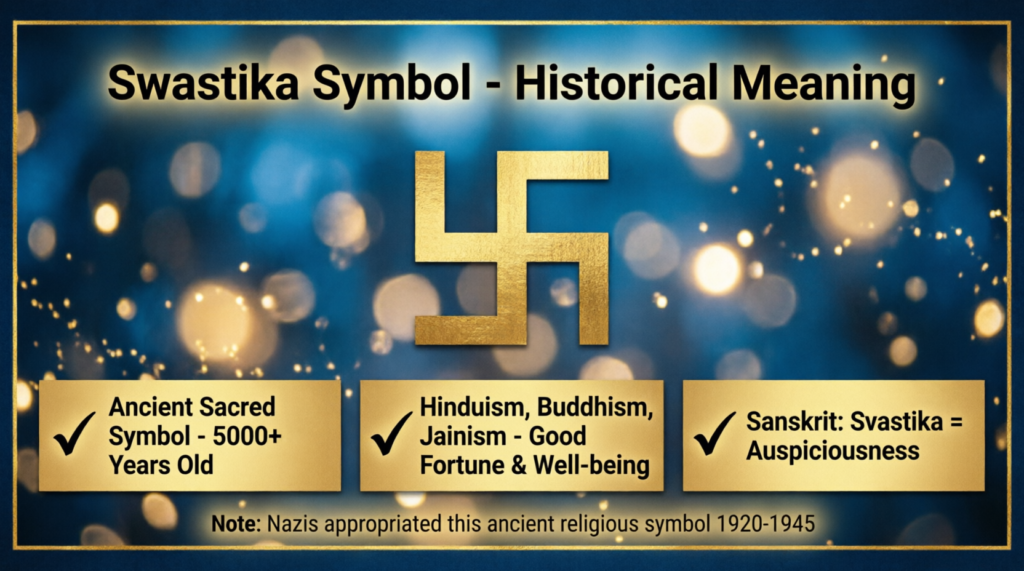
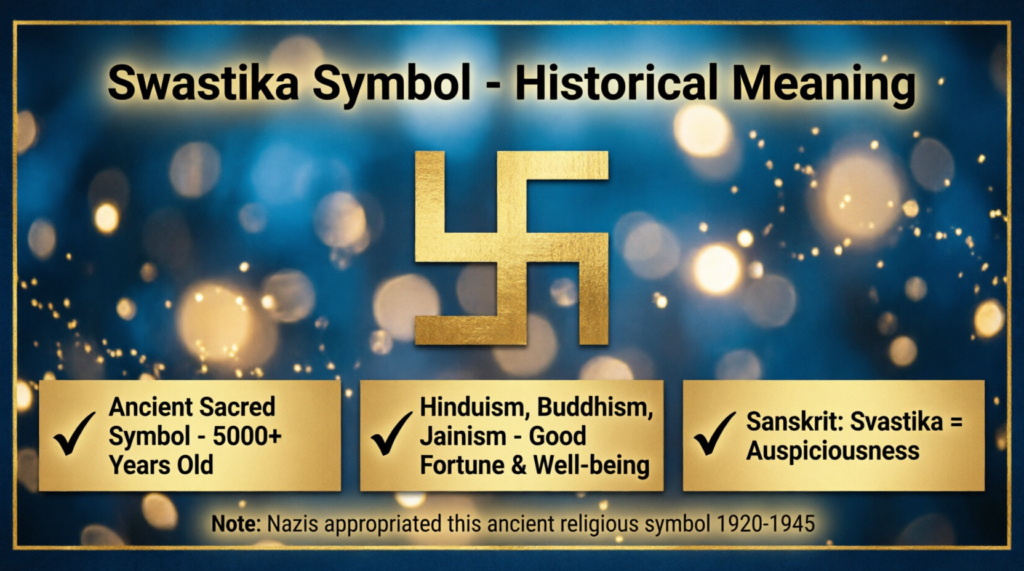
The word swastika comes from the Sanskrit svastika, associated with ideas such as well-being and good fortune. That meaning existed for thousands of years before the rise of Nazi Germany.
This distinction is important because the geometric motif itself did not originate with Hitler or the Nazi Party.
The Nazis appropriated an existing ancient symbol and gave it a new political meaning.
What Did the Nazi Swastika Look Like?
The most recognizable Nazi flag consisted of:
- A red background
- A white circular disk
- A black swastika in the center
Adolf Hitler designed the Nazi flag in 1920, combining the swastika with the red, black, and white colors associated with Imperial Germany.
The design became a powerful piece of political branding.
The Nazi regime used related imagery across:
- Flags
- Posters
- Armbands
- Party materials
- Medals and badges
- Military-related insignia
- Public buildings
- Political rallies
- Propaganda publications
The swastika therefore became much more than a graphic design. It became an instantly recognizable visual representation of Nazi power and ideology.
Why Did the Nazis Use Red, White, and Black?
The colors weren’t chosen randomly.
The Nazi flag drew on the colors of the German Empire, which existed from 1871 to 1918. The combination helped Nazi leaders appeal to people who rejected the Weimar Republic and wanted a return to an authoritarian nationalist past.
The Nazi movement effectively used the design as political branding.
The result was a symbol that could be recognized immediately at rallies, on uniforms, in propaganda, and throughout public life.
The Original Meaning of the Swastika Before Nazism
Here’s where the history becomes especially important.
The swastika did not originate as a Nazi symbol.
Evidence of swastika-like designs stretches back thousands of years. The motif appeared across different societies and regions, including parts of Asia, Europe, Africa, and the Americas. The United States Holocaust Memorial Museum notes that it was used for at least 5,000 years before Hitler adopted it.
The word itself comes from Sanskrit.
In many traditional contexts, the swastika has been associated with ideas such as:
- Good fortune
- Well-being
- Auspiciousness
- Prosperity
- Harmony
- Spiritual significance
Its meaning depends heavily on the culture and historical context in which it appears.
Swastika Meaning in Hinduism
In Hindu traditions, the swastika has a long-standing religious and cultural history and is generally associated with auspiciousness and good fortune.
It may appear in religious ceremonies, artwork, architecture, and household settings.
That meaning is fundamentally different from the meaning attached to the Nazi emblem.
Swastika Meaning in Buddhism
The symbol also appears in Buddhist traditions.
For example, museum collections document the swastika as an ancient Indian symbol of auspiciousness that spread into Korea through Buddhism.
Depending on the Buddhist tradition and cultural setting, the symbol may be connected with concepts such as good fortune, eternity, or Buddhist teachings.
Why Context Matters
A swastika appearing on an ancient Asian religious object is not automatically evidence of Nazi ideology.
Likewise, a swastika displayed alongside Nazi flags, Nazi slogans, or antisemitic imagery has a completely different historical meaning.
The symbol’s context matters.
How Did the Swastika Become a Nazi Symbol?
The transformation happened in Europe during the late 19th and early 20th centuries.
European writers and racial theorists began making false connections between the swastika and ideas about an ancient “Aryan” people. Some nationalist and racist movements adopted the symbol as part of their racial and political imagery.
The Nazi Party later adopted it.
In 1920, the Nazi Party formally chose the swastika as its principal symbol. The Nazis connected it to their fabricated racial concept of “Aryan” superiority and German nationalist identity.
This was a radical change in meaning.
The Nazis didn’t invent the swastika.
They appropriated it and attached it to an extremist ideology.
What Did the Swastika Mean to the Nazis?
Within Nazi ideology, the swastika was associated with the movement’s vision of an allegedly racially superior German nation.
It became connected with:
- Racial hierarchy
- Antisemitism
- Extreme nationalism
- Authoritarian government
- Anti-democratic politics
- Militarism
- Expansionism
- The Nazi Party
- The supposed “Aryan” racial community
These ideas were not harmless symbolism.
Nazi racial ideology placed Jews and other groups outside the Nazis’ imagined racial community and treated them as enemies. When the Nazis gained power, their ideology became government policy.
The swastika therefore became a visual shorthand for the Nazi worldview.
The Nazi Symbol and Adolf Hitler
Adolf Hitler played a major role in turning the swastika into the central visual symbol of the Nazi movement.
Hitler became leader of the Nazi Party and eventually became chancellor of Germany in January 1933. The Nazis then dismantled German democracy and established a dictatorship.
The swastika was everywhere.
It appeared at:
- Political rallies
- Government events
- Propaganda demonstrations
- Party gatherings
- Public displays
- Nazi organizations
- Posters and publications
This constant exposure strengthened the connection between the symbol and Nazi authority.
Why Was the Nazi Symbol So Powerful?
The Nazis understood something modern political movements still understand today:
Symbols can communicate an enormous amount of information instantly.
A person could see a swastika and immediately recognize the Nazi movement.
The regime used it to create a visual identity around:
- Political loyalty
- Nationalism
- Racial ideology
- Authority
- Propaganda
- Fear and intimidation
The symbol could appear alongside speeches, uniforms, marches, banners, posters, and mass gatherings.
This made Nazi ideology visually difficult to escape.
The Holocaust Museum describes the swastika as the most recognizable symbol of Nazi propaganda.
The Nazi Symbol and the Holocaust
The meaning of the Nazi swastika cannot be separated from the crimes committed under Nazi rule.
The Holocaust took place during the Nazi era from 1933 to 1945 and involved the systematic persecution and murder of Europe’s Jews by Nazi Germany and its collaborators. Approximately six million Jews were murdered.
Nazi persecution also targeted many other groups, including Roma and Sinti, people with disabilities, political opponents, Soviet prisoners of war, and others whom the regime regarded as enemies or racially inferior.
This history is why the Nazi swastika has such a powerful and painful meaning today.
For many people, it represents not merely a political party but the broader system of:
propaganda → persecution → dehumanization → mass murder.
What Does the Nazi Symbol Represent Today?
Today, the Nazi swastika is widely recognized as a symbol associated with:
- Nazism
- Antisemitism
- White supremacy
- Fascism
- Racial hatred
- Nazi dictatorship
- Holocaust history
- Neo-Nazi movements
- Extremist intimidation
The meaning can vary according to context, especially because the underlying swastika motif predates Nazism by thousands of years.
However, when the symbol appears specifically in a Nazi context, its historical meaning is unmistakable.
The US Holocaust Memorial Museum notes that extremist groups continue to use Nazi symbols to promote hatred and intimidation.
Is Every Swastika a Nazi Symbol?
No.
This is one of the most important distinctions to understand.
The geometric swastika existed for thousands of years before Nazism and remains a religious symbol in several Asian traditions.
A useful comparison
| Context | Typical meaning |
|---|---|
| Nazi Germany | Nazism, racial ideology, antisemitism, dictatorship |
| Hindu traditions | Auspiciousness, well-being, good fortune |
| Buddhism | Religious and cultural symbolism, varying by tradition |
| Ancient cultures | Varying symbolic or decorative meanings |
| Modern neo-Nazi use | Extremism, racial hatred, intimidation |
| Holocaust education | Historical representation of Nazi persecution and genocide |
The context, design, surrounding imagery, and historical setting are essential.
Nazi Swastika vs. Traditional Swastika
The two should not automatically be treated as culturally identical.
The Nazi version was deliberately incorporated into a political movement and its propaganda system.
Traditional religious versions existed independently for millennia.
The distinction can be understood this way:
Ancient swastika → older cultural and religious traditions
Nazi swastika → Nazi political ideology and propaganda
The Nazis changed the modern Western cultural associations of the symbol dramatically.
That historical appropriation is one reason the symbol can cause confusion today.
Why Does the Nazi Symbol Cause Such a Strong Reaction?
Symbols work emotionally as well as intellectually.
For survivors, descendants of victims, Jewish communities, and many others, Nazi imagery can evoke memories of persecution, dehumanization, forced displacement, concentration camps, mass murder, and the Holocaust.
The symbol can therefore function as more than a historical image.
In some contexts, displaying it can be intended to intimidate.
The Holocaust Museum explains that Nazi symbols such as the swastika have been used in modern times to intimidate or terrorize Jewish people and to promote antisemitic ideas.
This is why casually treating the Nazi swastika as an ordinary decorative symbol can erase important historical context.
Does the Swastika Always Mean Hate?
No.
This is a common misconception.
The swastika has a history that is much older and broader than Nazism.
In several Asian religious traditions, it continues to carry positive or sacred meanings. For example, The Metropolitan Museum of Art identifies the symbol on historical Korean objects as an ancient Indian symbol of auspiciousness introduced through Buddhism.
At the same time, a Nazi swastika displayed as part of Nazi imagery has a very different meaning.
So the most accurate answer is:
The swastika does not inherently have one universal meaning. Its meaning depends on cultural and historical context. The Nazi version, however, is specifically associated with Nazism, antisemitism, racial ideology, dictatorship, and the Holocaust.
Is the Nazi Symbol the Same as the Swastika?
Not exactly.
The swastika is the underlying geometric motif.
The Nazis appropriated a particular form of it and incorporated that form into their political branding.
This distinction matters because calling every swastika “the Nazi symbol” ignores thousands of years of history that existed before Nazi Germany.
At the same time, calling the Nazi emblem merely an “ancient religious symbol” ignores the way Nazi Germany deliberately transformed and weaponized its meaning.
Both parts of the history need to be understood.
Other Symbols Associated With Nazi Germany
The swastika is the most recognizable Nazi symbol, but it wasn’t the only one.
Other imagery associated with the Nazi regime included:
- Nazi flags
- The Nazi eagle
- SS insignia
- SA insignia
- Nazi Party emblems
- Military and political badges
- Propaganda imagery
- Uniform insignia
The SS, or Schutzstaffel, was particularly important within the Nazi system. It evolved from Hitler’s personal guard into a powerful organization involved in political repression, concentration camps, and the implementation of the “Final Solution,” the Nazi plan to murder Europe’s Jews.
Understanding these symbols can help historians identify Nazi propaganda and artifacts correctly.
Why Did the Nazis Use Symbols So Much?
Nazi Germany was heavily dependent on propaganda.
The regime used symbols, posters, films, rallies, newspapers, radio, uniforms, architecture, and public ceremonies to influence how people understood the state and their place within it.
A symbol could make an abstract political ideology visible.
Instead of explaining an entire political movement every time, the regime could display a recognizable emblem and immediately communicate:
“This belongs to the Nazi movement.”
That made symbols central to Nazi political communication.
What Does the Nazi Symbol Mean in Modern Culture?
In modern Western culture, the Nazi swastika is generally understood as a symbol of Nazi Germany and extremist hatred.
It can appear in:
- History books
- Holocaust museums
- Documentaries
- Films
- Video games
- News reporting
- Educational materials
- Historical photographs
- Extremist propaganda
The meaning depends heavily on purpose and context.
For example, a museum displaying a Nazi flag to teach visitors about the Holocaust is not endorsing Nazism.
Likewise, a historian showing the symbol in a classroom is using it as historical evidence.
That is very different from someone displaying the symbol to promote Nazi ideology or intimidate others.
Why Context Matters When Interpreting Nazi Symbols
A symbol doesn’t exist in a vacuum.
Consider these two situations:
Example 1: Historical education
A museum displays a Nazi flag alongside information about the Holocaust.
Meaning: historical documentation and education.
Example 2: Extremist propaganda
A person displays a Nazi flag alongside antisemitic slogans.
Meaning: potentially an expression or promotion of Nazi ideology and hatred.
Example 3: Religious artwork
An ancient Buddhist object contains a swastika as part of its traditional design.
Meaning: cultural or religious symbolism, not Nazi ideology.
The same basic geometric motif can therefore have radically different meanings.
Common Myths About the Nazi Symbol
Myth 1: Hitler invented the swastika
False.
The swastika is thousands of years older than Hitler and existed across many cultures before the Nazi movement.
Myth 2: The swastika has always represented evil
False.
In many traditions, it has historically represented auspiciousness, good fortune, well-being, or other positive concepts.
Myth 3: Every swastika is Nazi
False.
Context is essential, particularly in South Asian and Buddhist cultures where the symbol has older religious meanings.
Myth 4: The Nazis were simply using an ordinary religious symbol
Misleading.
Although the symbol itself was ancient, Nazi leaders deliberately appropriated it and connected it to their racial and political ideology.
Myth 5: The symbol has no meaning today
False.
Nazi imagery remains historically significant and is also used by some modern extremist groups.
Is the Nazi Symbol Illegal?
The legal status of Nazi symbols depends on the country and circumstances.
Some countries impose restrictions on public display or distribution of Nazi symbols and propaganda. Germany, for example, has maintained legal restrictions on Nazi organizations, propaganda, and symbols following the Second World War.
The rules aren’t identical everywhere.
In the United States, Nazi symbols can generally be displayed because of constitutional free-speech protections, although specific conduct involving threats, harassment, vandalism, or other crimes can still have legal consequences.
Therefore, if you’re asking whether displaying a Nazi symbol is legal, the answer depends on where you are and how the symbol is being used.
Why Did the Nazis Want a Powerful Symbol?
The Nazi Party needed an identity that could unite supporters and communicate its political message.
The swastika served several functions at once.
It:
- Made the Nazi movement visually recognizable.
- Linked the movement with supposed Germanic and “Aryan” heritage.
- Helped create a sense of group identity.
- Appeared repeatedly in propaganda.
- Reinforced the authority of the regime.
- Helped turn Nazi ideology into something visually memorable.
The Nazi leadership understood that political imagery could influence emotions and group identity.
The swastika became central to that strategy.
What Is the Difference Between Nazism and the Swastika?
This distinction is worth remembering:
Nazism is an ideology and political movement.
The swastika is an ancient symbol that the Nazis appropriated.
The Nazis gave one particular use of the symbol an extraordinarily destructive political meaning.
That doesn’t erase the symbol’s earlier history.
But it does explain why the Nazi version became so closely associated with hatred and genocide.
Why Is the Nazi Symbol Still Important to Study?
Learning about Nazi symbols isn’t about glorifying them.
It’s about understanding how propaganda works.
Nazi Germany demonstrates how governments and political movements can use:
- Symbols
- Repetition
- Propaganda
- Dehumanizing language
- Conspiracy theories
- Nationalist myths
- Political violence
to create an environment where discrimination and persecution become increasingly normalized.
Studying these warning signs can help people recognize extremist propaganda before it develops into something much worse.
Quick Facts About the Nazi Symbol
| Question | Answer |
|---|---|
| What is the Nazi symbol? | Most commonly, the swastika used by Nazi Germany |
| What is it called? | Swastika; Nazi German usage also includes Hakenkreuz |
| When did the Nazi Party adopt it? | 1920 |
| Did Hitler invent the swastika? | No |
| How old is the symbol? | At least several thousand years old |
| What did it mean before Nazism? | Meanings varied, including auspiciousness and well-being |
| What did it mean to Nazis? | A symbol tied to Nazi racial ideology and political identity |
| What does the Nazi version represent today? | Nazism, antisemitism, racial hatred, dictatorship, and Holocaust history |
| Is every swastika Nazi? | No |
| Is it illegal everywhere? | No; laws differ by country and context |
Frequently Asked Questions
What does the Nazi symbol mean?
The Nazi swastika represents Nazi Germany and its ideology of racial hierarchy, antisemitism, extreme nationalism, dictatorship, and political violence. It became one of the regime’s most recognizable propaganda symbols and is now strongly associated with the Holocaust and Nazi crimes.
Why did Hitler use the swastika?
The Nazi movement adopted the swastika because racist nationalist groups had already connected it with an invented idea of “Aryan” identity. The Nazi Party formally adopted it in 1920 and made it central to its political imagery.
Did the swastika originate with the Nazis?
No. The swastika is an ancient symbol that predates Nazism by thousands of years and has appeared in numerous cultures.
What did the swastika mean before Hitler?
Its meaning varied across cultures. In several Asian religious traditions, it has been associated with auspiciousness, good fortune, well-being, and religious significance.
Is the swastika a Hindu symbol?
The swastika has a long history in Hindu traditions and is used in religious and cultural contexts. It also appears in Buddhism, Jainism, and other traditions.
Is the Nazi swastika the same as a Hindu swastika?
They share the same basic geometric motif, but their historical and cultural meanings are very different. The Nazi regime appropriated the symbol and connected it to racial ideology and political propaganda, while Hindu traditions have much older religious uses.
Why is the Nazi swastika considered offensive?
Because it became the central symbol of a regime responsible for systematic persecution, mass violence, and the Holocaust, including the murder of approximately six million Jews. Modern extremist groups have also used it to communicate hatred and intimidation.
Is the Nazi symbol still used today?
Yes. It appears in historical education and documentation, but it is also sometimes used by neo-Nazi and other extremist groups to promote hatred or intimidation.
Can a swastika have a positive meaning?
Yes. In several religious and cultural traditions, especially in South Asia and parts of Asia, the symbol has positive or sacred meanings that predate Nazi Germany by thousands of years.
Why is the swastika associated with the Holocaust?
The swastika was the most recognizable symbol of Nazi propaganda. Because the Holocaust occurred under the Nazi regime, the symbol became deeply connected with Nazi persecution and genocide.
What is the Nazi flag?
The best-known Nazi flag featured a red field, a white circle, and a black swastika. Hitler designed this flag in 1920, using the colors red, white, and black associated with Imperial Germany.
What is the SS symbol?
The SS was the Schutzstaffel, a major Nazi organization that became deeply involved in political repression, concentration camps, and the mass murder of European Jews. Its insignia is separate from the swastika, although both are associated with Nazi Germany.
What does a Nazi symbol mean when used today?
It depends on the context. In a museum or history book, it may be used for education or historical documentation. When used by extremists alongside Nazi or antisemitic messages, it can function as a symbol of racial hatred, intimidation, or extremist ideology.
Final Takeaway: What Does the Nazi Symbol Mean?
So, what does the Nazi symbol mean?
The answer depends on which history you’re talking about.
The swastika itself is an ancient symbol with thousands of years of history and positive or sacred meanings in several cultures.
But the Nazi swastika is something different in historical context. The Nazi Party appropriated the symbol in 1920 and made it the centerpiece of its political identity and propaganda. Under Hitler’s dictatorship, it became associated with racial ideology, antisemitism, persecution, war, and the Holocaust.
That distinction is essential.
Understanding the Nazi symbol isn’t simply about knowing what a particular shape means. It’s about understanding how symbols can be appropriated, transformed, and used to communicate political ideology—and how propaganda can help normalize hatred and dehumanization.
The best way to interpret the symbol is therefore to look at its historical and cultural context.
An ancient swastika on a Buddhist artifact and a Nazi swastika on extremist propaganda may look similar, but they carry profoundly different meanings.
descover more post
Population Mean Symbol Definition Formula Examples and …
What Does the Fish Symbol Mean …
What Does the Yin Yang Symbol Mean Meaning History …

Luna Dream is a dream enthusiast and writer dedicated to exploring the meanings, symbols, and stories behind dreams. Through DreamETrue, she shares thoughtful and easy-to-understand insights to help readers discover the fascinating world of dreams.