Have you ever looked at the ☯ yin yang symbol and wondered what those black and white halves actually mean?
At first glance, it looks like a simple design. But the yin yang symbol represents a much deeper idea from Chinese philosophy: life is shaped by contrasting qualities that depend on, influence, and transform into one another.
It isn’t simply a symbol of “good versus evil.” It isn’t saying that one side is right and the other is wrong. Instead, it offers a different way of looking at reality—one where opposites can exist together, each helping define the other.
So, what does the yin yang symbol mean? Let’s break down its history, colors, dots, spiritual meaning, connection to Taoism, and the common misconceptions surrounding this famous symbol.
What Does the Yin Yang Symbol Mean?
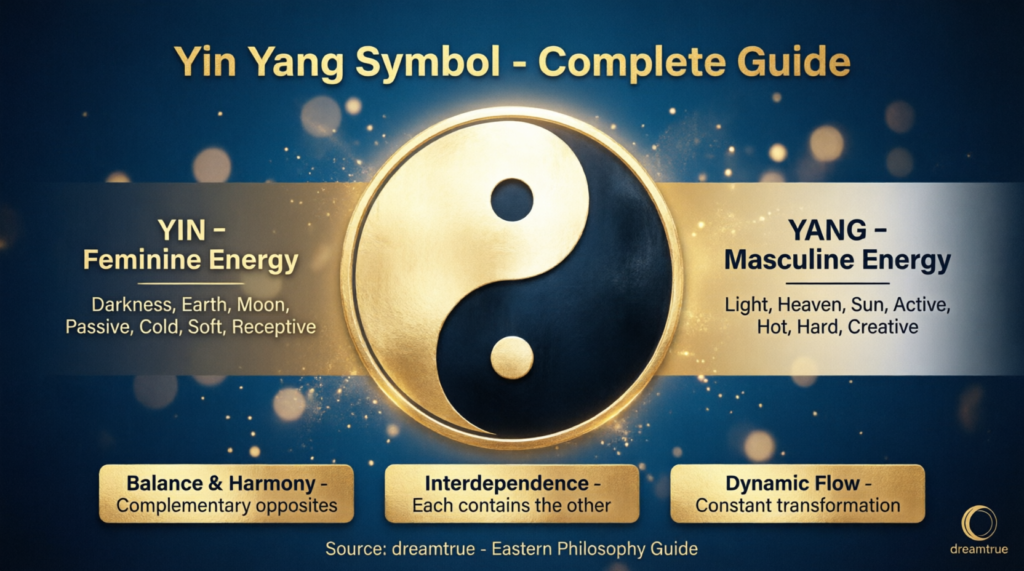
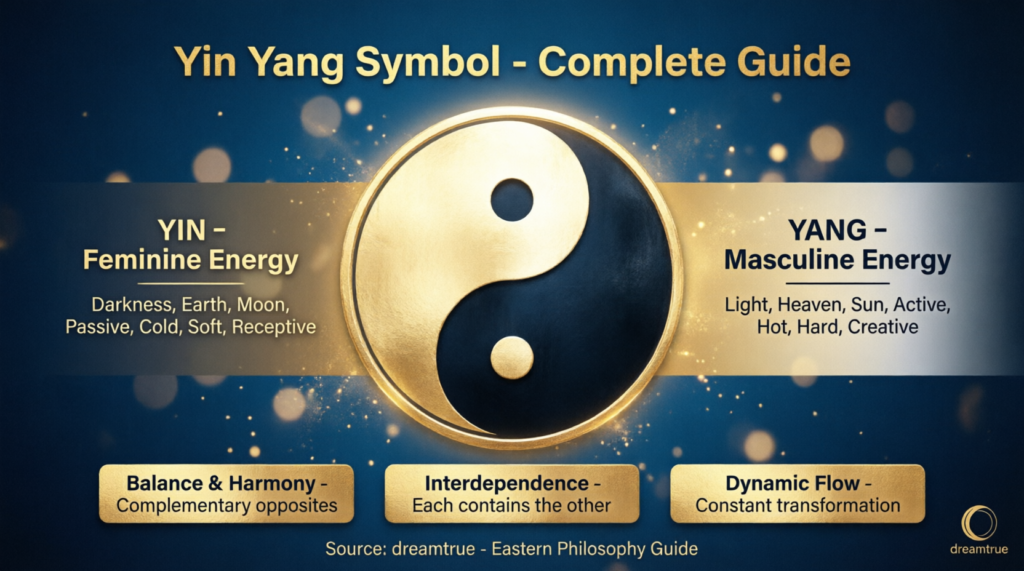
The yin yang symbol represents the complementary relationship between opposing but interconnected aspects of life. In Chinese thought, yin and yang describe contrasting qualities such as darkness and light, stillness and activity, inwardness and outwardness. Neither exists completely independently of the other, and their interaction is associated with continual change and transformation.
The familiar black-and-white design is commonly called the taijitu (太極圖), meaning a diagram associated with taiji, often translated as the “Supreme Ultimate.”
At its simplest, the symbol communicates five related ideas:
- Opposites exist together.
- Opposites depend on each other.
- Nothing is completely yin or completely yang.
- Opposites can transform into one another.
- Balance is dynamic rather than permanently fixed.
That’s why the symbol can be understood as a visual reminder that life isn’t always divided into simple either-or categories.
In simple terms: The yin yang symbol means that contrasting forces are interconnected and complementary, and that harmony comes from understanding their relationship rather than treating one side as completely separate from the other.
What Is the Yin Yang Symbol Called?
The symbol is commonly called the yin-yang symbol, yin and yang symbol, yin-yang sign, or Taoist symbol in English.
The Chinese term most closely associated with the familiar diagram is taijitu (太極圖).
The words themselves are older than the modern black-and-white design. Yin and yang developed as concepts within ancient Chinese thought, while the familiar circular diagram belongs to a later history of Chinese cosmological and philosophical diagrams.
This distinction matters because yin and yang are concepts, while the taijitu is a visual representation associated with them.
Yin and Yang Meaning Explained
To understand the symbol, it helps to understand the two terms separately.
What Does Yin Mean?
Yin (陰/阴) is traditionally associated with qualities such as:
- darkness
- shade
- coolness
- stillness
- receptivity
- inward movement
- rest
- the moon
- night
- winter
The word’s traditional associations are connected with the shaded or less-sunny side of things.
However, yin does not simply mean “bad,” weak, or evil.
That is one of the most important points to understand.
What Does Yang Mean?
Yang (陽/阳) is traditionally associated with qualities such as:
- light
- warmth
- activity
- movement
- outward expression
- brightness
- the sun
- daytime
- summer
Yang does not simply mean “good,” powerful, or superior.
In early Chinese cosmological thinking, yin and yang are better understood as relational qualities or complementary poles whose interaction helps explain change.
Yin vs. Yang at a Glance
| Yin | Yang |
|---|---|
| Dark | Light |
| Shade | Brightness |
| Cool | Warm |
| Rest | Activity |
| Inward | Outward |
| Receptive | Expressive |
| Night | Day |
| Winter | Summer |
| Traditionally associated with feminine qualities | Traditionally associated with masculine qualities |
These associations aren’t rigid labels. Something can be yin in one relationship and yang in another.
That’s why reducing yin and yang to fixed categories can miss the point.
What Do the Black and White Colors Mean?
The black and white halves of the familiar symbol represent yin and yang.
Traditionally, the black portion is associated with yin, while the white portion represents yang.
But the colors themselves aren’t meant to communicate that black equals evil and white equals good.
Instead, they make the contrast visually obvious.
The design shows two different qualities occupying the same circular whole. The boundary between them curves rather than forming a rigid straight line, suggesting movement and interaction.
The symbolism is therefore more nuanced than a simple black-versus-white conflict.
What Do the Dots in the Yin Yang Symbol Mean?
The small white dot inside the black section and the black dot inside the white section are among the most recognizable parts of the symbol.
They are commonly interpreted as showing that yin contains yang and yang contains yin.
In other words, neither side is completely isolated or pure.
This is why people often explain the dots as:
“There is a little yin within yang, and a little yang within yin.”
The deeper idea is that opposite qualities can contain the potential or presence of their counterparts.
For example:
- Day eventually gives way to night.
- Summer eventually turns toward winter.
- Activity eventually requires rest.
- Stillness can eventually give way to movement.
The dots therefore reinforce the idea of interdependence and transformation.
Why Is the Line Curved?
Look closely at the yin yang symbol and you’ll notice that the two halves aren’t separated by a straight line.
The dividing line curves like an S.
That’s important.
A straight line would make yin and yang look like two permanently separate territories. The curved line instead gives the impression of movement, flow, and transition.
It visually suggests that the relationship between yin and yang is dynamic.
One quality rises while the other recedes. Then circumstances change, and the relationship changes again.
This is consistent with the broader role of yin and yang in Chinese cosmological thought, where change is understood through contrasting qualities that alternate and interact.
Why Is the Yin Yang Symbol a Circle?
The circle creates a sense of wholeness and unity.
Inside the circle are two contrasting forms, but together they create one complete image.
This makes the symbol a useful visual expression of an important philosophical idea:
Difference doesn’t necessarily destroy unity.
You can have contrast without complete separation.
You can have change without losing the larger whole.
The circle also fits the idea of cycles—such as day and night, seasons, growth and decline, activity and rest.
Is Yin Yang About Balance?
Yes—but “balance” needs to be understood correctly.
Many modern explanations describe yin and yang as a symbol of balance. That’s reasonable, but it can become misleading if we imagine balance as an exact 50/50 split.
The traditional idea is closer to dynamic harmony.
Yin and yang are constantly changing in relation to each other.
Think about day and night.
At sunrise, daylight grows while darkness decreases. At sunset, the relationship reverses. There isn’t a permanent state in which day and night remain exactly equal.
The point is the cycle and relationship, not a frozen mathematical midpoint.
Chinese philosophical traditions frequently describe yin and yang through patterns of alternation, interaction, and change.
A Better Way to Think About Yin Yang Balance
Instead of asking:
“How do I make everything exactly 50% yin and 50% yang?”
a more useful interpretation is:
“How do these different qualities interact, and what happens when one becomes excessive or insufficient?”
That shift makes the concept much easier to understand.
Is Yin Yang a Symbol of Good and Evil?
Not primarily.
This is one of the most common misconceptions about the yin yang symbol.
People sometimes assume:
- white = good
- black = evil
But that’s an oversimplification.
Yin and yang aren’t inherently moral categories. Early Chinese philosophical sources generally treat them as complementary principles or qualities involved in change rather than as cosmic forces of good and evil.
Yin can describe darkness, but darkness isn’t automatically evil.
Yang can describe light, but light isn’t automatically morally good.
The same quality can be useful or harmful depending on the circumstances.
For example, sunlight supports life, but too much heat can be destructive. Darkness can represent night and rest, both of which are necessary parts of natural cycles.
So What Is the “Good in Evil and Evil in Good” Idea?
The popular interpretation comes partly from the dots: each side contains a small amount of the other.
That can be a useful modern metaphor for complexity and interdependence.
However, it shouldn’t be presented as the complete historical meaning of yin and yang.
The broader philosophical concept concerns relationships, polarity, transformation, and complementary processes, not simply morality.
Yin Yang and Taoism: What’s the Connection?
The yin yang symbol is strongly associated with Taoism (Daoism), one of China’s major philosophical and religious traditions.
But there’s an important historical nuance.
Yin-yang thought and Daoism are related, but they aren’t identical concepts.
Chinese thought contains several traditions that used yin and yang ideas, and the systematic cosmological theories associated with yin and yang developed through a long historical process. The Stanford Encyclopedia of Philosophy notes that Han-era thinkers used yin and yang to understand changes ranging from seasons and celestial movements to human emotions.
Daoist traditions later incorporated yin and yang into broader cosmological frameworks.
In religious Daoism, yin and yang are described as major emblems of duality and as complementary principles involved in generating phenomena and regulating cosmic processes through cyclical alternation.
So it is more accurate to say:
The yin yang symbol is closely associated with Taoism, but yin-yang theory has a broader history within Chinese philosophy and cosmology.
Is the Yin Yang Symbol Originally Buddhist?
No.
The familiar yin yang symbol is associated primarily with Chinese philosophical and cosmological traditions, especially Daoism and related Chinese thought.
It is not originally a Buddhist symbol.
Buddhist traditions in East Asia have interacted with and influenced Chinese culture for centuries, so you’ll sometimes see yin-yang imagery in broader Asian spiritual or cultural contexts.
But that doesn’t make the symbol Buddhist in origin.
Where Did the Yin Yang Symbol Come From?
The history is more complicated than the common claim that “the yin yang symbol is thousands of years old.”
The concepts of yin and yang are ancient, but the familiar black-and-white circular diagram developed much later.
Yin and yang became important concepts in early Chinese cosmology and philosophy. By the Han period, yin-yang theories were being used to describe patterns of change throughout nature and the human world.
The development of taijitu diagrams is associated with later Chinese intellectual history. The famous Neo-Confucian philosopher Zhou Dunyi (1017–1073) is associated with a Taijitu diagram and his Taijitu shuo (“Explanation of the Diagram of the Supreme Ultimate”). Later periods produced multiple versions of taijitu diagrams.
This means we should distinguish between:
Ancient yin-yang philosophy → later cosmological diagrams → the modern familiar yin-yang icon.
That timeline is much more historically accurate than saying the exact black-and-white symbol existed unchanged thousands of years ago.
What Does Taijitu Mean?
Taijitu (太極圖) can be understood as a “diagram of taiji,” with taiji commonly translated as “Supreme Ultimate.”
The term refers to diagrams expressing aspects of Chinese cosmology, including the relationship between unity, polarity, yin, yang, and the unfolding of phenomena.
Importantly, there have been multiple forms of taijitu, not just the familiar black-and-white circle.
The modern symbol people recognize today is therefore one part of a much larger visual and philosophical history.
Yin Yang Symbol and the Concept of Qi
Another important concept connected with yin and yang is qi (氣).
Qi is often translated into English using words such as “vital energy,” “breath,” or “pneuma,” although none of these translations perfectly captures its historical meanings.
In several Chinese cosmological traditions, yin and yang were understood in relation to qi.
The Stanford Encyclopedia of Philosophy explains that some Chinese philosophical texts treat yin and yang as qualities or types of qi, while later traditions developed more elaborate accounts of how yin and yang participate in the formation and transformation of things.
This is important because modern websites sometimes describe yin and yang simply as two invisible “energies.”
That’s a convenient modern explanation, but historically the concepts are more complicated than that.
Yin Yang and the Five Elements
Yin and yang are also connected in traditional Chinese cosmology with the Five Phases, commonly called the Five Elements:
- Wood
- Fire
- Earth
- Metal
- Water
In traditional correlative cosmology, these categories were used to relate different aspects of nature, time, the body, and the cosmos.
Religious Daoist cosmology, for example, incorporated yin and yang alongside the Five Agents and the Eight Trigrams as part of a larger symbolic system for understanding the relationships among cosmic phenomena.
This shows why the yin yang symbol shouldn’t be treated as an isolated idea. It belongs to a much broader network of Chinese philosophical and cosmological concepts.
Yin Yang and the I Ching
The I Ching, or Book of Changes (Yijing), is another major part of the story.
The I Ching uses broken and unbroken lines to form trigrams and hexagrams. These line types are traditionally associated with yin and yang.
The eight trigrams, or bagua, became part of wider Chinese cosmological systems and were used to symbolize different configurations of yin and yang.
This is why you’ll sometimes see the yin yang symbol surrounded by eight trigrams.
That design is often called a bagua or taijitu-with-bagua arrangement.
What Does Yin Yang Mean Spiritually?
From a spiritual perspective, people often use yin yang symbolism as a reminder of:
- harmony
- interconnectedness
- acceptance of change
- moderation
- flexibility
- inner balance
- coexistence of differences
- the temporary nature of extremes
However, it’s important to separate traditional philosophy from modern spiritual interpretation.
Traditional Daoist thought is much richer than the modern self-help idea of simply “finding balance.”
Daoist philosophy focuses on living in accordance with Dao (道), often translated as “the Way,” and emphasizes naturalness, responsiveness, and understanding how things unfold.
So if someone uses the yin yang symbol spiritually today, that personal interpretation can be meaningful—but it shouldn’t automatically be presented as an exact statement of historical Daoist doctrine.
What Does Yin Yang Mean in Relationships?
In modern culture, yin yang is often used to describe relationships between two people who are different but complementary.
For example, someone might describe two partners as:
- quiet and outgoing
- logical and intuitive
- calm and energetic
- cautious and adventurous
The metaphor works because the yin-yang concept helps us think about difference without assuming that difference means incompatibility.
But there is a caveat.
Yin and yang shouldn’t be used to claim that men and women must have fixed personalities or that one gender is naturally superior to another.
Traditional Chinese texts do associate yin and yang with gendered qualities in certain contexts, but those associations were part of particular historical systems of thought and shouldn’t automatically be treated as modern scientific facts.
What Does Yin Yang Mean in Love?
For many people today, the yin yang symbol represents two people who are different but bring balance to each other.
As a relationship metaphor, it can suggest:
- mutual support
- complementarity
- acceptance of differences
- emotional balance
- partnership
- interconnectedness
But a healthy relationship doesn’t require two people to be complete opposites.
The deeper lesson is better understood as learning how differences interact rather than searching for a supposedly “perfect opposite.”
Yin Yang Symbol Meaning in Tattoos
The yin yang symbol is popular as a tattoo because its visual simplicity carries a lot of meaning.
Someone may choose a yin yang tattoo to represent:
- balance
- personal growth
- harmony
- duality
- acceptance of complexity
- life changes
- the connection between opposites
- a reminder that difficult periods can change
A tattoo is ultimately personal, so its meaning can differ from the traditional philosophical meaning.
If you want the tattoo to communicate the historical concept accurately, remember that yin doesn’t simply mean evil and yang doesn’t simply mean good.
The symbol is more about relationship and transformation than moral opposition.
What Does the Yin Yang Symbol Mean in Different Cultures?
The symbol has traveled far beyond its original Chinese philosophical context.
Today it appears in:
- tattoos
- jewelry
- clothing
- graphic design
- martial arts
- wellness spaces
- popular spirituality
- Western philosophy discussions
- modern art and decoration
It has also become recognizable as a broader symbol of balance and complementary opposites.
However, the modern global meaning isn’t always identical to its historical Chinese meaning.
That’s a common pattern with ancient symbols: once they enter a new culture, people reinterpret them.
Yin Yang in Martial Arts
The symbol is often associated with Tai Chi (Taijiquan) and other Chinese martial arts.
This connection makes intuitive sense because martial arts frequently explore relationships between qualities such as:
- softness and hardness
- yielding and force
- movement and stillness
- defense and attack
The yin-yang framework can therefore be used as a metaphor for how apparently opposite techniques interact.
Does Yin Yang Have a Biblical Meaning?
There is no biblical origin or traditional biblical meaning for the yin yang symbol.
The symbol comes from Chinese philosophical and cosmological traditions, not Christianity or the Bible.
A Christian writer might use yin-yang imagery as a personal analogy for concepts such as balance or contrasting qualities, but that would be a modern interpretation, not a biblical teaching.
This distinction matters whenever symbols from one religious or philosophical tradition are compared with another.
Is Yin Yang a Religious Symbol?
It can be.
The symbol is strongly associated with Daoism, which includes both philosophical and religious traditions.
At the same time, its use today is much broader.
Someone wearing a yin yang necklace, for example, may be interested in:
- Daoism
- Chinese philosophy
- meditation
- balance
- spirituality
- martial arts
- Asian culture
- the visual design itself
Therefore, seeing the symbol doesn’t automatically tell you what religious beliefs the person has.
Is Yin Yang a Symbol of Harmony?
Yes, but harmony is better understood as an active relationship than a perfectly static condition.
The two sides don’t simply sit next to each other.
They curve around one another.
They contain aspects of one another.
And they continuously change.
That’s why the symbol can communicate a richer idea than simple “peace.”
It suggests that harmony can emerge from learning how differences relate and transform.
Is Yin Yang a Symbol of Duality?
Yes.
Duality is one of its central ideas.
The symbol presents two contrasting aspects:
yin ↔ yang
But it doesn’t present them as two completely independent worlds.
Instead, the two are interconnected within a single circle.
This is sometimes described as polarity rather than simple dualism.
The distinction is useful because yin and yang aren’t necessarily two absolute, independent substances battling each other. They are relational categories used to understand patterns of contrast and change.
Common Misconceptions About the Yin Yang Symbol
Myth 1: Yin Means Evil
False.
Yin can be associated with darkness, coolness, stillness, and receptivity, but it isn’t synonymous with evil.
Myth 2: Yang Means Good
False.
Yang is associated with brightness, activity, warmth, and outward movement, not automatically moral goodness.
Myth 3: Yin Yang Means Good vs. Evil
Too simplistic.
The symbol is much broader and concerns complementary relationships throughout nature and life.
Myth 4: Yin and Yang Must Always Be 50/50
Not exactly.
The concept emphasizes dynamic balance and changing relationships rather than a permanent numerical split.
Myth 5: The Modern Symbol Is Thousands of Years Old
Not in its present familiar form.
The underlying yin-yang concepts are ancient, but the recognizable taijitu diagram developed through later Chinese intellectual history.
Myth 6: Yin Yang Is Originally Buddhist
No.
It comes from Chinese philosophical and cosmological traditions and is particularly associated with Daoism.
What the Yin Yang Symbol Teaches in Everyday Life
You don’t have to adopt Daoism to appreciate the metaphor.
The symbol can encourage us to notice that life contains many relationships that aren’t simply either/or.
For example:
Work and Rest
Constant activity eventually leads to exhaustion.
Constant rest prevents progress.
A healthy rhythm requires understanding both.
Confidence and Humility
Confidence can help you act.
Humility can help you learn.
Either quality can become problematic when taken to an extreme.
Independence and Connection
Being independent can be valuable.
So can relying on others.
Healthy relationships often require both.
Change and Stability
Stability provides a foundation.
Change allows growth.
Neither completely replaces the other.
These examples are modern applications, not literal statements that every life situation is a formal yin-yang pair.
Yin Yang Symbol: Quick Meaning Table
| Symbolic feature | Common interpretation |
|---|---|
| Black half | Yin |
| White half | Yang |
| Black dot | Yang within yin |
| White dot | Yin within yang |
| Curved division | Interaction, movement, transformation |
| Circle | Wholeness and unity |
| Two halves together | Complementarity and interdependence |
| Overall motion | Cycles and dynamic change |
What Is the Main Message of Yin Yang?
If you remember only one idea, remember this:
Opposites don’t always need to defeat each other. They can depend on each other.
The yin yang symbol asks us to look beyond rigid categories.
Light helps us recognize darkness.
Activity makes us appreciate rest.
Summer makes winter recognizable.
Movement becomes meaningful partly because stillness exists.
The symbol doesn’t necessarily say that every opposite is equally desirable in every situation. Instead, it offers a framework for thinking about relationships, change, context, and interdependence.
Frequently Asked Questions About the Yin Yang Symbol
What does the yin yang symbol mean in simple terms?
It represents the relationship between complementary opposites. Yin and yang describe contrasting qualities such as darkness and light, stillness and activity, but neither exists completely independently of the other.
What do the two dots in yin yang mean?
The dots are commonly understood to show that each side contains a seed or aspect of the other: yin contains yang, and yang contains yin.
Is yin yang good and evil?
No. That’s a popular simplification. Yin and yang aren’t simply good and evil. They describe complementary qualities involved in relationships, change, and transformation.
Is yin black or white?
In the familiar modern symbol, yin is generally represented by black and yang by white.
Is yin feminine and yang masculine?
Traditional Chinese thought sometimes associates yin with feminine qualities and yang with masculine qualities. But these are historical symbolic associations, not scientific rules about personality or gender.
Is yin yang a Taoist symbol?
It is strongly associated with Daoism/Taoism, but yin-yang concepts have a broader history in Chinese philosophy and cosmology.
What is the yin yang symbol called in Chinese?
The familiar diagram is commonly called taijitu (太極圖), meaning a diagram of taiji, or the “Supreme Ultimate.”
Does yin yang mean balance?
Yes, but not necessarily a rigid 50/50 balance. The more useful idea is dynamic balance—the changing relationship and interaction between contrasting qualities.
What does yin yang mean spiritually?
Modern spiritual interpretations often use it to represent harmony, interconnectedness, acceptance of change, and balance. These interpretations should be distinguished from historical Daoist teachings.
What does yin yang mean in love?
As a modern relationship symbol, it can represent two people with different but complementary qualities. It may suggest partnership, harmony, mutual support, and acceptance of differences.
Does yin yang have a biblical meaning?
No traditional biblical meaning exists because the symbol comes from Chinese philosophical and cosmological traditions rather than the Bible.
Is yin yang Chinese or Japanese?
The yin-yang concept and taijitu are rooted in Chinese intellectual and cultural history. The symbol has subsequently spread throughout East Asia and around the world.
Is yin yang a symbol of peace?
It can represent harmony and peaceful coexistence in modern interpretations, but its historical meaning is broader than peace. It concerns complementary opposites, change, and cosmic relationships.
What is the difference between yin yang and Taoism?
Yin and yang are concepts within Chinese thought; Taoism/Daoism is a much broader philosophical and religious tradition. Daoist traditions incorporated yin-yang ideas, but Daoism cannot be reduced to the yin-yang symbol alone.
Final Takeaway: What Does the Yin Yang Symbol Really Mean?
The yin yang symbol means that contrasting aspects of reality can be interconnected, complementary, and constantly changing.
Its black and white halves represent yin and yang. The curved division suggests movement rather than rigid separation. The two dots show that each side contains an aspect or seed of the other. And the surrounding circle brings the two contrasting halves into one whole.
Most importantly, yin and yang aren’t simply good and evil.
They’re a way of thinking about relationships: light and dark, activity and rest, expansion and contraction, movement and stillness, and countless other patterns of change.
The symbol’s lasting appeal comes from a simple but powerful idea:
Life isn’t always about choosing one side. Sometimes wisdom comes from understanding how both sides belong to the same larger whole.
descover more post
What Does the Triangle Symbol Mean? △ ▲ Δ Explained …
Mean Symbol in Statistics x̄, μ, Formulas Examples and …

Zayan is the creator and lead writer at DreamETrue, a blog dedicated to exploring the fascinating world of dreams and their meanings. With a passion for dream symbolism, spiritual insights, and easy-to-understand explanations, Zayan creates well-researched content that helps readers better understand the messages and emotions behind their dreams.
Every article published on DreamETrue is written with a focus on accuracy, clarity, and reader value. By combining information from trusted sources, cultural perspectives, and psychological interpretations, Zayan aims to make dream-related topics simple, engaging, and accessible for everyone.
Whether you’re curious about a recurring dream, searching for the meaning of a specific symbol, or simply interested in learning more about dreams, Zayan’s goal is to provide helpful, reliable, and easy-to-read content that informs and inspires.