Have you ever seen the blue eye-shaped symbol 🧿 on a necklace, bracelet, wall, car, or social media post and wondered, what does the evil eye symbol mean?
The answer is more interesting than simply “protection from bad luck.”
The evil eye is an ancient cross-cultural belief connected with envy, harmful attention, misfortune, and protection. The familiar blue-and-white eye is commonly called a nazar or nazar boncuğu, but the belief itself is much older and appears in different forms across cultures.
In this guide, we’ll explain what the symbol means, where the belief came from, why the eye is usually blue, what it means in Islam and Christianity, and how the symbol differs from the broader belief in the evil eye.
Quick Answer: What Does the Evil Eye Symbol Mean?
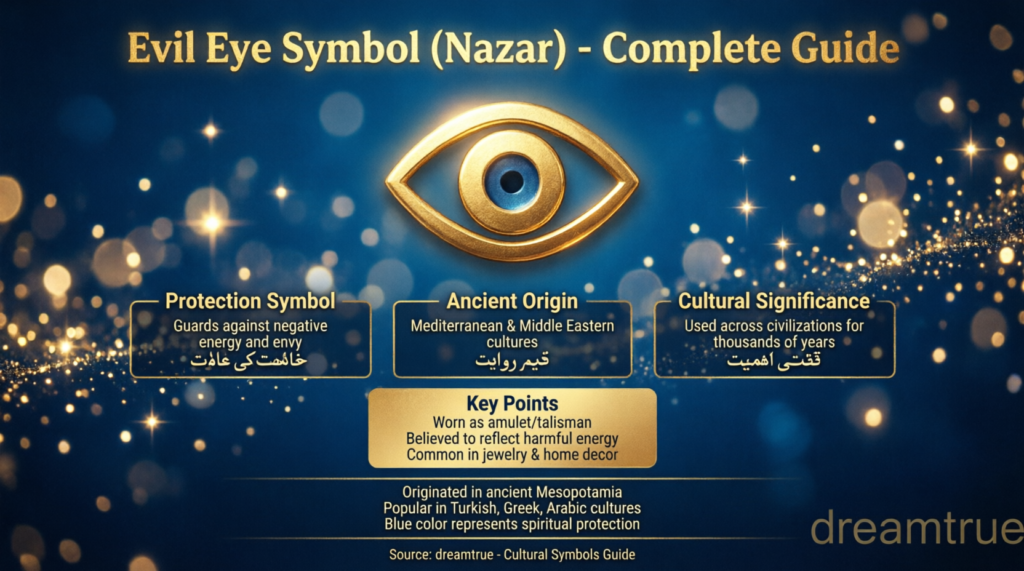
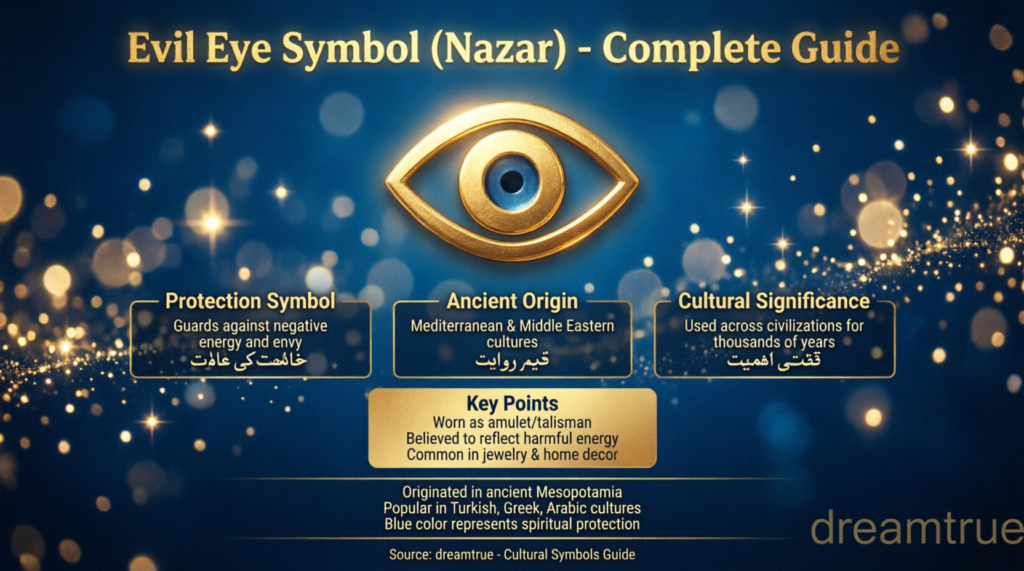
The evil eye symbol is traditionally understood as a protective symbol against the harmful effects of envy, jealousy, or a malevolent gaze. The familiar blue eye-shaped nazar amulet is believed in several cultures to guard against misfortune or reflect harmful attention away. Its meaning is cultural and religious rather than scientifically established.
In simple terms: 🧿 usually means protection from the evil eye, while the evil eye itself refers to a belief that envy or harmful attention can bring misfortune or harm.
What Is the Evil Eye?
The evil eye is a traditional belief that a person can cause harm to another person through a particular look, gaze, or expression of envy.
Depending on the culture, the supposed effects may include:
- Bad luck
- Illness
- Misfortune
- Loss or financial problems
- Relationship difficulties
- Problems affecting children or livestock
- General feelings of vulnerability
The belief isn’t limited to one country or religion. Historical and anthropological scholarship documents versions of the evil eye across the Ancient Near East, Mediterranean, Europe, South Asia, and other regions. Oxford Bibliographies describes the scholarly literature on the evil eye as extensive, covering biblical traditions, the Ancient Near East, Greece and Rome, Judaism, Christianity, Islam, and other cultural settings.
The important distinction
There are actually two related meanings that people often mix together:
| Term | Meaning |
|---|---|
| Evil eye | The belief that a harmful gaze or envy can cause misfortune |
| Evil eye symbol | A visual representation associated with protection against that harm |
| Nazar | A term associated with sight/gaze and, commonly, the protective eye amulet |
| Nazar boncuğu | The traditional Turkish eye bead/amulet |
| 🧿 emoji | A modern digital representation of the protective eye symbol |
So when someone wears an evil eye necklace, they’re usually wearing the protective symbol, not symbolically wishing evil on someone else.
What Does the 🧿 Evil Eye Symbol Represent?
The symbol is most commonly associated with protection.
The basic idea is straightforward: an eye is used to guard against a harmful or envious gaze.
The protective meaning can include:
- Protection from envy
- Protection from misfortune
- Spiritual safeguarding
- Good fortune
- Peace of mind
- Cultural identity
- A reminder to remain humble
However, the meaning isn’t identical everywhere.
In one culture, the symbol may be treated as a traditional protective amulet. Somewhere else, it may be primarily decorative. Another person may wear it because it connects them with their family heritage.
That’s why it’s better to say the symbol is traditionally believed to offer protection, rather than claiming it objectively prevents bad events.
Why Is the Evil Eye Shaped Like an Eye?
The eye is central to the belief because the supposed harm is traditionally connected to looking or being looked at.
The symbol essentially turns the eye into a protective image.
Instead of simply hiding from a harmful gaze, the protective amulet presents an eye back toward the world.
This creates a powerful symbolic message:
“The harmful gaze will not easily reach me.”
The exact interpretation varies across cultures, but the connection between the eye, attention, envy, and protection is one of the strongest recurring themes.
What Is a Nazar?
Nazar is a word associated with sight, looking, observation, or attention in languages influenced by Arabic and related traditions. The term is widely used across several cultures, including Turkish, Persian, Urdu, Punjabi, Hindi, Kurdish, and others.
The familiar nazar amulet is an eye-shaped charm traditionally believed to protect against the evil eye.
In Turkey, the famous blue glass bead is commonly called the nazar boncuğu.
A historical example held by the Museum of Witchcraft and Magic is an elaborate Turkish Nazar Boncugu dating to 1889, described as a protective house charm incorporating blue and white glass eye beads.
So:
Nazar = the broader concept associated with the gaze/sight and evil-eye tradition
Nazar amulet = the protective object associated with that belief
What Do the Colors of the Evil Eye Symbol Mean?
The classic evil eye charm usually contains blue, white, and black concentric shapes.
But you’ll now find evil eye jewelry in many colors.
One important caution: there isn’t a universal historical color code accepted across all cultures.
Modern jewelry sellers and spiritual communities sometimes assign specific meanings to different colors. Those meanings shouldn’t be presented as universal ancient rules.
Common modern interpretations
| Color | Common modern association |
|---|---|
| Blue | Protection, peace, traditional nazar symbolism |
| Light blue | Calmness and tranquility |
| White | Purity and innocence |
| Black | Strength, protection, seriousness |
| Red | Courage, energy, passion |
| Green | Growth, health, renewal |
| Yellow/Gold | Happiness, optimism, prosperity |
| Pink | Love, friendship, affection |
| Purple | Spirituality, creativity, mystery |
The blue eye remains the most recognizable version, particularly because of its strong association with the Turkish nazar tradition.
Does a blue evil eye mean something different?
Usually, blue is the traditional and most recognizable protective color.
But don’t assume that every blue eye charm has precisely the same religious meaning. Its significance depends on the person, culture, and context.
Why Is the Evil Eye Usually Blue?
This is one of the most common questions about the symbol.
The simple answer is that blue became strongly associated with the traditional nazar bead, particularly in Turkish and wider Mediterranean contexts.
The classic design typically uses:
- Dark blue
- White
- Light blue
- Black
The result resembles a human eye.
A Turkish Nazar Boncugu in the Museum of Witchcraft and Magic’s collection, for example, contains blue and white glass eye beads and was probably intended as a house-protection charm.
It’s therefore safer to connect the blue color to the historical development and visual tradition of the nazar amulet rather than claim that blue universally has one supernatural property.
Where Did the Evil Eye Symbol Come From?
There isn’t one simple birthplace for the evil eye belief.
That’s an important point.
The belief is extremely old and appears in different forms across multiple societies. Scholars have studied examples associated with the Ancient Near East, Greece, Rome, biblical communities, Judaism, Christianity, Islam, and many later folk traditions.
In other words:
The evil eye belief is much older and broader than the modern blue nazar bead.
The blue eye-shaped amulet that many people recognize today became especially associated with Turkish and neighboring Mediterranean traditions, but it would be inaccurate to say that the entire concept of the evil eye originated in modern Turkey.
Evil Eye Symbol in Ancient Cultures
The fear of harmful envy or supernatural effects from a gaze has deep historical roots.
Ancient societies often interpreted unexplained illness, sudden misfortune, or unexpected loss through religious or supernatural frameworks.
The evil eye provided one explanation:
Someone’s envy or gaze had caused harm.
Protective objects and rituals developed alongside that belief.
A key reason the tradition has survived for so long is that the underlying human experience—being envied, fearing misfortune, protecting children, and worrying about sudden changes—isn’t limited to any one historical period.
Evil Eye Meaning in Turkey
The evil eye is particularly visible in Turkish culture, where the traditional blue glass bead is known as the nazar boncuğu.
You’ll often see the symbol:
- In homes
- On doors
- In shops
- In cars
- On jewelry
- On gifts
- In decorative objects
- In workplaces
The symbol can therefore function as both cultural decoration and traditional protection.
A museum example from Turkey demonstrates that the practice of using eye-shaped objects for house protection has a documented material history.
It’s also important not to reduce the symbol to “just Turkish.” The broader evil-eye tradition crosses cultural boundaries, while the specific blue glass nazar design has its own strong Turkish identity.
Evil Eye Meaning in Greece
Greece has its own long-standing traditions surrounding the evil eye, commonly referred to as mati.
Like the Turkish nazar, the Greek eye symbol is associated with protection against harmful attention or envy.
The similarity between Greek and Turkish eye charms is one reason the symbol is often described as a shared Mediterranean cultural tradition, even though different communities have their own terminology, practices, and histories.
Evil Eye Meaning in Pakistan and South Asia
The evil eye is also deeply familiar across South Asian cultures, where it is commonly associated with nazar.
Expressions such as:
- Nazar lagna
- Nazar lag gayi
- Nazar utarna
- Chashm-e-baddoor
are associated with the idea of harmful envy or attention.
Research specifically examining rural Punjab, Pakistan found that belief in the evil eye has been connected with envy and concern about children’s wellbeing, along with protective practices.
This is particularly important because it shows that the evil eye isn’t merely an internet trend or modern jewelry fashion. It remains part of living cultural traditions.
What Does the Evil Eye Mean in Islam?
This question needs a careful distinction between Islamic teachings about the evil eye and the use of an eye-shaped amulet.
In mainstream Islamic hadith literature, the concept of al-ʿayn (the evil eye) is explicitly discussed.
A hadith recorded in Sahih al-Bukhari 5740 states that the effect of the evil eye is real. Another report in Bukhari describes seeking ruqyah for the evil eye.
So the Islamic concept of the evil eye should not simply be dismissed as identical to every folk version of the belief.
But what about the blue 🧿 amulet?
That’s a separate issue.
The blue nazar bead is a cultural amulet, and its religious status should not automatically be equated with the Islamic teaching about al-ʿayn.
Muslims and Islamic scholars can distinguish between:
- Believing in the evil eye
- Seeking protection through prayer or Qur’anic recitation
- Cultural customs
- Believing an object itself possesses supernatural power
These are not automatically the same thing.
If you’re asking from an Islamic perspective, it’s therefore better to examine the specific religious practice rather than assume that “evil eye belief = blue eye amulet.”
Does the Quran Mention the Evil Eye?
This is another area where precision matters.
Some people connect the evil eye with Quran 68:51–52, which mentions disbelievers nearly causing the Prophet to slip with their eyes.
However, interpretations of this passage differ, and it should not be presented as a simple statement that the Quran directly teaches the popular blue-eye amulet tradition.
There is also an important distinction between the biblical phrase “evil eye” and later folk beliefs about a magical gaze.
Scholarly discussion of the Hebrew Bible notes that biblical references commonly associated with an “evil eye” can refer to envy, selfishness, or stinginess, rather than necessarily describing a supernatural curse transmitted by looking.
What Does the Evil Eye Mean in Christianity?
Christian interpretations vary.
The phrase “evil eye” appears in biblical translations, but its meaning depends heavily on context.
In several passages, the expression is connected to attitudes such as:
- Envy
- Jealousy
- Selfishness
- Greed
- Covetousness
For example, biblical reference material notes that the expression can refer to being selfish toward someone rather than describing a magical gaze.
This means:
The biblical “evil eye” should not automatically be interpreted as the modern 🧿 symbol.
The two ideas overlap historically but aren’t interchangeable.
Is the Evil Eye a Religious Symbol?
Not necessarily.
The evil eye symbol can be:
- Religious
- Spiritual
- Cultural
- Traditional
- Decorative
- Fashion-related
Its meaning depends on who is using it.
For some people, it represents spiritual protection. For others, it represents cultural heritage. Others simply like the design.
The same object can therefore carry different meanings for different people.
Is the Evil Eye a Good or Bad Symbol?
For most people who use the 🧿 protective eye, it is considered a good or protective symbol.
That’s because the symbol generally represents protection against the evil eye.
This distinction is easy to miss:
The evil eye = the harmful gaze or belief
The evil eye amulet = an object traditionally used for protection against it
So wearing the symbol isn’t normally intended to “give someone the evil eye.”
What Does It Mean When Someone Gives You an Evil Eye Necklace?
If someone gives you an evil eye necklace, they may be expressing a wish for:
- Protection
- Good luck
- Safety
- Peace
- Wellbeing
- Cultural connection
The exact meaning depends on the person giving it.
For example, a Turkish family might give a nazar as a traditional protective gift, while someone else might give it simply because they associate the symbol with positive energy and safety.
The most reliable interpretation is therefore the giver’s intended meaning.
What Does It Mean When the Evil Eye Symbol Breaks?
This is a popular belief surrounding nazar jewelry.
Some traditions say that if an evil eye bead breaks, it has absorbed or intercepted harmful energy and has therefore completed its protective role.
But this is a folk belief, not a scientifically demonstrated property of glass.
There are many ordinary reasons a glass bead might break:
- Impact
- Temperature changes
- Manufacturing defects
- Wear and tear
- Accidental drops
So you can respect the cultural interpretation without presenting it as a proven physical fact.
Does the Evil Eye Actually Work?
This depends on what you mean by “work.”
As a scientific claim
There is no established scientific evidence that a glass eye amulet can physically block supernatural energy, reverse another person’s envy, or prevent bad luck.
As a cultural symbol
It can absolutely have meaning.
A symbol may provide:
- Emotional reassurance
- Cultural identity
- A sense of tradition
- Personal comfort
- A reminder of family beliefs
Anthropologists have studied the evil eye in relation to envy, social relationships, and cultural expectations. Research on Swat Pukhtun communities, for example, examines how fear of the evil eye connects with cultural patterns surrounding envy.
So there’s a meaningful distinction:
Cultural significance does not require scientific proof of supernatural effects.
Psychological Meaning of the Evil Eye
The evil eye can also be understood through psychology and anthropology.
People naturally worry about:
- Other people’s jealousy
- Losing something valuable
- Social competition
- Unexplained bad events
- Protecting children
- Sudden changes in fortune
A protective symbol can provide a visible way to express those concerns.
This doesn’t prove that the evil eye causes illness or bad luck.
Instead, it helps explain why the tradition can remain meaningful even in modern societies.
The symbol turns an invisible concern—“Someone may envy what I have”—into something visible and understandable.
Why Do People Fear the Evil Eye?
At its deepest level, the belief often revolves around envy.
Imagine someone receives:
- A beautiful home
- A healthy child
- A successful business
- A new car
- A happy marriage
- Financial success
- Social recognition
In many cultures, people worry that excessive attention or envy could somehow disrupt that good fortune.
This is one reason traditional expressions often encourage people to acknowledge blessings without excessive boasting.
The evil eye therefore has a social dimension as well as a spiritual one.
Evil Eye vs. Nazar: What’s the Difference?
These terms are closely related, but they’re not always identical.
| Evil Eye | Nazar |
|---|---|
| The belief in harmful attention or a gaze | A term associated with sight/gaze and the evil-eye tradition |
| Can refer to the harmful effect itself | Often refers to the protective tradition or amulet |
| Exists across many cultures | Especially associated with Middle Eastern, South Asian, Turkish, and surrounding traditions |
| May have religious, folk, or cultural interpretations | Often represented by an eye-shaped bead |
| Doesn’t necessarily involve an object | Frequently associated with the 🧿 amulet |
The terminology changes from one language and culture to another.
Evil Eye vs. Hamsa: Are They the Same?
No.
The evil eye is a belief associated with harmful envy or a gaze.
The Hamsa is a hand-shaped symbol associated with protection in parts of the Middle East and North Africa.
A Hamsa may sometimes contain an eye in its center.
That combination can visually connect the two traditions, but the symbols are not identical.
A museum example from Persia demonstrates another form of protection: a brass amuletic hand specifically described as being intended to avert the evil eye.
Simple distinction
🧿 Nazar: eye-shaped protective symbol
🪬 Hamsa: hand-shaped protective symbol
Evil eye: the broader belief in harmful attention or a gaze
Common Places You’ll See the Evil Eye Symbol
Today, the symbol appears in both traditional and modern settings.
You may see it on:
- Necklaces
- Bracelets
- Rings
- Earrings
- Keychains
- Home decorations
- Wall hangings
- Doors
- Cars
- Baby items
- Clothing
- Tattoos
- Phone cases
- Social media posts
- The 🧿 emoji
Its popularity has expanded far beyond the places where traditional evil-eye beliefs originated.
Is the Evil Eye Symbol Good for Jewelry?
From a cultural perspective, many people wear evil eye jewelry as a symbol of:
- Protection
- Heritage
- Good wishes
- Personal spirituality
- Fashion
But whether it is appropriate for a particular person depends on their religious or cultural beliefs.
If you’re buying one as a gift, it’s worth considering what the recipient actually believes about amulets and protective symbols.
What Does the Evil Eye Emoji 🧿 Mean?
The 🧿 emoji generally represents the evil eye protection symbol, especially the nazar.
People may use it online to communicate ideas such as:
- “Protect me from bad energy.”
- “Stay safe.”
- “Don’t jinx it.”
- “Protection from envy.”
- “Good vibes.”
- “May nothing bad happen.”
However, online usage is often playful or aesthetic rather than deeply religious.
Common Myths About the Evil Eye Symbol
Myth 1: The evil eye symbol itself is evil
Not usually.
The protective eye symbol is generally intended to guard against the evil eye rather than represent evil.
Myth 2: The symbol belongs to only one religion
Not exactly.
Evil-eye traditions cross religious and cultural boundaries. Specific interpretations differ between communities.
Myth 3: The blue bead originated the entire evil-eye belief
No.
The belief in harmful gazes is much older and more widespread than the modern blue nazar bead.
Myth 4: Every color has an ancient universal meaning
No.
Many color meanings circulating online are modern or culturally specific interpretations.
Myth 5: A broken bead proves supernatural energy was absorbed
That’s a traditional belief, not a scientifically established fact.
Myth 6: The evil eye always comes from deliberate jealousy
Not necessarily.
Different cultural traditions interpret the cause differently. Some focus on envy, while others allow for harmful attention that isn’t consciously intended.
What Does the Evil Eye Symbol Mean Spiritually?
Spiritually, people may interpret the symbol as representing:
- Protection
- Awareness
- Boundaries
- Peace
- Good intentions
- Guarding blessings
- Protection from envy
- Spiritual mindfulness
But “spiritual meaning” isn’t a universal definition.
Someone may view the symbol as a sacred protective object, while another person may view it purely as a cultural design.
Both interpretations exist.
Is Wearing an Evil Eye Symbol Bad Luck?
There is no scientific basis for saying that simply wearing an evil eye symbol causes bad luck.
Whether it is appropriate can depend on your religion and personal beliefs.
For someone who views it as cultural jewelry, it may have little spiritual significance.
For someone whose faith discourages protective amulets, the issue may be religious rather than scientific.
The most useful approach is to separate cultural tradition, religious doctrine, and personal belief instead of treating them as one thing.
What Does the Evil Eye Symbol Mean in Different Cultures?
Here’s a quick overview:
| Culture/Region | Common association |
|---|---|
| Turkey | Nazar boncuğu; protection against the evil eye |
| Greece | Mati; protection from harmful attention |
| Pakistan/Punjab | Nazar; protection from envy or harmful attention |
| India | Nazar; various protective customs and practices |
| Iran/Persian traditions | Cheshm nazar and related protective traditions |
| Middle East | Multiple forms of evil-eye beliefs and protective objects |
| Italy | Malocchio, with regional protective practices |
| Jewish traditions | Evil-eye concepts appear in religious and folk contexts |
| Christian contexts | Biblical “evil eye” can refer to envy, greed, or selfishness depending on the passage |
These traditions shouldn’t be treated as identical. They share themes but developed within different historical and religious environments.
Why Does the Evil Eye Symbol Remain Popular Today?
The symbol has survived because it works on several levels at once.
1. It has a memorable design
The eye is instantly recognizable.
2. It carries cultural history
For many families, the symbol connects generations.
3. It expresses protection
People naturally understand the idea of wanting to protect something valuable.
4. It has spiritual meaning for some people
For believers, it can represent faith, prayer, or protection.
5. It’s visually appealing
Modern jewelry and interior design have transformed the symbol into a popular aesthetic.
That’s why you’ll find the evil eye in both traditional homes and modern fashion.
Evil Eye Symbol: Fact vs. Belief
This distinction is especially important when discussing spirituality.
| Claim | Best classification |
|---|---|
| Evil-eye traditions exist across cultures | Historical/cultural fact |
| Nazar beads have been used as protective objects | Historical/cultural fact |
| Envy is associated with evil-eye beliefs | Cultural/anthropological observation |
| A blue bead can stop supernatural harm | Traditional belief, not scientifically established |
| Islamic hadith discuss the evil eye | Religious textual claim |
| Every culture gives identical meaning to the symbol | False |
| A broken bead proves supernatural protection occurred | Folk belief |
| The biblical “evil eye” always means a magical gaze | Incorrect oversimplification |
This separation helps prevent cultural traditions from being presented as scientific facts.
Frequently Asked Questions About the Evil Eye Symbol
What does the evil eye symbol mean?
The evil eye symbol traditionally represents protection against the evil eye, a belief that envy, harmful attention, or a particular gaze can cause misfortune. The blue nazar is the best-known version.
What does 🧿 mean?
The 🧿 emoji represents the nazar or evil eye protection symbol. Online, it can mean protection, safety, good luck, or avoiding envy and bad energy.
Is the evil eye good or bad?
The evil eye itself is traditionally considered harmful. The protective eye symbol is generally considered beneficial because it is intended to guard against that harm.
What does a blue evil eye mean?
A blue evil eye typically represents the traditional nazar protective symbol, especially in Turkish and Mediterranean contexts. Specific meanings can vary by culture.
What is the evil eye called?
Names vary. Common terms include evil eye, nazar, nazar boncuğu, mati, and malocchio, depending on language and region.
Is the evil eye a religious symbol?
Not necessarily. It can be a religious belief, cultural tradition, folk practice, decorative motif, or fashion symbol.
Does the evil eye really work?
There is no established scientific evidence that an evil eye amulet prevents supernatural harm. Its cultural, emotional, and religious meaning can nevertheless be very significant to believers and communities.
What does an evil eye necklace symbolize?
An evil eye necklace commonly symbolizes protection, safety, good wishes, and protection from envy or harmful attention.
What happens if an evil eye bracelet breaks?
Some traditions interpret a broken bracelet as a sign that it has absorbed or stopped harmful energy. This is a folk belief, not a scientifically demonstrated event.
What does the evil eye mean in Islam?
Islamic hadith explicitly discuss the evil eye (al-ʿayn) and affirm its reality within Islamic belief. However, the religious concept shouldn’t automatically be equated with every cultural practice involving a blue eye amulet.
Is the evil eye mentioned in the Bible?
The phrase “evil eye” appears in biblical translations, but its meaning often relates to envy, selfishness, greed, or covetousness, depending on context. It should not automatically be equated with the modern nazar charm.
Is the evil eye the same as the Hamsa?
No. The evil eye is a belief associated with harmful attention, while the Hamsa is a hand-shaped protective symbol. Some designs combine a Hamsa with an eye.
Why do people wear evil eye jewelry?
People wear it for different reasons, including cultural heritage, traditional protection, spirituality, personal meaning, or simply fashion.
Key Takeaways
If you only remember a few things about the evil eye symbol, remember these:
- 🧿 usually represents protection against the evil eye.
- The evil eye is traditionally associated with envy, harmful attention, or a damaging gaze.
- The familiar blue eye is commonly called a nazar or nazar boncuğu.
- The broader evil-eye belief is much older than the modern blue glass bead.
- The tradition appears across multiple cultures and religious environments.
- Blue is the classic color, but there is no universal ancient color code for every modern evil eye design.
- Islamic sources explicitly discuss the reality of the evil eye, but that doesn’t automatically make every nazar amulet an Islamic religious object.
- Biblical references to the “evil eye” can mean envy, selfishness, or greed, rather than the modern supernatural gaze.
- There is no established scientific evidence that an evil eye amulet provides supernatural protection.
- For many people, however, the symbol remains meaningful as a marker of culture, tradition, identity, and protection.
Conclusion: What Does the Evil Eye Symbol Mean?
So, what does the evil eye symbol mean?
At its simplest, the 🧿 symbol represents protection from the evil eye—the traditional fear that envy, harmful attention, or a malevolent gaze can bring misfortune.
But its story is much bigger than a single definition.
The symbol sits at the intersection of history, folklore, religion, anthropology, psychology, family tradition, and modern fashion. From Turkish nazar beads to South Asian beliefs about nazar, from Mediterranean traditions to Islamic discussions of al-ʿayn, different communities have developed their own ways of understanding and responding to the idea.
The most important distinction is this: the evil eye is a belief, while the eye-shaped charm is a symbol associated with protection from that belief.
Whether you see the 🧿 as spiritual protection, cultural heritage, a meaningful gift, or simply beautiful jewelry, its enduring popularity reflects something very human—the desire to protect the things we value most.
descover more post
What Does the 🪐 Symbol Mean Complete Guide to …
Sample Mean Symbol Definition Formula How to Type It …
What Does the Triangle Symbol Mean? △ ▲ Δ Explained …

About Zoya
Zoya is the author and content creator behind DreamETrue, where she shares well-researched articles about dream meanings, dream symbolism, and interpretations from cultural, spiritual, and psychological perspectives.
Her goal is to make dream-related topics simple, trustworthy, and easy to understand for readers around the world. Every article is carefully written with a focus on clarity, accuracy, and providing genuine value, helping readers explore the fascinating world of dreams with confidence.
Through DreamETrue, Zoya is committed to publishing original, informative, and reader-focused content that follows high editorial standards. Whether you’re curious about a recurring dream or looking for the meaning behind a specific dream symbol, her mission is to provide reliable guidance in a clear and engaging way.
When she’s not researching dream symbolism, Zoya enjoys reading, learning about human psychology, and creating helpful content that inspires curiosity and understanding.