Have you ever seen the symbol ; and wondered, “What does this symbol mean?” You’re not alone. The semicolon is one of those tiny marks that can mean different things depending on where you see it.
In an English sentence, it’s punctuation. In programming, it can separate or terminate statements. In data files, it can act as a delimiter. And in tattoos or mental-health awareness, the semicolon can carry a much deeper symbolic meaning.
So, what does this symbol mean ; exactly? Let’s break it down in simple terms.
Quick Answer: What Does This Symbol Mean ;?
The symbol ; is called a semicolon. In normal writing, it separates two closely related independent clauses or separates complicated items in a list. In programming, it may mark the end of a statement. In cultural contexts, especially semicolon tattoos, it can symbolize continuation, survival, and hope.
What Is the ; Symbol Called?
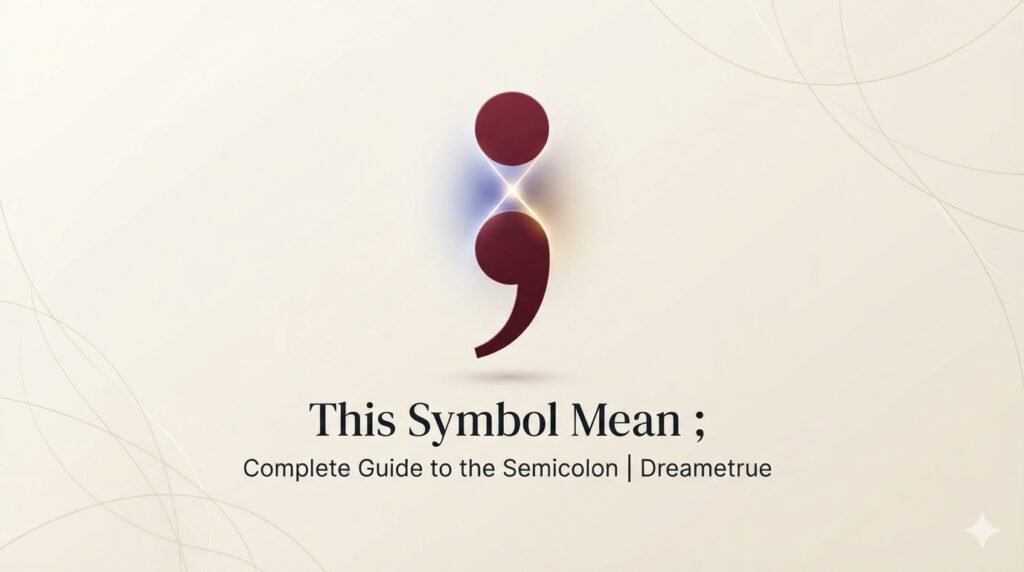
The symbol ; is called a semicolon.
It looks like a combination of two punctuation marks:
- A period at the bottom
- A comma-like mark at the top
The semicolon is written as:
;
Its name comes from “semi” + “colon,” reflecting its relationship to the colon (:). Dictionary sources define it primarily as punctuation used to separate parts of a sentence or items in a detailed list.
Semicolon vs. Colon
These two symbols look similar, but they don’t perform the same job.
| Symbol | Name | Common purpose |
|---|---|---|
; | Semicolon | Separates closely related clauses or complex list items |
: | Colon | Introduces an explanation, example, list, or elaboration |
For example:
Semicolon:
I wanted to go outside; it started raining.
Colon:
I bought three things: bread, milk, and eggs.
A simple way to remember it is:
Colon = introduces
Semicolon = separates
What Does a Semicolon Mean in Grammar?
In English grammar, the semicolon creates a stronger separation than a comma but doesn’t completely end the relationship between two ideas like a period does.
The most important use is connecting two closely related independent clauses.
An independent clause is a group of words that can stand alone as a complete sentence.
Example
Sarah studied all night; she passed the exam.
You could write:
Sarah studied all night. She passed the exam.
Both sentences are grammatically complete. The semicolon simply emphasizes that the two ideas are closely connected.
Cambridge Dictionary similarly defines the semicolon as a mark used between parts of a sentence that could generally stand as grammatical sentences on their own, as well as between items in a list.
When Should You Use a Semicolon?
There are several common situations.
1. To Join Closely Related Sentences
Use a semicolon when two independent clauses are strongly connected.
Example:
The weather was beautiful; we decided to go hiking.
Both sides can stand alone:
The weather was beautiful.
We decided to go hiking.
The semicolon keeps them connected.
2. To Separate Complicated List Items
Semicolons can make a complicated list easier to understand, particularly when individual list items already contain commas.
Example:
We visited Paris, France; Rome, Italy; and Madrid, Spain.
Without semicolons, the commas can make the boundaries between the items unclear.
Oxford notes that semicolons can separate items in a detailed list.
3. Before Certain Transitional Words
A semicolon can appear before transitional expressions such as:
- however
- therefore
- nevertheless
- consequently
- meanwhile
- instead
Example:
I wanted to buy the laptop; however, it was too expensive.
The semicolon separates the two independent clauses, while however connects their ideas.
What Does ; Mean in Texting?
This is where things become more complicated.
In ordinary texting, ; doesn’t have one universally agreed emotional meaning.
Its interpretation depends heavily on context.
Someone might use a semicolon simply because they’re writing normally. Another person might use it deliberately as a stylistic pause.
For example:
Okay; I’ll see you later.
Here, it’s probably just punctuation.
But a standalone:
;
could be interpreted differently depending on the conversation, platform, or relationship.
Does ; Mean Something Special in Text Messages?
Not necessarily.
Unlike symbols such as ❤️ or 😂, the semicolon doesn’t have one standardized emotional meaning in everyday texting.
It may indicate:
- A pause
- Separation between thoughts
- A continuation of an idea
- Formal or careful writing
- A stylistic choice
- An inside joke
- A reference to the semicolon as a symbol of survival
Context matters more than the character itself.
So if someone sends you ;, don’t automatically assume they’re angry, flirting, sad, or annoyed.
What Does a Semicolon Mean in a Text From Someone?
If someone uses a semicolon in a message, look at the whole sentence, not just the punctuation.
For example:
“I understand; don’t worry.”
This is ordinary punctuation.
Compare that with:
“I was going to tell you; never mind.”
Here, the semicolon helps connect two thoughts, but the emotional meaning comes primarily from the words.
Why Can Punctuation Feel Emotional in Texting?
Face-to-face conversations contain facial expressions, voice tone, pauses, and gestures.
Text messages don’t.
As a result, people sometimes interpret punctuation as a clue to someone’s tone.
But punctuation alone isn’t reliable enough to determine someone’s emotions.
Don’t overinterpret a single semicolon.
What Does a Semicolon Tattoo Mean?
The semicolon has another widely recognized modern meaning.
A semicolon tattoo can represent continuation, survival, hope, and mental-health awareness.
The basic idea comes from the grammatical function of the semicolon:
A sentence could have ended, but it continued.
Project Semicolon describes the semicolon tattoo as a symbol associated with survival, connection, and mental-health awareness. The organization traces its movement to 2013 and Amy Bleuel.


5
Why Is the Semicolon Associated With Mental Health?
The symbolism is based on a metaphor.
In writing, an author could use a period to end a sentence. Instead, a semicolon allows the sentence to continue.
The modern symbolic interpretation is essentially:
“My story isn’t over.”
For many people, the semicolon represents:
- Continuing through difficult experiences
- Hope
- Survival
- Recovery
- Connection
- Mental-health awareness
- Remembering someone who died
It’s important to distinguish this cultural symbolism from the grammatical definition. A semicolon doesn’t inherently mean mental health or survival; that meaning comes from the movement and the people who adopted the symbol.
What Does the Semicolon Mean Spiritually?
There is no single established spiritual meaning of the semicolon.
Some people give their semicolon tattoos or artwork personal spiritual interpretations, such as:
- A new beginning
- Continuing one’s life journey
- Hope after hardship
- Strength
- Personal transformation
- Choosing to keep going
These are personal or cultural interpretations, not universal religious teachings.
That’s an important distinction.
The semicolon has a documented grammatical meaning, while spiritual interpretations depend on the individual and their tradition.
Does the Semicolon Have a Biblical Meaning?
The semicolon does not have a specific biblical meaning.
The Bible predates modern English punctuation systems, so the modern semicolon isn’t a biblical symbol in the same sense as religious symbols that have historical roots in biblical traditions.
Someone may personally use a semicolon alongside Bible verses or Christian themes to represent hope, perseverance, or faith, but that is a personal interpretation, not a standard biblical definition.
What Does ; Mean in Programming?
If you’re seeing ; inside computer code, you’re dealing with a completely different use.
Many programming languages use semicolons to separate or terminate statements.
For example, JavaScript commonly uses:
let name = "Alex";
console.log(name);
Here, the semicolon marks the end of statements.
MDN explains that JavaScript statements can be separated by semicolons and that JavaScript also has rules for automatic semicolon insertion (ASI) in certain situations.
Why Do Programmers Use Semicolons?
A programming language needs a way to understand where one instruction ends and another begins.
In languages that use semicolons, the character can provide that boundary.
For example:
let x = 10;
let y = 20;
let total = x + y;
Each instruction is clearly separated.
However, semicolon rules differ between programming languages. You shouldn’t assume that ; behaves identically everywhere.
What Does ; Mean in JavaScript?
JavaScript is an interesting example because semicolons are often optional in certain situations due to automatic semicolon insertion.
For example, JavaScript can interpret some code without explicitly written semicolons.
However, semicolon insertion has specific rules, and omitting semicolons can sometimes produce unexpected behavior when lines are interpreted differently than the programmer intended. MDN documents these rules in detail.
A common style is:
const age = 25;
const name = "Alex";
In this example, each statement ends with ;.
What Does ; Mean in Other Programming Languages?
The exact meaning varies.
| Language/context | Typical role of ; |
|---|---|
| JavaScript | Statement termination/separation |
| Java | Statement termination |
| C | Statement termination |
| C++ | Statement termination |
| C# | Statement termination |
| PHP | Commonly terminates statements |
| SQL | Often terminates a statement or batch, depending on environment |
| Python | Can separate multiple simple statements on one line |
The key point is that semicolon meaning is language-dependent in programming.
What Does ; Mean in a CSV File?
You may also encounter semicolons when working with spreadsheets or data files.
A CSV-style file uses a delimiter to separate columns.
While commas are common, some systems use semicolons instead.
For example:
Name;Age;Country
Ali;25;Pakistan
Sara;29;Canada
Here, ; separates the fields.
Microsoft explains that Excel allows the delimiter used when importing text/CSV files to be changed, and regional settings can result in semicolons being used as list separators.
Why Use a Semicolon Instead of a Comma?
One reason is that some locales use a comma as the decimal separator.
For example:
12,5
If a comma were also being used to separate columns, the data could become ambiguous.
A semicolon can therefore serve as the field separator.
Semicolon vs. Comma vs. Period
Understanding the difference between these punctuation marks makes the semicolon much easier.
| Symbol | Name | General function |
|---|---|---|
, | Comma | Short separation within a sentence |
; | Semicolon | Stronger separation between related clauses/items |
. | Period/full stop | Ends a statement |
: | Colon | Introduces an explanation, list, or example |
Think of the semicolon as sitting somewhere between a comma and a period in terms of separation.
That doesn’t mean it’s simply a “longer comma,” though. It has its own grammatical rules.
What Is the Difference Between a Semicolon and a Colon?
This is one of the most common questions.
Semicolon
I wanted to call you; I was too busy.
The semicolon connects two related independent clauses.
Colon
I had one problem: I was too busy.
The colon introduces an explanation.
A useful rule is:
Use a semicolon to connect. Use a colon to introduce.
There are exceptions and more advanced uses, but this distinction works well for beginners.
What Is the Difference Between a Semicolon and a Comma?
A comma usually provides a lighter separation.
A semicolon creates a stronger boundary.
Compare:
I was tired, so I went home.
with:
I was tired; I went home.
The second version treats the two clauses as closely related but independent statements.
Also, don’t use a semicolon simply because you want a longer pause. Grammar matters more than the length of the pause.
Where Did the Semicolon Come From?
The semicolon has a long history in European printing.
Merriam-Webster notes that the semicolon was introduced into modern type by an Italian printer around 1566 and identifies its first known English use in the modern dictionary sense as 1644.
Its history also helps explain why the symbol occupies a middle ground between a comma and a period.
Over time, writers developed conventions for using it to organize complex sentences and lists.
Today, it’s used in everything from academic writing to computer programming.
What Does a Semicolon Symbolize?
Beyond grammar and technology, the semicolon can symbolize different things.
| Context | Meaning |
|---|---|
| English grammar | Separates related clauses |
| Complex lists | Separates individual items |
| Texting | Usually ordinary punctuation; meaning depends on context |
| Programming | Often separates or terminates statements |
| CSV/data | Can act as a field delimiter |
| Semicolon tattoo | Often represents continuation, survival, hope, or awareness |
| Personal spirituality | May represent continuation or transformation |
| Art/design | Can carry whatever meaning the creator assigns |
This is why the question “What does this symbol mean ;?” doesn’t have one answer.
The context determines the meaning.
Common Mistakes With the Semicolon
The semicolon is useful, but it’s also easy to misuse.
Mistake 1: Using It Like a Random Comma
Don’t replace every comma with a semicolon.
Incorrect:
I bought apples; oranges; and bananas.
Better:
I bought apples, oranges, and bananas.
Use semicolons when the structure calls for stronger separation.
Mistake 2: Joining Incomplete Sentences
A semicolon normally connects independent clauses.
Incorrect:
Because I was tired; I went home.
The first part isn’t an independent clause.
Better:
Because I was tired, I went home.
Or:
I was tired; I went home.
Mistake 3: Confusing It With a Colon
Incorrect:
I have three goals; improve my writing, learn coding, and exercise.
Better:
I have three goals: improve my writing, learn coding, and exercise.
The colon introduces the list.
Mistake 4: Assuming Every Semicolon Has a Hidden Meaning
Seeing ; in a message doesn’t automatically mean something emotional or symbolic.
Sometimes it’s simply punctuation.
How to Know What ; Means When You See It
Use this quick decision process.
Step 1: Look at the surrounding words
Is it inside a normal sentence?
If yes, it’s probably punctuation.
Step 2: Look at the platform
Is it in:
- An email?
- A text?
- A social-media post?
- Computer code?
- A spreadsheet?
- A CSV file?
The environment gives you a major clue.
Step 3: Consider the context
A semicolon in:
let x = 5;
has a very different purpose from one in:
I survived; I kept going.
Step 4: Don’t assume emotional meaning
Especially in texting, punctuation can be interpreted differently by different people.
Look at the person’s actual words and communication style before assigning an emotional meaning.
Why Do People Search “What Does This Symbol Mean ;”?
The query can come from several different situations.
Someone may have:
- Seen
;in a text message - Found it in a social-media post
- Seen a semicolon tattoo
- Encountered it in computer code
- Found semicolons in a CSV file
- Been confused about English punctuation
- Wondered whether
;has a spiritual meaning - Confused it with
: - Seen someone use it repeatedly online
These are different search intents, even though the same symbol appears in each question.
That’s why a good explanation needs to distinguish literal meaning from contextual meaning.
Frequently Asked Questions About the ; Symbol
What is the symbol ; called?
It is called a semicolon.
What does ; mean in English?
In English writing, the semicolon commonly separates two closely related independent clauses or separates complicated items in a list.
What does ; mean in texting?
Usually, it is simply punctuation. Depending on context, it may create a pause or separate thoughts, but it has no single universal emotional meaning in texting.
What does a semicolon tattoo mean?
A semicolon tattoo is widely associated with continuation, survival, hope, and mental-health awareness. Project Semicolon describes it as a symbol of survival and connection.
Does a semicolon mean “keep going”?
In the context of the modern semicolon-symbol movement, yes, that’s a common interpretation. The idea comes from treating the semicolon as a sentence that could have ended but continued.
What does ; mean in coding?
In many programming languages, it marks the end of a statement or separates statements. The exact rules depend on the programming language.
What does ; mean in JavaScript?
JavaScript uses semicolons as statement terminators, although automatic semicolon insertion means they can be omitted in some circumstances.
What does ; mean in Python?
Python can use semicolons to place multiple simple statements on the same line, although normal Python style generally puts statements on separate lines.
What does ; mean in Excel?
It can be used as a list or field separator depending on regional settings and how data is imported or exported. Microsoft Excel allows users to select delimiters when importing text/CSV data.
Is ; the same as 😕
No.
; is a semicolon, while : is a colon. They have different grammatical and technical functions.
Is a semicolon stronger than a comma?
Generally, yes. A semicolon creates a stronger separation than a comma while keeping closely related ideas connected.
Is a semicolon stronger than a period?
No. A period normally creates a complete sentence boundary. A semicolon keeps two related independent clauses within the same sentence.
The Simple Meaning of ; to Remember
If you only remember one thing, remember this:
;is a semicolon. Its meaning depends on context.
In grammar, it separates related ideas.
In lists, it separates complicated items.
In programming, it often separates or terminates statements.
In data files, it can separate fields.
In texting, it’s usually punctuation unless the surrounding context gives it another meaning.
And as a modern cultural symbol, especially in tattoos, it can represent continuation, survival, hope, and mental-health awareness.
So when you see ;, don’t ask only, “What does this symbol mean?”
Ask:
“Where did I see it, and how is it being used?”
That’s the key to understanding the semicolon correctly.
discover more post
What Does the Monster Symbol Mean The Real …
What Does This Symbol Mean in Writing A Complete Guide …
What Does the Infinity Symbol Mean ∞ Meaning History …

About Zoya
Zoya is the author and content creator behind DreamETrue, where she shares well-researched articles about dream meanings, dream symbolism, and interpretations from cultural, spiritual, and psychological perspectives.
Her goal is to make dream-related topics simple, trustworthy, and easy to understand for readers around the world. Every article is carefully written with a focus on clarity, accuracy, and providing genuine value, helping readers explore the fascinating world of dreams with confidence.
Through DreamETrue, Zoya is committed to publishing original, informative, and reader-focused content that follows high editorial standards. Whether you’re curious about a recurring dream or looking for the meaning behind a specific dream symbol, her mission is to provide reliable guidance in a clear and engaging way.
When she’s not researching dream symbolism, Zoya enjoys reading, learning about human psychology, and creating helpful content that inspires curiosity and understanding.