You’ve probably seen it on a hospital sign, doctor’s office, ambulance, prescription pad, medical website, or pharmacy logo: a snake wrapped around a staff.
But what does the medical symbol mean? Why is a snake associated with healing in the first place? And why do some medical logos show one snake, while others show two snakes and wings?
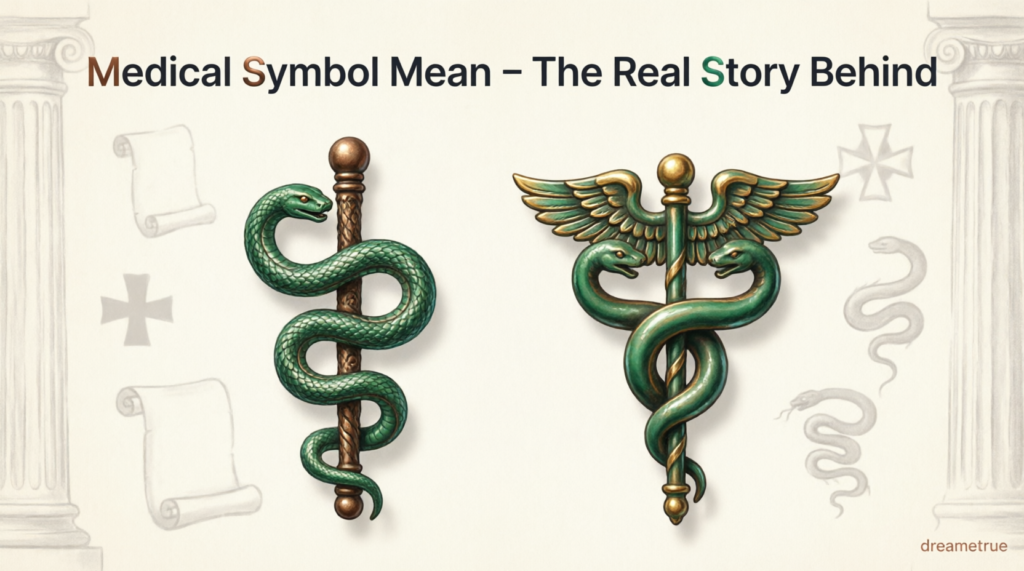
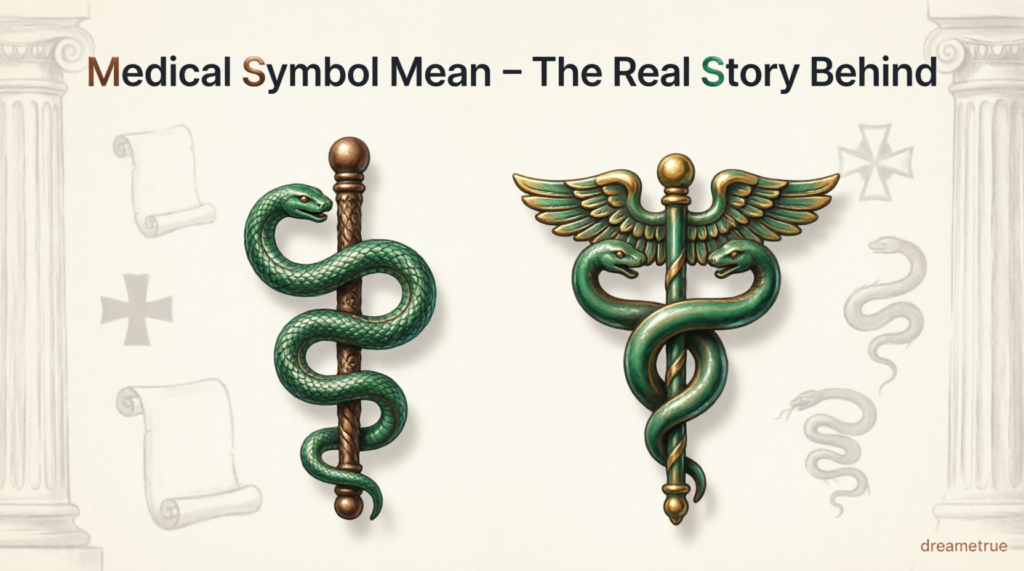
The answer is more interesting than it first appears. The symbol most historically associated with medicine is the Rod of Asclepius, a staff with a single serpent. The similar-looking Caduceus, with two snakes and wings, actually belonged to Hermes and was traditionally associated with commerce, communication, and negotiation rather than medicine.
Featured Snippet Answer:
The traditional medical symbol is the Rod of Asclepius, showing one snake wrapped around a staff. It represents medicine, healing, and the medical profession and comes from ancient Greek traditions surrounding Asclepius, the god of healing. The two-snake, winged Caduceus is a different symbol historically associated with Hermes.
What Does the Medical Symbol Mean?
The traditional medical symbol is the Rod of Asclepius (also called the Staff of Asclepius or Aesculapian staff).
It consists of:
- One staff or rod
- One serpent wrapped around it
- No wings
The symbol is associated with medicine, healing, physicians, and healthcare.
The World Health Organization uses a staff with a single snake in its emblem and explains that the staff has long been associated with medicine and the medical profession. WHO traces the emblem to Asclepius, whom the ancient Greeks revered as a god of healing.
So, if someone asks, “What is the medical symbol?”, the historically accurate answer is generally:
The Rod of Asclepius: one snake wrapped around a staff.
What Is the Rod of Asclepius?
The Rod of Asclepius is a traditional emblem of medicine featuring a single serpent coiled around a staff.
It takes its name from Asclepius, a figure in ancient Greek religion and mythology associated with healing and medicine.
The symbol has remained connected with medicine for more than two thousand years. A historical review in World Journal of Surgery traces the association between the serpent, Asclepius, and healing back to at least the fourth century BCE.
Today, the Rod of Asclepius appears in medical organizations, healthcare emblems, professional insignia, and public-health imagery around the world.
Merriam-Webster defines the Staff of Asclepius as a staff with a single snake wrapped around it that is used as a symbol of medicine.
What Does the Snake Mean in the Medical Symbol?
The snake is the most visually striking part of the symbol.
Its meaning isn’t based on one universally proven explanation. Instead, several historical and symbolic interpretations have developed around the serpent.
These include:
- Healing
- Renewal
- Life and death
- Transformation
- Rejuvenation
- Protection
- The mysterious power of nature
- The struggle between illness and recovery
One obvious characteristic of snakes is that they shed their skin. Throughout history, this has made the snake a powerful metaphor for renewal and rejuvenation.
A historical review in World Journal of Surgery notes that the serpent has been associated with medicine for more than 2,400 years and that its symbolism has been connected with ideas including life, death, renewal, and healing.
However, it’s important not to turn these interpretations into a single “official” meaning.
The historical record is more complicated.
Why Is a Snake Associated With Healing?
At first, a snake seems like an unusual choice for medicine.
Snakes can be dangerous. Some are venomous, and their bites have historically caused serious illness and death.
Yet snakes also became associated with healing and transformation in several ancient cultures.
Their ability to shed their skin may have encouraged associations with renewal and new life. Their venom also has a fascinating duality: something potentially harmful can, under controlled scientific conditions, become part of medicine.
But these are interpretations, not proof of exactly why the original symbol was created.
Ancient traditions surrounding Asclepius provide the strongest direct historical connection between the single serpent and healing.
Who Was Asclepius?
Asclepius was an ancient Greek figure associated with medicine and healing.
According to Greek mythology, he became so skilled at healing that stories attributed extraordinary powers to him.
The World Health Organization describes Asclepius as a figure revered by the ancient Greeks as a god of healing and explains that his cult involved snakes.
His name is also preserved in the Roman form Aesculapius.
That’s why you may encounter terms such as:
- Rod of Asclepius
- Staff of Asclepius
- Aesculapian staff
- Staff of Aesculapius
They refer to essentially the same medical emblem.
What Does Asclepius Have to Do With Modern Medicine?
The connection is symbolic rather than a claim that modern medicine comes directly from Greek mythology.
Asclepius became an enduring representation of the healing profession.
Ancient sanctuaries dedicated to him became associated with people seeking relief from illness. The broader tradition helped establish the serpent-and-staff image as an enduring emblem of healing.
Over centuries, the symbol survived changes in language, religion, art, and medical practice.
Eventually, it became recognizable far beyond the ancient Mediterranean world.
What Does the Staff Mean?
The staff itself has also been interpreted symbolically.
A staff can represent:
- Support
- Guidance
- Authority
- Travel
- Wisdom
- The healer’s role
Historical interpretations aren’t completely uniform, so it’s safer to say that the staff and serpent together became the recognizable emblem of Asclepius and healing rather than claiming that every part has one proven symbolic definition.
JAMA notes that serpent-and-staff imagery has long been associated with healing arts and discusses interpretations connecting the staff with sacred trees and the serpent with life, death, and healing.
Why Is There a Snake in the Medical Symbol?
The short answer is:
Because the serpent became historically associated with Asclepius and healing in ancient Greek tradition.
The deeper explanation includes mythology, ancient religious practice, symbolism, and centuries of cultural transmission.
The snake’s ability to shed its skin may have contributed to associations with renewal, while ancient traditions surrounding Asclepius provided a direct connection between serpents and healing.
Rod of Asclepius vs. Caduceus: What’s the Difference?
This is where many people get confused.
The two symbols look similar, but they’re historically different.
| Feature | Rod of Asclepius | Caduceus |
|---|---|---|
| Snakes | One | Two |
| Wings | No | Usually yes |
| Associated figure | Asclepius | Hermes |
| Traditional association | Healing and medicine | Commerce, communication, negotiation |
| Historical medical connection | Strong | Historically not the primary medical emblem |
| Common modern use | Medicine and healthcare | Sometimes incorrectly used for medicine |
The distinction is well established in medical-history literature. The Rod of Asclepius has one serpent, while the Caduceus has two serpents and commonly includes wings.
What Does the Caduceus Mean?
The Caduceus is traditionally associated with Hermes, the Greek messenger god.
It is typically shown as:
- A staff
- Two intertwined snakes
- Wings near the top
Hermes was associated with areas including:
- Commerce
- Trade
- Merchants
- Communication
- Travel
- Negotiation
The symbol therefore has a very different historical origin from the Rod of Asclepius.
The Science Museum Group explains that the Caduceus became associated with Hermes and eventually commerce, while the single-snake staff became associated with Asclepius and healing.
Why Do So Many Medical Organizations Use the Caduceus?
This is one of the most fascinating parts of the story.
The Caduceus became widely used in American medical contexts despite its older association with Hermes.
One important turning point came in the early 20th century.
Historical medical literature identifies 1902, when the U.S. Army Medical Corps incorporated the Caduceus, as an important moment in its adoption as a medical emblem in the United States.
Once a symbol becomes familiar, it can remain popular even when its original historical meaning is forgotten.
That’s essentially what happened with the Caduceus in many healthcare settings.
Is the Caduceus Actually a Medical Symbol?
The answer needs some nuance.
Historically?
No—not in the same sense as the Rod of Asclepius.
The Caduceus belongs to Hermes and traditionally relates to commerce, communication, and related functions.
In modern usage?
Yes, it can function as a medical symbol.
Many medical organizations, hospitals, military medical services, and healthcare-related businesses have used it.
So saying “the Caduceus is never used for medicine” would be inaccurate.
A better statement is:
The Caduceus is widely used in modern medical imagery, but the Rod of Asclepius has the stronger historical connection to medicine and healing.
That distinction is supported by medical-history research.
Why Does the WHO Use One Snake?
The World Health Organization emblem includes a staff with a snake wrapped around it.
WHO explains that its emblem was chosen by the First World Health Assembly in 1948 and incorporates the United Nations symbol together with a staff and serpent associated with medicine.
This is a useful real-world example of the Rod of Asclepius tradition.
It also helps answer the common question:
“Which snake symbol is the real medical symbol?”
The single-snake staff is the traditional answer.
Is the Rod of Asclepius the Official Symbol of Medicine?
There isn’t one worldwide organization that controls every medical symbol used everywhere.
However, the Rod of Asclepius is widely recognized as the traditional emblem of medicine.
It is used by major medical and health organizations, including the World Health Organization.
The American Medical Association also uses the Staff of Asclepius as its insignia. Merriam-Webster specifically identifies the staff as the AMA’s official insignia.
So the safest wording is:
The Rod of Asclepius is the traditional and widely recognized symbol of medicine, although other symbols—including the Caduceus—are also used in healthcare.
What Does the Medical Symbol Mean in Different Countries?
Medical symbolism isn’t completely uniform around the world.
Different countries and institutions may use:
- Rod of Asclepius
- Caduceus
- Red Cross
- Bowl of Hygieia
- Star of Life
- Local medical association emblems
- National healthcare symbols
The Rod of Asclepius remains particularly widespread as a general symbol of medicine.
The WHO emblem is one major international example.
What Is the Star of Life?
The Star of Life is another important healthcare symbol, especially associated with emergency medical services.
It is usually shown as a blue six-pointed star containing the Rod of Asclepius.
Each point is traditionally associated with a stage of the emergency medical response system.
The symbol is therefore more specific than the general medical snake-and-staff emblem.
Rod of Asclepius
Broadly represents:
Medicine and healing
Star of Life
Commonly represents:
Emergency medical services
These symbols are related, but they aren’t interchangeable in every context.
What Is the Bowl of Hygieia?
The Bowl of Hygieia is especially associated with pharmacy.
It typically depicts:
- A bowl or cup
- A serpent wrapped around or near it
Hygieia was associated with health, cleanliness, and sanitation in ancient Greek tradition.
The Science Museum Group notes that the Bowl of Hygieia became associated with pharmacy and traces an early appearance on a coin to the Parisian Society of Pharmacy in 1796.
So if you see a snake and cup, you’re more likely looking at a pharmacy symbol than the general medical emblem.
Common Medical Symbols and Their Meanings
| Symbol | Common association |
|---|---|
| 🐍 + staff | Rod of Asclepius / medicine |
| Two snakes + wings | Caduceus / Hermes |
| Star with snake and staff | Emergency medical services |
| Snake + bowl/cup | Pharmacy |
| Red Cross | Humanitarian and medical-related use, subject to specific legal protections |
| Rx | Prescription-related terminology |
| Green cross | Pharmacy in many countries |
| Heart | Health, cardiovascular care, or general wellness depending on context |
Not every healthcare organization uses these symbols in exactly the same way.
What Does the Red Cross Symbol Mean?
The Red Cross emblem is often confused with a general medical logo.
But it has a specific humanitarian history and legal significance.
The Red Cross emblem is associated with the International Red Cross and Red Crescent Movement and has protected uses under international humanitarian law.
That means it shouldn’t simply be treated as a generic decorative healthcare icon.
This distinction matters when discussing medical symbols because not every health-related symbol is interchangeable.
What Does the Rx Symbol Mean?
You may also see Rx on prescriptions and pharmacy-related materials.
It is commonly associated with:
- Prescription
- Medical prescription
- Pharmacy
- Medication
The exact historical origin of “Rx” is debated, and popular explanations shouldn’t automatically be presented as established fact.
Unlike the Rod of Asclepius, Rx isn’t primarily a pictorial symbol of medicine itself.
It’s a written abbreviation associated with prescriptions.
What Does the Medical Symbol Mean Spiritually?
The Rod of Asclepius has a historical religious and mythological background, but its modern medical meaning is primarily professional and symbolic, not a spiritual instruction.
Historically, Asclepius was part of ancient Greek religious traditions surrounding healing. WHO itself notes that Asclepius was revered as a god of healing and that his cult involved snakes.
Modern hospitals generally use the symbol to communicate ideas such as:
- Healthcare
- Medicine
- Healing
- Medical expertise
- Professional care
That doesn’t mean a hospital displaying the symbol is making a religious statement.
Historical belief vs. modern meaning
Historical: connected to Asclepius and ancient healing traditions.
Modern: commonly recognized as an emblem of medicine.
Those are two different contexts.
Does the Medical Symbol Have a Biblical Meaning?
The Rod of Asclepius itself is not a biblical symbol.
However, snakes do appear in biblical traditions, which sometimes creates confusion.
One well-known example is the bronze serpent raised by Moses in Numbers 21:6–9.
Because both stories involve a serpent associated with healing, some writers have suggested symbolic connections.
But it is important not to present them as the same historical symbol.
The distinction
Rod of Asclepius:
Ancient Greek tradition associated with Asclepius and healing.
Bronze serpent of Moses:
A separate biblical account.
The fact that both involve snakes doesn’t establish that one symbol originated from the other.
JAMA has discussed the biblical bronze serpent alongside the broader history of serpent symbolism in medicine.
Why Do So Many Cultures Associate Snakes With Healing?
The serpent is an unusually powerful symbol because it can represent apparently opposite ideas.
A snake can be associated with:
- Danger
- Death
- Protection
- Renewal
- Fertility
- Transformation
- Healing
The symbolism changes across cultures.
A historical review notes that serpent symbolism appears in multiple ancient traditions and that its meanings have included both threatening and regenerative ideas.
So there isn’t a single worldwide “snake meaning.”
The medical use of the serpent is part of a much larger human history of symbolic interpretation.
Is the Snake a Symbol of Life and Death?
In some historical interpretations, yes.
The snake’s association with both danger and renewal makes it particularly suited to the boundary between illness and healing.
JAMA describes traditions in which serpents were associated with life, death, deliverance, and healing.
But this should be described as symbolic interpretation, not as a universal scientific meaning.
Does the Snake Symbol Mean Rebirth?
It can symbolize renewal or regeneration in historical and cultural interpretations.
The most obvious visual reason is the snake’s ability to shed its skin.
However, the specific meaning assigned to the Rod of Asclepius comes from the wider history of Asclepius and the serpent rather than from a single ancient document saying:
“The snake means rebirth.”
Historical symbolism rarely works that neatly.
What Does the Medical Symbol Mean Psychologically?
From a modern communication perspective, the symbol works because it is visually distinctive and culturally recognizable.
A person doesn’t need to know Greek mythology to understand that a snake wrapped around a staff probably has something to do with healthcare.
That makes symbols powerful communication tools.
They can:
- Communicate complex ideas quickly
- Cross language barriers
- Create institutional identity
- Help people identify medical services
- Connect modern institutions with historical traditions
This is one reason symbols remain useful even in an age of digital interfaces and text-based communication.
Why Is the Medical Symbol So Recognizable?
There are several reasons.
It is visually simple
One staff + one snake creates a distinctive shape.
It has a long history
The association with healing stretches back to antiquity.
Major institutions use it
Organizations such as WHO incorporate the staff-and-serpent imagery into official branding.
It works across languages
You don’t have to read the word “medicine” to recognize the symbol.
That’s an enormous advantage for hospitals and healthcare systems.
Medical Symbol Meaning: One Snake vs. Two Snakes
This is the easiest way to remember the difference:
One snake = Rod of Asclepius = medicine and healing.
Two snakes + wings = Caduceus = Hermes and historically commerce/communication, although widely used in modern medical imagery.
If you’re designing a medical logo and want the historically traditional emblem of medicine, the single-snake Rod of Asclepius is the more historically accurate choice.
Why Do People Call the Caduceus the “Medical Symbol”?
Because modern usage has blurred the distinction.
Once a recognizable symbol is repeatedly used by hospitals, military medical organizations, publishers, and healthcare businesses, people naturally begin associating it with medicine.
That doesn’t erase its original historical meaning.
This is an excellent example of how symbolic meaning can evolve through repeated cultural use.
Research on medical symbolism has documented the widespread use of the Caduceus in medical settings despite its different classical origin.
Is Using the Caduceus for Medicine Wrong?
Calling it simply “wrong” is too simplistic.
From a historical perspective
The Rod of Asclepius has the stronger connection to medicine.
From a modern cultural perspective
The Caduceus is widely recognizable as a medical symbol, especially in the United States.
From a design perspective
An organization can choose the Caduceus intentionally because audiences already associate it with healthcare.
So the most accurate conclusion is:
The Caduceus is historically associated with Hermes, but modern medical culture has adopted it extensively as a healthcare symbol.
Popular Myths About the Medical Symbol
Myth 1: Every medical symbol with a snake is the Rod of Asclepius
False.
The Caduceus also contains snakes, but it has two.
The Rod of Asclepius has one.
Myth 2: Two snakes automatically mean medicine
Not historically.
Two snakes plus wings identify the Caduceus, which belongs to Hermes.
Its traditional associations are different from those of Asclepius.
Myth 3: The snake represents only poison
Not in medical symbolism.
The serpent has accumulated many meanings, including healing, renewal, danger, and transformation.
Myth 4: The medical symbol is a religious symbol used by hospitals
Not necessarily.
The Rod of Asclepius has ancient religious and mythological roots, but its modern use generally communicates medicine and healthcare, not worship.
Myth 5: The Caduceus was invented specifically for doctors
No.
The Caduceus has a much older association with Hermes.
Its widespread modern medical use developed later.
Medical Symbol Meaning at a Glance
| Question | Answer |
|---|---|
| What is the traditional medical symbol? | Rod of Asclepius |
| How many snakes does it have? | One |
| Who is Asclepius? | Ancient Greek figure associated with healing |
| What does the staff represent? | Part of the traditional healing emblem; interpretations vary |
| What does the snake represent? | Healing and broader ideas of life, death, renewal, and transformation |
| What is the Caduceus? | Staff of Hermes with two snakes and usually wings |
| Is the Caduceus used in medicine? | Yes, widely in modern contexts |
| Is it historically the primary medical symbol? | No |
| Does WHO use the Rod of Asclepius? | Yes, its emblem includes a staff with a snake |
| What is the pharmacy symbol? | Often the Bowl of Hygieia |
| What is the emergency medical symbol? | Star of Life |
| Is the Rod of Asclepius biblical? | No; it comes from ancient Greek tradition |
How to Identify the Medical Symbol Correctly
When you see a snake-and-staff symbol, count the snakes.
One snake
Rod of Asclepius
→ Medicine and healing
Two snakes + wings
Caduceus
→ Hermes; historically commerce and communication, although commonly used in modern medical imagery
Snake + bowl
Bowl of Hygieia
→ Pharmacy
Six-pointed star + staff and snake
Star of Life
→ Emergency medical services
This simple visual test can prevent most confusion.
Why the Medical Symbol Still Matters Today
It may seem strange that a symbol from ancient Greek culture remains relevant in modern hospitals.
But that’s precisely what makes symbols powerful.
Medicine has changed enormously.
Modern doctors use:
- MRI
- CT scans
- Genomic testing
- Robotic surgery
- Artificial intelligence
- Telemedicine
- Advanced pharmaceuticals
- Minimally invasive procedures
Yet the profession still uses an ancient serpent-and-staff image.
Why?
Because the symbol isn’t meant to describe the technology.
It represents the idea of healing and the medical profession itself.
WHO’s continued use of the staff and serpent is a clear example of how ancient symbolism remains embedded in modern global healthcare identity.
The Medical Symbol and the Meaning of Healing
There’s a deeper reason the Rod of Asclepius remains effective.
Medicine isn’t simply about machines, medicines, or diagnoses.
At its core, it involves a human relationship:
Someone is suffering, and another person is trying to help.
The ancient healing symbol captures that idea in a simple visual form.
The serpent makes it memorable.
The staff makes it distinctive.
And the history of Asclepius gives it a connection to one of humanity’s oldest concerns:
How do we heal the sick?
Frequently Asked Questions About the Medical Symbol
What does the medical symbol mean?
The traditional medical symbol, the Rod of Asclepius, represents medicine, healing, physicians, and healthcare. It depicts a single snake wrapped around a staff.
What is the real medical symbol?
The Rod of Asclepius, featuring one snake around a staff, is the traditional medical emblem.
Why is a snake the symbol of medicine?
The serpent became associated with healing through ancient traditions surrounding Asclepius. Its symbolism has also been connected with renewal, life, death, and transformation.
What does the snake and staff symbol mean?
A single snake wrapped around a staff represents the Rod of Asclepius, a traditional symbol of medicine and healing.
What does the one-snake medical symbol mean?
It refers to the Rod of Asclepius and traditionally represents medicine and healing.
What does the two-snake medical symbol mean?
The two-snake, usually winged staff is the Caduceus, traditionally associated with Hermes. It has become widely used in modern medical imagery despite its different classical origin.
What is the difference between the Caduceus and Rod of Asclepius?
The Rod of Asclepius has one snake and represents medicine and healing. The Caduceus has two snakes and usually wings and is associated historically with Hermes.
Is the Caduceus a medical symbol?
It is widely used as a medical symbol today, particularly in the United States, but historically it was not the primary emblem of medicine.
Why does WHO use a snake symbol?
WHO uses a staff with a snake because the staff has a longstanding association with medicine and traces back to Asclepius and ancient Greek healing traditions.
Is the medical symbol Greek?
The traditional Rod of Asclepius has its major historical roots in ancient Greek traditions surrounding Asclepius.
Who was Asclepius?
Asclepius was an ancient Greek figure revered as a god of healing and associated with medicine.
What does Asclepius symbolize?
Asclepius represents healing and the medical profession in the historical tradition that developed around him.
Is the Rod of Asclepius a religious symbol?
It originated in an ancient religious and mythological context, but today it is primarily used as a secular professional symbol of medicine and healthcare.
Is the medical snake symbol in the Bible?
The Rod of Asclepius itself is not a biblical symbol. Biblical texts contain separate stories involving serpents, including the bronze serpent associated with Moses.
What does a snake symbolize spiritually?
Snake symbolism varies greatly between cultures. It can represent renewal, transformation, danger, healing, fertility, wisdom, or other concepts. There is no single universal spiritual meaning.
What does a snake represent in medicine?
In medical symbolism, the snake is primarily connected with healing through the historical tradition of Asclepius, while broader interpretations include renewal and the tension between life and death.
What is the pharmacy symbol?
One traditional pharmacy emblem is the Bowl of Hygieia, depicting a serpent associated with a bowl or cup.
What is the emergency medical symbol?
The Star of Life, usually showing a staff and serpent inside a six-pointed star, is widely associated with emergency medical services.
Why does the medical symbol have a snake and not another animal?
The serpent had established associations with healing in ancient traditions surrounding Asclepius, helping it become an enduring emblem of medicine.
Does the medical symbol mean healing?
Yes. The Rod of Asclepius is traditionally associated with medicine and healing.
Is the Caduceus the same as the Rod of Asclepius?
No. They are different symbols with different classical origins.
Why are there two medical symbols?
Because the historically correct Rod of Asclepius and the later-adopted Caduceus became confused and, in some places, used interchangeably.
Final Answer: What Does the Medical Symbol Mean?
The traditional medical symbol is the Rod of Asclepius: one snake wrapped around a staff.
It represents medicine, healing, and the medical profession, and its roots reach back to ancient Greek traditions surrounding Asclepius, a figure associated with healing. The World Health Organization continues to use this staff-and-serpent imagery in its emblem.
The biggest source of confusion is the Caduceus, which has two snakes and usually wings. Although it’s widely used in modern medical imagery, its classical association is with Hermes, not Asclepius or medicine. Its adoption in American medical settings, particularly through the U.S. Army Medical Corps in the early 20th century, helped cement the modern confusion.
So the easiest rule to remember is:
One snake = Rod of Asclepius = traditional symbol of medicine.
Two snakes + wings = Caduceus = Hermes, later adopted widely in medical imagery.
The symbol may be thousands of years old, but its basic message remains remarkably easy to understand:
Healing, medicine, and the human effort to overcome illness.
descover more post
What Does the Diamond Symbol Mean?
What Does the Om Symbol Mean ॐ Meaning History …
Evil Eye Symbol Mean History 🧿 Nazar 2026

Zayan is the creator and lead writer at DreamETrue, a blog dedicated to exploring the fascinating world of dreams and their meanings. With a passion for dream symbolism, spiritual insights, and easy-to-understand explanations, Zayan creates well-researched content that helps readers better understand the messages and emotions behind their dreams.
Every article published on DreamETrue is written with a focus on accuracy, clarity, and reader value. By combining information from trusted sources, cultural perspectives, and psychological interpretations, Zayan aims to make dream-related topics simple, engaging, and accessible for everyone.
Whether you’re curious about a recurring dream, searching for the meaning of a specific symbol, or simply interested in learning more about dreams, Zayan’s goal is to provide helpful, reliable, and easy-to-read content that informs and inspires.