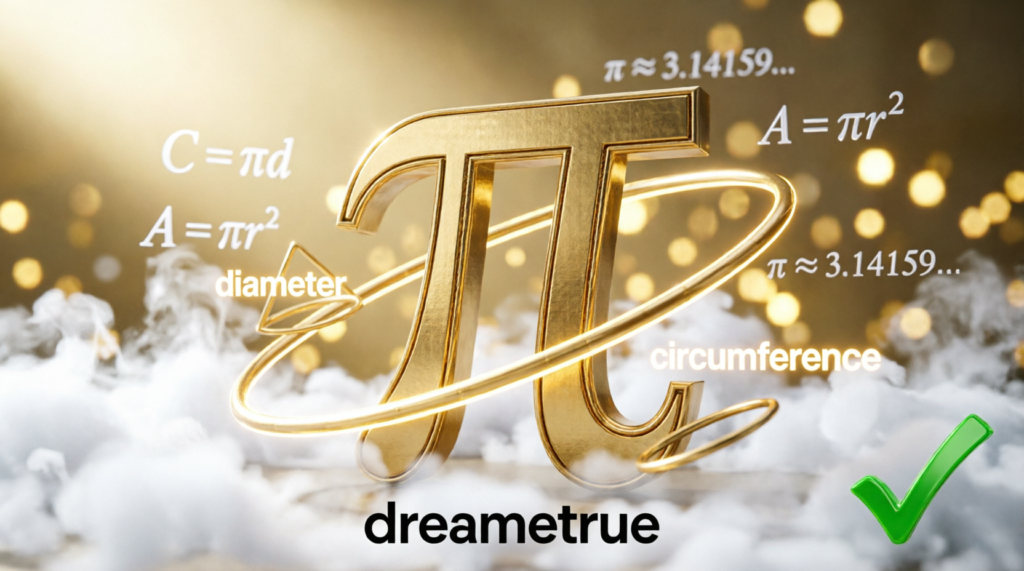
Have you ever seen π in a math equation and wondered what that strange symbol actually means?
The symbol looks simple, but it represents one of the most important constants in mathematics. You’ll find π in geometry, trigonometry, physics, engineering, astronomy, computer science, and even space exploration.
So, what does the symbol pi mean?
In mathematics, π (pi) represents the constant ratio of a circle’s circumference to its diameter. No matter how large or small a circle is, dividing its circumference by its diameter always gives approximately 3.14159.
And that’s only the beginning. Pi is irrational, transcendental, infinitely long in decimal form, and deeply connected to circles, angles, waves, spheres, and many areas of science.
Featured Snippet Answer: What Does the Symbol π Mean?
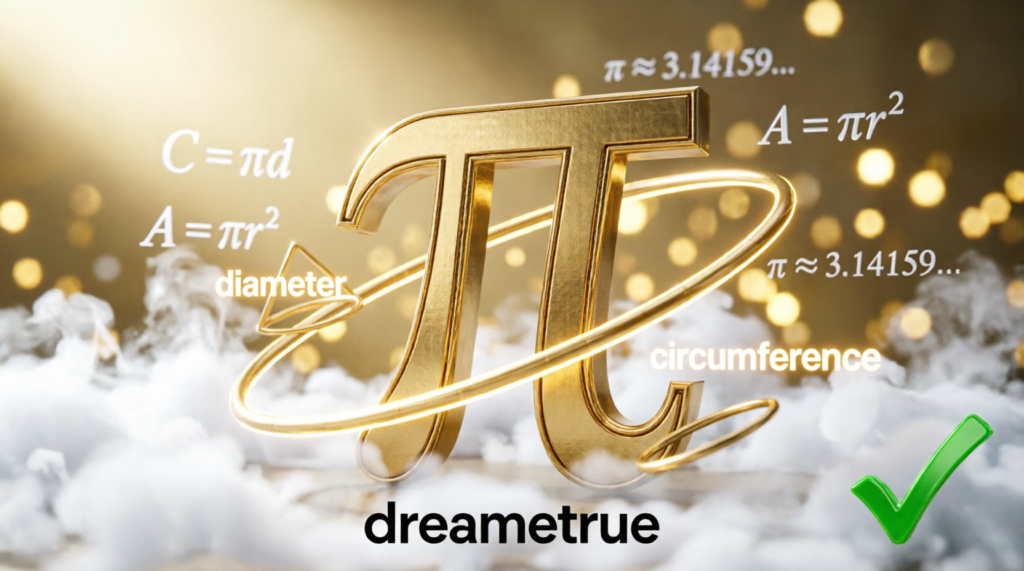
The symbol π (pi) represents a mathematical constant equal to the ratio of a circle’s circumference to its diameter. Its approximate value is 3.14159. Pi is irrational and its decimal digits continue forever without repeating. It is used to calculate circles, spheres, angles, waves, and many scientific and engineering measurements.
What Is the Meaning of π in Math?
The simplest definition is:
π = circumference ÷ diameter
In other words, if you measure around a circle and divide that measurement by the distance across the circle through its center, you always get the same constant.
That constant is π.
The basic value of pi
π begins:
π = 3.14159265358979323846…
For everyday calculations, you’ll often see it rounded to:
- 3.14
- 3.1416
- 22/7 as a useful approximation
The exact value of π cannot be written as a terminating decimal or an ordinary fraction. Its decimal expansion continues indefinitely.
A simple example
Imagine a circle with a diameter of 10 cm.
Its circumference is approximately:
10 × π = 31.4159 cm
So the distance around the circle is about 31.42 cm.
The same relationship works for a tiny coin, a bicycle wheel, a planet, or any other perfect circle.
Why Is π Used for Circles?
This is one of the most important things to understand about the pi symbol.
A circle has a special geometric relationship between its circumference and diameter. That relationship doesn’t change when the circle gets bigger or smaller.
For example:
| Circle diameter | Approximate circumference |
|---|---|
| 1 cm | 3.14 cm |
| 2 cm | 6.28 cm |
| 5 cm | 15.71 cm |
| 10 cm | 31.42 cm |
| 20 cm | 62.83 cm |
The circumference always equals:
C = πd
where:
- C = circumference
- π = pi
- d = diameter
Because the diameter is twice the radius, you can also write:
C = 2πr
where r is the radius.
What Does π Mean in a Circle Formula?
Pi appears in several fundamental circle formulas.
Circumference of a circle
C = 2πr
or
C = πd
Use this when you want to find the distance around a circle.
Area of a circle
A = πr²
Here, you square the radius and multiply it by π.
For example, if a circle has a radius of 5 cm:
A = π × 5²
A = 25π
A ≈ 78.54 cm²
Volume of a cylinder
Pi also appears when calculating the volume of a cylinder:
V = πr²h
where:
- r = radius
- h = height
Volume of a sphere
For a sphere:
V = 4/3πr³
Surface area of a sphere
The surface area is:
A = 4πr²
These formulas show why π isn’t simply a number students memorize for exams. It is a constant that naturally appears whenever circular or spherical geometry is involved.
What Does the π Symbol Look Like?
The lowercase pi symbol is:
π
The uppercase Greek letter is:
Π
These aren’t always used for the same purpose.
In elementary and everyday mathematics, π normally refers to the circle constant.
The Unicode standard identifies π (U+03C0) as the Greek small letter pi and specifically associates it with the mathematical constant 3.141592….
Lowercase π vs uppercase Π
| Symbol | Common meaning |
|---|---|
| π | The mathematical constant pi |
| Π | Often used for products in advanced mathematics |
| ϖ | A variant pi symbol used in some technical contexts |
So if you see πr², you’re almost certainly looking at the familiar circle constant.
Where Did the Pi Symbol Come From?
The number now called pi is far older than the symbol π.
Ancient civilizations were already working with approximations of the circle constant thousands of years ago.
Babylonian and Egyptian mathematical sources contain early approximations. Later, Greek mathematicians developed more systematic methods for calculating it.
Archimedes and pi
Around the third century BCE, Archimedes of Syracuse developed a famous geometric method for estimating pi.
He used polygons placed inside and outside a circle. By increasing the number of polygon sides, he could squeeze the possible value of the circle constant into increasingly narrow bounds.
The important point is that mathematicians knew about the underlying constant long before the modern symbol became standard.
William Jones introduced π as the symbol
Welsh mathematician William Jones used the Greek letter π for the circle constant in 1706.
The notation was later adopted and popularized by Leonhard Euler, helping it become standard mathematical notation.
So there are really two different questions:
- Who discovered pi? No single person did.
- Who introduced π as the modern symbol? William Jones is credited with the first known use of π with its present meaning in 1706.
Euler’s later adoption helped establish the symbol in mathematical writing.
Why Is Pi Approximately 3.14?
Pi isn’t actually equal to 3.14.
3.14 is only a rounded approximation.
The true value begins:
3.141592653589793238462643383279…
The digits continue forever.
That means:
π ≈ 3.14
is useful for quick calculations, but:
π ≠ 3.14
in an exact mathematical sense.
The National Institute of Standards and Technology’s Digital Library of Mathematical Functions gives π beginning with 3.141592653589793….
Is Pi an Irrational Number?
Yes.
Pi is an irrational number.
That means it cannot be expressed exactly as a fraction of two integers.
For example:
1/2 = 0.5
is rational.
22/7 = 3.142857…
is also rational.
But:
π = 3.1415926535…
cannot be represented exactly as a fraction of two integers.
Does pi ever end?
No.
Its decimal representation doesn’t terminate.
Does pi repeat?
No repeating pattern has been established, and pi is mathematically known to be irrational, meaning its decimal expansion cannot eventually repeat in a fixed cycle.
That’s why there is no final digit of pi.
Is Pi a Transcendental Number?
Yes.
Pi is not only irrational; it is also transcendental.
A transcendental number is a number that isn’t the root of any nonzero polynomial equation with rational coefficients.
The mathematician Ferdinand von Lindemann proved the transcendence of π in the 19th century.
This result has a famous consequence.
Why can’t you “square the circle”?
One of the classic problems of ancient Greek mathematics was to construct a square with exactly the same area as a given circle using only an unmarked straightedge and compass.
This is known as squaring the circle.
Because π is transcendental, such a construction is impossible using those classical tools.
What Is Pi Used For?
Pi is used whenever mathematics involves circles, rotations, curves, spheres, or many forms of periodic motion.
Common applications include:
- Geometry
- Trigonometry
- Calculus
- Physics
- Engineering
- Astronomy
- Computer graphics
- Statistics and probability
- Signal processing
- Architecture
- Mechanical design
- Space exploration
NASA explains that pi is fundamental for calculations involving circles, curves, and spheres and is used across physics, engineering, and computer science.
How Is Pi Used in Real Life?
You don’t need to be a mathematician to encounter pi.
Wheels and tires
If you know a wheel’s diameter, you can calculate approximately how far it travels in one complete rotation:
Distance = πd
Pipes and tanks
Engineers use pi to calculate circular cross-sectional areas, surface areas, and volumes.
Construction
Circular foundations, domes, columns, arches, tanks, and other structures can require formulas involving π.
Manufacturing
Machines with rotating components depend heavily on measurements involving circles, angles, and radians.
Computer graphics
Graphics programs use geometry and trigonometry to create circular motion, rotations, curves, and 3D objects.
How Does NASA Use Pi?
Pi isn’t confined to classrooms.
NASA scientists and engineers use it in practical space-related calculations.
For example, NASA explains that pi helps with calculating circular areas, spacecraft parachutes, planetary volumes, rover movement, and other space-science problems.
NASA’s Jet Propulsion Laboratory has also documented uses of pi in:
- spacecraft orbits
- Mars rover operations
- planetary measurements
- parachute sizing
- exoplanet research
- orbital calculations
- measurements of planetary surfaces
That’s a good reminder that π isn’t just a classroom symbol. It’s part of the mathematics used to explore the universe.
What Does π Mean in Trigonometry?
Pi becomes especially important when working with angles.
A full circle contains:
2π radians
A half-circle contains:
π radians
A quarter-circle contains:
π/2 radians
Here’s the basic conversion:
180° = π radians
So:
| Degrees | Radians |
|---|---|
| 30° | π/6 |
| 45° | π/4 |
| 60° | π/3 |
| 90° | π/2 |
| 180° | π |
| 270° | 3π/2 |
| 360° | 2π |
This is why pi appears constantly in trigonometry.
Whenever you describe rotation in radians, π naturally enters the picture.
Why Does π Appear in Physics?
Pi appears throughout physics because many physical systems involve circles, rotations, waves, oscillations, and periodic behavior.
You may encounter π in:
- angular motion
- wave equations
- electromagnetism
- quantum mechanics
- statistics
- harmonic motion
- Fourier analysis
- spherical geometry
A full rotation is 2π radians, so any physical process involving rotation can naturally introduce pi.
Pi also appears in equations involving spheres and three-dimensional geometry.
Does π Have a Meaning Outside Mathematics?
This is where context matters.
The standard meaning of π is mathematical, not spiritual or religious.
People sometimes attach broader ideas to pi because of its infinite digits, connection with circles, and appearance throughout nature and science.
Common symbolic associations include:
- infinity
- continuity
- cycles
- completeness
- mathematical order
- curiosity
- the connection between simple shapes and complex mathematics
These are interpretations, not the formal definition of π.
There is no universally accepted spiritual meaning of the pi symbol comparable to established religious symbols.
Does Pi Have a Biblical Meaning?
No specific biblical meaning is assigned to the symbol π.
The Bible does contain descriptions of circular measurements, which have sometimes led people to discuss pi in biblical contexts. However, the Greek mathematical symbol π is not a biblical symbol with an established theological meaning.
It’s important to distinguish between:
Mathematical fact:
π is the ratio of circumference to diameter.
Religious interpretation:
Someone may personally interpret mathematical order or the circle as representing ideas such as perfection or eternity.
The second is a personal or theological interpretation, not the mathematical definition of π.
Does Pi Have a Spiritual Meaning?
There is no universally recognized spiritual meaning of π.
Some modern discussions associate pi with concepts such as:
- infinity
- eternity
- unity
- cycles
- balance
- the endless nature of existence
Those associations can be meaningful in philosophical or spiritual discussions, but they aren’t established properties of the mathematical constant.
A useful rule is:
Pi has a precise mathematical definition, while its spiritual symbolism is subjective.
That distinction prevents popular interpretations from being mistaken for historical or mathematical facts.
What Does Pi Symbolize in Popular Culture?
Pi has become more than a mathematical constant in popular culture.
Its infinite decimal expansion has made it a symbol of mathematical mystery and human curiosity.
People are fascinated by questions such as:
- Where do the digits come from?
- Do the digits contain every possible sequence?
- Why does such a simple geometric relationship produce such a complicated number?
- Can we ever calculate all of pi?
The answer to the last question is no. Since pi has infinitely many decimal digits, there is no final digit to calculate.
Pi’s strange combination of simplicity and infinity is part of what makes it so appealing.
What Is Pi Day?
Pi Day is celebrated on March 14, commonly written as 3/14 in the month/day date format, matching the first three digits of π: 3.14.
The first known Pi Day celebration took place in 1988, and in 2009 the U.S. House of Representatives passed a resolution supporting March 14 as Pi Day.
People celebrate with:
- math activities
- pi memorization challenges
- circular demonstrations
- classroom experiments
- puzzles
- and, naturally, pie
Pi Day is a cultural celebration of mathematics rather than a separate mathematical definition of π.
What Is the Difference Between π and 3.14?
This is a common beginner mistake.
π is the exact mathematical constant.
3.14 is an approximation.
Think of it this way:
π = 3.141592653589793…
while:
3.14 ≈ π
For many everyday calculations, 3.14 is accurate enough.
For more precise scientific or engineering calculations, more digits may be required.
NASA notes that although pi has been calculated to enormous numbers of digits, scientists and engineers generally need far fewer digits for practical work.
Is 22/7 the Same as Pi?
No.
22/7 is an approximation of π, not π itself.
Calculate it:
22 ÷ 7 = 3.142857142857…
Compare that with:
π = 3.141592653589…
They’re close, but they’re not equal.
The fraction 22/7 is useful because it gives a reasonably close approximation with simple numbers.
What Is the Difference Between π and Π?
The symbols may look like uppercase and lowercase versions of the same Greek letter, but mathematical notation gives them different jobs.
Lowercase π
π usually means the circle constant:
π ≈ 3.14159
Uppercase Π
Π is commonly used as a product symbol in advanced mathematics.
For example, just as Σ can represent a sum, Π can represent a product.
So don’t automatically assume that every Greek pi-looking symbol means 3.14159.
Context matters.
Is Pi an Infinite Number?
Pi is not “infinite” in the sense that its value is infinitely large.
That’s an important distinction.
Pi has a finite value:
π ≈ 3.14159
But its decimal representation has infinitely many digits.
So:
- Pi is not infinitely large.
- Pi has infinitely many decimal places.
- Pi never reaches a final decimal digit.
- Its decimal expansion does not terminate.
How Many Digits of Pi Do We Need?
For most everyday calculations, you don’t need many.
Using 3.14 can be enough for rough estimates.
For more precise work, calculators and computers can use many more digits.
But calculating trillions of digits isn’t necessary simply to measure an ordinary circle. NASA explains that practical engineering calculations require far fewer digits than the enormous computational records for pi.
The huge number of calculated digits is mostly useful for mathematical research, computation testing, and exploring the properties of the constant.
Why Is Pi So Important?
Pi is important because one simple geometric relationship connects to an enormous range of mathematics.
It begins with a circle:
circumference ÷ diameter = π
From there, pi appears in:
circles → angles → trigonometry → waves → calculus → physics → engineering → astronomy
That is what makes π remarkable.
It isn’t merely a number used in one formula. It’s a mathematical constant that repeatedly appears when studying continuous shapes, rotation, periodicity, and geometry.
Common Misconceptions About the Pi Symbol
Myth 1: Pi equals exactly 3.14
False.
3.14 is only an approximation.
Myth 2: Pi was invented by one person
False.
People studied the circle constant for thousands of years. The modern symbol π was introduced much later.
Myth 3: William Jones discovered pi
Not exactly.
William Jones is credited with using π for the circle constant in 1706, but the mathematical constant itself was known long before him.
Myth 4: 22/7 equals pi
False.
22/7 is a rational approximation of π.
Myth 5: Pi is infinitely large
False.
Pi has a finite value of approximately 3.14159, but infinitely many decimal digits.
Myth 6: Pi has a fixed spiritual meaning
Not as a historical or mathematical fact.
Spiritual interpretations exist, but they are personal or cultural associations rather than the formal meaning of π.
Pi vs Other Important Mathematical Constants
Pi isn’t the only famous mathematical constant.
| Constant | Approximate value | Common association |
|---|---|---|
| π | 3.14159 | Circles and geometry |
| e | 2.71828 | Exponential growth and calculus |
| φ | 1.61803 | Golden ratio |
| √2 | 1.41421 | Geometry |
| i | √−1 | Complex numbers |
The key point is that each constant has its own mathematical role.
π is especially associated with circles, rotations, radians, and periodic phenomena.
Quick Reference: What Does π Mean?
| Question | Answer |
|---|---|
| What does π mean? | The ratio of a circle’s circumference to its diameter |
| What is pi approximately? | 3.14159 |
| Is pi exact? | Yes, π itself is exact; 3.14 is an approximation |
| Is pi irrational? | Yes |
| Is pi transcendental? | Yes |
| Does pi end? | No |
| Does pi repeat? | Its decimal expansion does not terminate or eventually repeat |
| Who introduced π as the modern symbol? | William Jones, in 1706 |
| Who popularized the symbol? | Leonhard Euler |
| What is π used for? | Circles, angles, spheres, waves, physics, engineering, astronomy, and more |
| Is 22/7 equal to π? | No, it’s an approximation |
| What is Pi Day? | March 14, written 3/14 in U.S. date format |
Frequently Asked Questions About the Pi Symbol
What does the symbol π mean?
The symbol π represents the mathematical constant that equals the ratio of a circle’s circumference to its diameter. Its approximate value is 3.14159.
What does pi mean in simple words?
Pi is the special number that tells you the relationship between the distance around a circle and the distance across it through the center.
Why is pi written as π?
π is the Greek letter pi. William Jones used it for the circle constant in 1706, and Leonhard Euler later helped make the notation standard.
What is pi equal to?
Pi is approximately:
3.141592653589793…
It continues forever.
Is pi 3.14 or 22/7?
Neither is exactly equal to pi.
3.14 and 22/7 are approximations.
Why is pi important?
Pi connects circle geometry with many other fields, including trigonometry, calculus, physics, engineering, astronomy, and computer science.
Is pi an irrational number?
Yes. Pi cannot be expressed exactly as a ratio of two integers.
Is pi a transcendental number?
Yes. Ferdinand von Lindemann proved that π is transcendental.
What is the symbol for pi?
The standard lowercase symbol is:
π
The uppercase Greek letter is:
Π
Does pi have a spiritual or religious meaning?
Not as an established mathematical, biblical, or religious symbol. Some people give pi personal symbolic associations such as infinity, cycles, or completeness, but these are interpretations rather than its formal meaning.
What is pi used for in real life?
Pi is used to calculate measurements involving circles, spheres, rotations, waves, and curved objects. Scientists and engineers use it in areas ranging from mechanical design to spacecraft and planetary science.
Why is Pi Day celebrated on March 14?
March 14 can be written 3/14, which resembles the first three digits of pi, 3.14.
Final Answer: What Does the Symbol Pi Mean?
So, what does the symbol pi mean?
π (pi) is the mathematical constant representing the ratio of a circle’s circumference to its diameter. Its value begins 3.1415926535 and continues forever without terminating.
The symbol may look like just another Greek letter, but it represents an idea that reaches far beyond basic geometry.
Pi helps us calculate circles, spheres, angles, rotations, waves, and countless scientific measurements. It appears in classrooms, engineering laboratories, computer programs, astronomical calculations, and NASA missions.
Its history is equally fascinating: people studied the circle constant for thousands of years before William Jones introduced the modern π notation in 1706, and Euler later helped establish it as standard mathematical notation.
Most importantly, remember this simple definition:
π = circumference ÷ diameter
Once you understand that relationship, the meaning of the pi symbol becomes much easier to understand—and you’ll start recognizing why this tiny Greek letter appears in so much of mathematics and science.
descover more post
What Does the 🪐 Symbol Mean Complete Guide to …
Sample Mean Symbol Definition Formula How to Type It …
What Does the Nazi Symbol Mean History Swastika …

Luna Dream is a dream enthusiast and writer dedicated to exploring the meanings, symbols, and stories behind dreams. Through DreamETrue, she shares thoughtful and easy-to-understand insights to help readers discover the fascinating world of dreams.